
Thinking Machines Lab released Inkling on July 15, 2026, and the enterprise AI conversation shifted overnight. For the first time, a U.S. lab founded by Mira Murati (former OpenAI CTO) published a frontier-scale model with open weights under an Apache 2.0 license. Enterprises can download it, host it in their own VPC, fine-tune it on proprietary data, and govern it under their own security perimeter.
This is not another model launch. It is a structural change in who controls enterprise AI infrastructure. In this post, we explain what Inkling is, why open weights matter for enterprise AI strategy, and how Shakudo makes open-weight models operational in production environments where data sovereignty is non-negotiable.
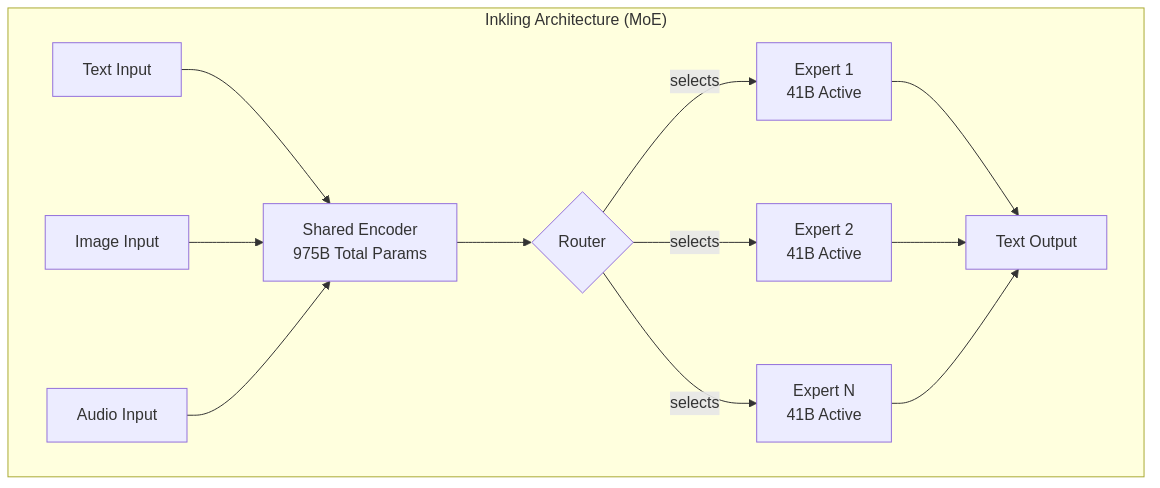
Inkling is a mixture-of-experts (MoE) transformer model with 975 billion total parameters and 41 billion active parameters per token. Thinking Machines Lab pretrained it on 45 trillion tokens spanning text, images, audio, and video. The model accepts multimodal inputs and generates text outputs, with a context window extending to 1 million tokens.
Key specifications:
Thinking Machines Lab describes its mission as building AI that “extends human will and judgment.” The release of Inkling under Apache 2.0 is consistent with that mission. Rather than offering API access to a locked model, the lab published the weights so that organizations can run, modify, and build on the model inside their own environments.
The distinction between open-weight models and closed API-based models is not academic. It determines who controls the model, where data flows, how costs scale, and what compliance options exist. Four factors drive enterprise interest in open weights:
With a closed API, the provider controls the model version, the inference infrastructure, and the data pipeline. When the provider updates the model, behavior changes whether the enterprise wants it or not. With open weights, the enterprise controls the model version. Updates happen on the enterprise’s schedule, not the provider’s.
Closed API providers offer limited fine-tuning, usually through their hosted infrastructure, which means training data must leave the enterprise’s perimeter. Open weights let enterprises fine-tune locally on proprietary data that never leaves their VPC or on-premises environment. For regulated industries such as banking, healthcare, and aerospace, this is the difference between viable and non-viable.
API pricing is per-token. At high inference volumes, costs scale linearly with usage and can become a significant line item. With self-hosted open weights, the cost model shifts to infrastructure (GPU compute), which can be optimized, reserved, and amortized. At sufficient scale, self-hosting open weights is cheaper than paying per-token API fees.
Many enterprises operate under data residency requirements that prohibit sending data to third-party API endpoints. Open weights let these organizations run AI workloads inside their existing compliance boundaries. The model comes to the data, not the other way around.
| Feature | Inkling (Open Weights) | Closed Frontier Models (GPT, Claude, Gemini) |
|---|---|---|
| Weights available for download | Yes | No |
| Self-hosting in VPC/on-prem | Yes | No |
| Fine-tuning on local data | Yes, full control | Limited, data sent to provider |
| Data residency control | Full | Depends on provider region |
| License | Apache 2.0 | Proprietary |
| Version control | Enterprise controls | Provider controls |
| Cost model | Infrastructure (amortizable) | Per-token (scales linearly) |
Downloading model weights is the easy part. Running a production-grade AI system on those weights inside your own infrastructure is where most organizations stall. We call this the sovereign AI gap: the distance between “I have the weights” and “I have a reliable, governed, observable AI system serving real workloads.”

The gap exists because a model file is not a system. Production AI requires infrastructure orchestration, model serving, request routing, load balancing, monitoring, logging, governance, security scanning, and cost management. Organizations that download Inkling from Hugging Face get a powerful model. They do not get any of the surrounding operational machinery.
| What You Get With Weights | What You Need for Production |
|---|---|
| Model file on disk | Model serving infrastructure (vLLM, TGI, etc.) |
| Static model version | Version management and rollback |
| Raw inference capability | Request routing and load balancing |
| No built-in monitoring | Telemetry, logging, alerting |
| No governance layer | Access control, audit trails |
| No cost controls | Token tracking, budget limits |
| No fine-tuning pipeline | Data prep, training, evaluation, deployment |
This gap is precisely what Shakudo was built to close.
Shakudo is the operating system for AI and data. It runs inside the enterprise’s own VPC, on-premises, or private cloud. It is tool-agnostic, which means it works with open-weight models like Inkling alongside any other model the enterprise chooses to use. The platform provides four capabilities that bridge the sovereign AI gap:
Deploy open-weight models in your own infrastructure. Shakudo handles the model serving stack (vLLM, text-generation-inference, or equivalent), container orchestration, and GPU scheduling. You bring the weights, Shakudo provides the production runtime.
Fine-tune models on data that never leaves your perimeter. Shakudo manages the full fine-tuning pipeline: data preparation, training jobs, evaluation, and deployment of the fine-tuned model. All of it runs inside your infrastructure.
Govern AI usage with access control and audit trails. Every request, every model invocation, every fine-tuning job is logged and auditable. Shakudo Platform provides the governance layer that regulated industries require.
Observe and optimize costs across all models. AI Gateway routes requests to the right model, tracks token usage and costs, and provides the telemetry needed to operate AI as a production system rather than a research experiment.


The point is not that enterprises should use only open weights. The point is that enterprises should have the choice. Kaji, Shakudo’s AI coding agent, can deploy and manage applications that use Inkling for sensitive workloads and closed models for tasks where convenience matters more than sovereignty. The enterprise decides which workloads run where.
Here is what it looks like to take Inkling from download to production on Shakudo:
Pull the model. Download Inkling weights from Hugging Face to your Shakudo-managed storage inside your VPC. No data leaves your perimeter.
Deploy the serving layer. Shakudo provisions the model serving container (vLLM or equivalent), schedules GPU resources, and exposes an internal API endpoint. The model is now available to your applications.
Route through AI Gateway. Configure AI Gateway to route requests to Inkling for sovereignty-sensitive workloads and to other models for different use cases. The gateway handles fallbacks, rate limiting, and cost tracking.
Fine-tune on your data. Prepare your domain-specific dataset inside your VPC. Shakudo orchestrates the fine-tuning job, runs evaluation benchmarks, and deploys the fine-tuned model version alongside the base model.
Govern and audit. Every request to the model is logged. Access policies control who can invoke which models. Audit trails are exportable for compliance reviews.
Observe and optimize. Telemetry from Shakudo Platform shows token usage, latency, error rates, and cost across all models. When Inkling is cheaper for a given workload, the gateway routes there. When a closed model performs better for a specific task, it routes there instead.

Sovereign AI is the practice of running AI workloads inside infrastructure that the enterprise controls, whether that is a VPC, a private cloud, or an on-premises data center. The goal is to maintain control over data, model behavior, and governance rather than relying on third-party API providers. Open-weight models like Inkling make sovereign AI practical because the enterprise can download and run the model in its own environment.
Running a self-hosted LLM in production requires more than downloading model weights. You need a model serving runtime (such as vLLM or text-generation-inference), GPU infrastructure, request routing, monitoring, logging, access control, and a fine-tuning pipeline. Platforms like Shakudo provide all of these as an integrated stack that runs inside your own VPC or on-premises environment.
An open weights model is a machine learning model whose trained parameters (weights) are published for download, typically under a permissive license. Unlike closed API-based models where the weights are proprietary and only accessible through the provider’s API, open weights models let anyone download, host, modify, and fine-tune the model locally. Inkling is released under Apache 2.0, one of the most permissive open source licenses available.
Yes. Inkling is released under Apache 2.0, which permits fine-tuning and modification. Thinking Machines Lab also offers Tinker, its own fine-tuning platform. For enterprises that need to fine-tune on proprietary data inside their own perimeter, Shakudo manages the full pipeline locally: data preparation, training, evaluation, and deployment of the fine-tuned model version.
Shakudo is tool-agnostic. It runs inside the enterprise’s own infrastructure and supports open-weight models like Inkling alongside closed models from any provider. The enterprise retains control over which models to use, where data flows, and when to switch models. Because Shakudo runs on the enterprise’s own VPC or on-premises, the platform itself does not create a dependency on external infrastructure.
At sufficient inference volume, self-hosting open weights like Inkling is typically cheaper than paying per-token API fees. The cost model shifts from per-token pricing to infrastructure costs (GPU compute), which can be reserved and amortized. For lower-volume workloads, API-based models may still be more cost-effective. AI Gateway can route requests to whichever model is most cost-effective for each workload, giving enterprises the best of both approaches.