






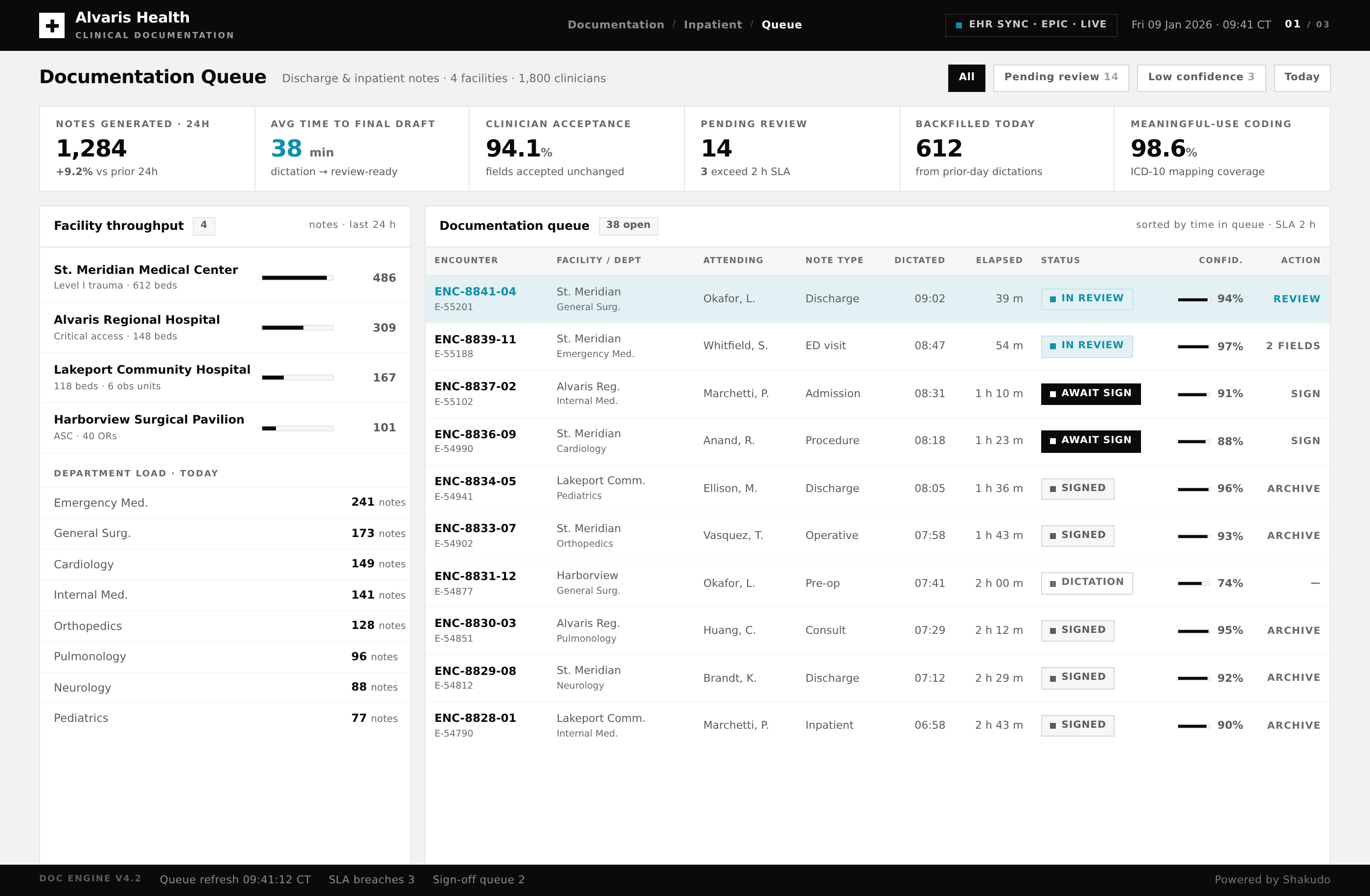
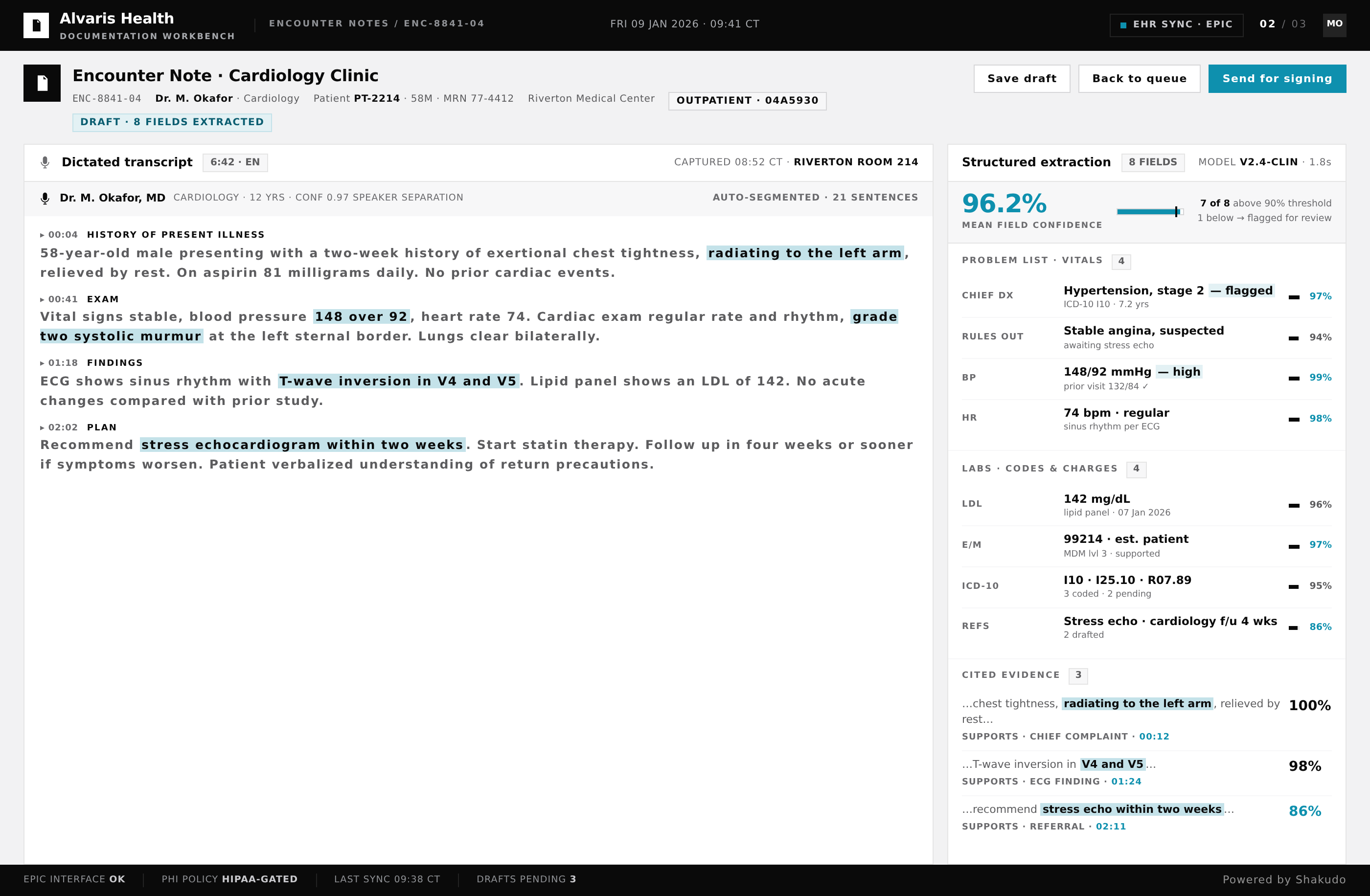
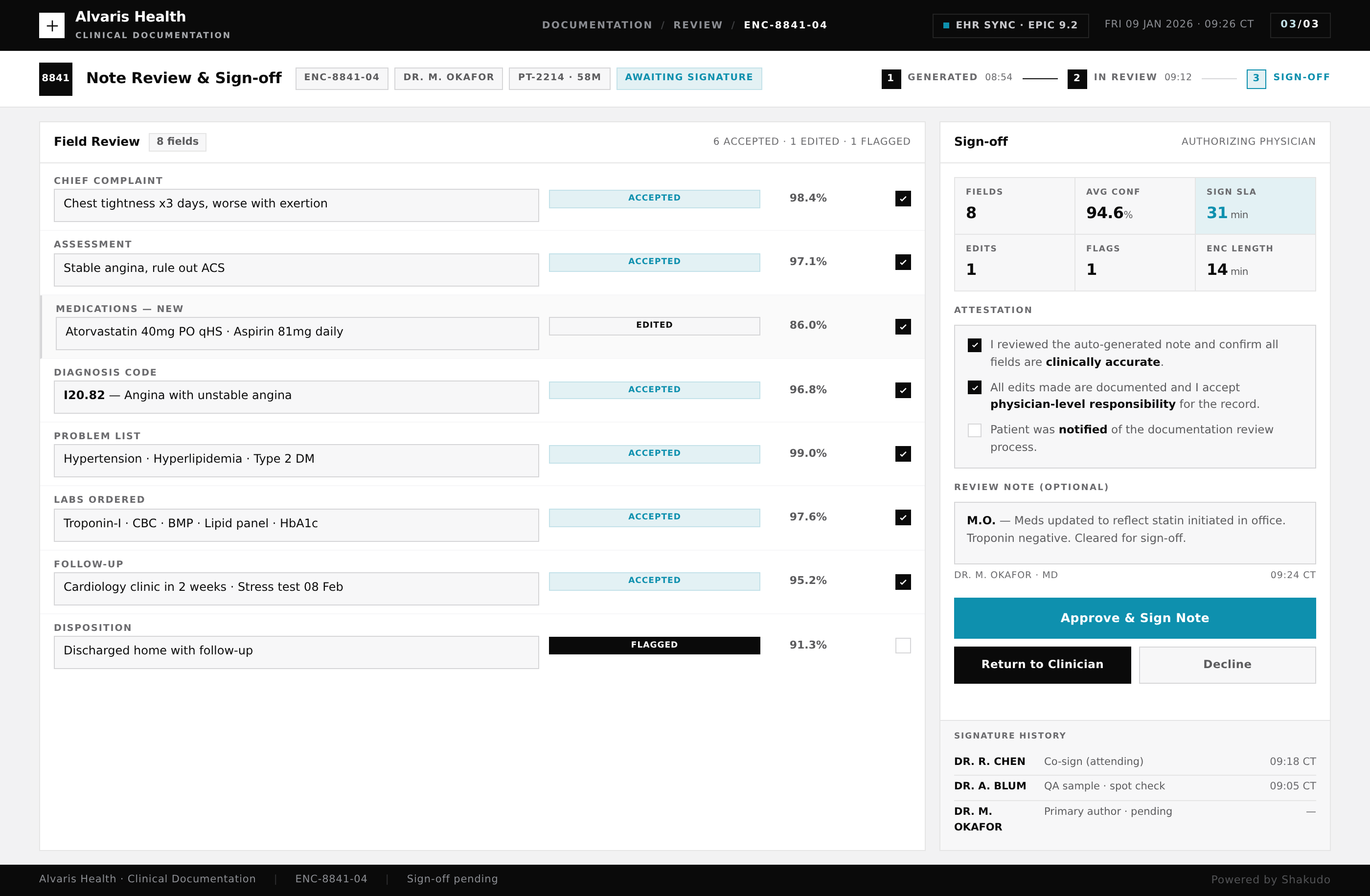
Three screens from a live run: the encounter queue, the AI-drafted note, and the physician sign-off.
1–2 / 3
Clinicians write the chart after the last patient leaves. Dictation, transcription, template-filling, sign-off: hours of documentation work that never gets billed, and that compounds into after-hours charting, delayed coding, and burnout. Rapid clinical note generation removes the typing while keeping the clinical judgment intact.
For a busy practice or hospital unit, the cost shows up in operational terms: documentation time per patient, after-hours charting volume, and a revenue cycle that starts late because the note that triggers coding was finished late. The encounter itself took thirty minutes; the record of it takes two more, most of them unpaid.
The market calls this category ambient AI. The system captures the encounter, drafts the clinical note in the format your EHR expects, SOAP or free text, and returns it for clinician review before sign-off. Recent peer-reviewed work measuring the quality of AI-generated notes reaches the same conclusion: the draft gets close, and clinician review stays non-negotiable. A system that makes the review step a first-class feature, rather than a caveat, matches how the work actually has to be done.
The draft should be available before the clinician leaves the room, or while the next patient is being seen. That latency comes from where the inference runs. When the model runs on the organization's own environment, the note is ready to review when the clinician is. No remote round trip, no queue behind another tenant, no transcript leaving the building.
Evaluate any candidate against five criteria. First, the draft is grounded in the actual encounter and the patient's prior records, so no two notes start from the same template. Second, a human clinician reviews and signs every note; the system keeps a clean audit trail of what changed. Third, it runs on infrastructure the organization controls, on-premises or private cloud, so patient data never leaves the environment. Fourth, it deploys as a working platform that keeps running after the engagement ends. Fifth, it writes the signed note to the EHR over FHIR so the record stays in one place.
Four beats. Capture: ambient audio from the encounter is streamed and transcribed inside your environment. Draft: an on-environment large language model generates the structured note from the transcript, with the patient's prior records retrieved for context so the draft reflects the longitudinal record. Review: the clinician reads, edits, and signs the note in the clinical interface. Integrate: the signed note is written to the EHR over FHIR, and the coding workflow starts on time.
Ambulatory and clinic practices where after-hours charting is the pain. Hospital systems where patient data has to stay inside their own environment. Health-system IT teams that want a platform they own and operate. When the scope is right, a conversation with Shakudo is the fastest way to see what the deployment would look like in your setting.
The draft is produced as the encounter ends, from the live transcript, so the clinician reviews it while the patient is still in the room or the next patient is being seen. The speed comes from inference running on the organization's own environment.
A scribe produces a note. A platform is the infrastructure that captures the encounter, drafts the note, retrieves prior records for context, routes the draft to review, and writes the signed result to the EHR. It runs inside the organization's environment and keeps running after deployment, instead of ending when a subscription ends.
Yes, because the system is on-environment infrastructure. Scaling means adding capture points. Throughput scales with the compute the organization already provisions.
The AI drafts from the encounter; the physician keeps full authorship and signs the final note. The system removes the typing; the clinical judgment stays with the physician. Every signed note stays a physician-authored record.
Depth comes from retrieving the patient's prior records for context alongside the live transcript, so the draft reflects the longitudinal record. The note can reference prior visits, conditions, and treatment history the way an experienced clinician would.
Shakudo deploys an AI clinical documentation system inside your own environment. The note is drafted from the live encounter and ready for clinician review before the visit ends, while patient data never leaves the infrastructure your organization controls.









"What drew me in is simple. When developers ship production-ready code this quickly, how can I have environments spun up fast enough? Shakudo is how we close that gap."


"Shakudo does not just provide the platform. It is a real partnership. They are always there to help and execute our vision faster and the right way. It is like a co-team working together to achieve our goals."