

OpenHands on Shakudo
Meta description: Deploy OpenHands on Shakudo to automate software engineering tasks with secure runtimes, enterprise integrations, and faster developer workflows.
Executive Summary
OpenHands is an open-source AI software engineering agent that can plan, execute, and iterate on development tasks in a real runtime environment. It goes beyond chat-based coding assistance by interacting with repositories, running commands, modifying files, and helping teams close the loop from issue to implementation.
For enterprise teams, the value is practical: less manual triage, faster remediation, quicker test creation, and better leverage of engineering time across repetitive or time-sensitive tasks. OpenHands is released under the MIT license and can be self-hosted, making it a strong fit for organizations that want control, auditability, and deployment flexibility.
Shakudo provides the environment needed to operationalize OpenHands in a secure and production-ready way. Instead of treating agentic coding as a disconnected experiment, teams can run OpenHands alongside their existing platform stack, developer workflows, model infrastructure, and governance controls.
Business value
- Reduce manual engineering effort on repetitive development tasks
- Shorten bug triage and remediation cycles
- Accelerate migrations, refactors, and test generation
- Improve developer productivity without introducing another siloed toolchain
Overview
OpenHands is designed for AI-assisted software engineering. It can work through tasks such as debugging, writing code, generating tests, updating configurations, and supporting migration or modernization efforts.
Unlike standard chat interfaces, OpenHands is built to act inside a working environment. That makes it useful for teams that need more than suggestions: they need an agent that can inspect code, execute steps, and help move technical work forward.
What OpenHands enables
- Repository-aware coding assistance
- Execution of engineering tasks in an isolated runtime
- Iterative debugging and remediation workflows
- Test generation and validation support
- Structured handling of code changes across real projects
Where it fits
OpenHands is well suited for:
- Platform teams managing many services and repositories
- Engineering teams handling recurring bug backlogs
- Data and ML teams maintaining notebooks, pipelines, and app glue code
- Organizations modernizing older codebases or frameworks
- Teams that want open-source agent infrastructure instead of closed tooling
| Business Problem | How It Shows Up | How OpenHands Helps |
|---|---|---|
| Repetitive Engineering Work | Developers repeatedly fix similar bugs, write similar tests, and update the same dependency patterns across repositories. | Automates repeatable implementation, testing, and validation workflows so teams can focus on higher-value engineering work. |
| Maintenance Backlog | Technical debt, outdated frameworks, and stale documentation continue to grow faster than teams can address them. | Applies systematic updates across codebases and creates reviewable pull requests with supporting tests and documentation. |
| Slow Remediation | Pipeline failures and production bugs require time-consuming manual investigation and repeated debugging cycles. | Analyzes logs, identifies root causes, implements fixes, and validates changes before submitting them for review. |
| Knowledge Silos | Critical system context lives with a small number of senior engineers, creating risk and slowing onboarding. | Documents code behavior and exposes reasoning through transparent agent traces and generated artifacts. |
| Scaling Code Quality | Pull request volume grows faster than review capacity, leading to inconsistent quality and slower releases. | Provides automated first-pass review and applies consistent checks for style, security, performance, and test coverage. |
Features
OpenHands combines autonomous planning, secure execution, and deep development tool integration to function as a complete AI software engineer rather than a code suggestion tool. It can understand a natural language request, break it into executable steps, interact directly with your development environment, and deliver tested code changes with full visibility into every action. The result is a platform that automates complex engineering workflows while keeping developers firmly in control.
Multi-Agent Architecture
At the core of OpenHands is a multi-agent system in which specialized agents collaborate to solve complex tasks. The Planner Agent decomposes large requirements into manageable steps, the CodeAct Agent writes code and executes commands, the Browsing Agent researches documentation and external resources, and the Commit Writer Agent summarizes changes into clean commit messages. This division of responsibilities allows OpenHands to tackle problems that require both reasoning and execution.
Complete Development Environment Access
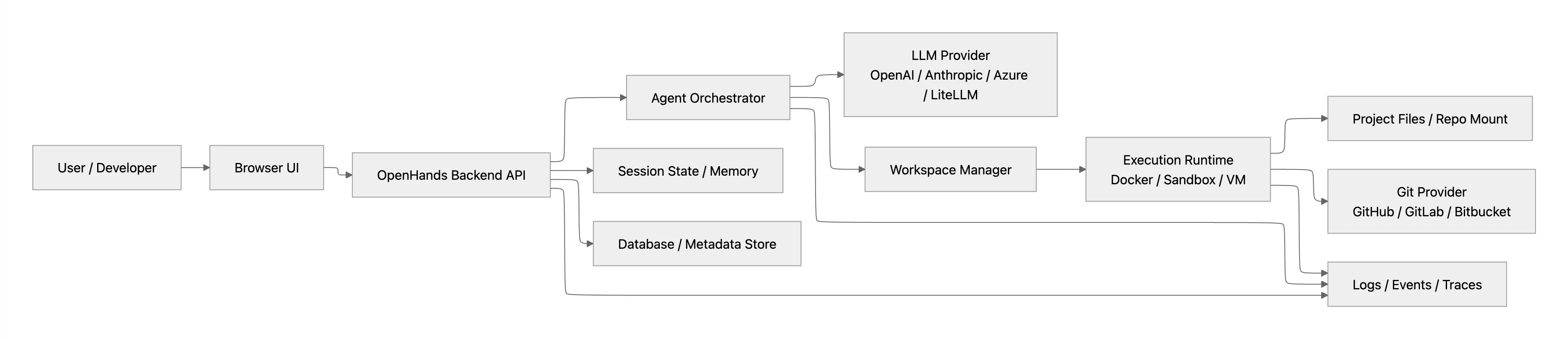
Unlike tools that only generate code suggestions, OpenHands operates directly within a secure sandboxed environment. It can edit files, install packages, run tests, inspect logs, trigger CI/CD pipelines, and create pull requests. Because it validates its work as it goes, OpenHands delivers working solutions rather than isolated code snippets.
Self-Correcting Execution
OpenHands uses an iterative execution loop that mirrors how experienced engineers debug software. When it encounters errors, it analyzes the output, researches potential solutions, modifies its approach, and retries until the task succeeds or requires human intervention. This ability to self-correct makes OpenHands highly effective for debugging, migrations, and large-scale refactoring.
Toolchain and Workflow Integration
OpenHands integrates seamlessly with Git repositories, testing frameworks, security scanners, CI/CD systems, and development tools already used by engineering teams. It can coordinate updates across multiple repositories, trigger automated validation pipelines, and generate pull requests that fit naturally into existing workflows.
Secure and Observable by Design
All agent activity runs inside isolated Docker containers or sandboxed environments with network controls, file system isolation, and resource limits. Every action is logged, giving teams complete visibility into commands executed, files modified, and reasoning steps taken. This transparency makes it possible to adopt autonomous engineering while maintaining enterprise governance and auditability.
Open Source and Model Flexibility
OpenHands is fully open source under the MIT license, allowing organizations to self-host, customize agent behavior, and avoid vendor lock-in. It supports a broad range of models, including OpenAI, Anthropic, Azure OpenAI, and open-source models such as Llama and DeepSeek, enabling teams to choose the right balance of cost, performance, and privacy.
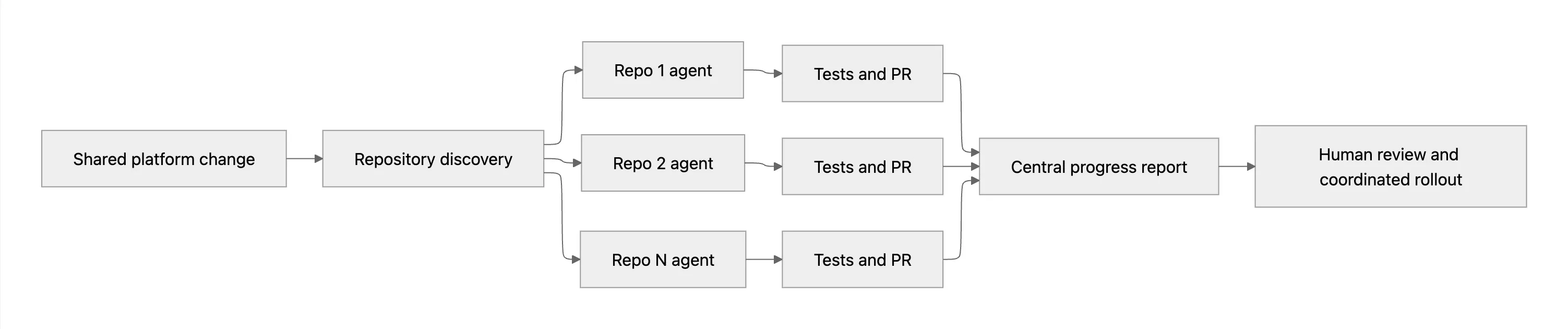
Many enterprise engineering initiatives span far beyond a single repository. Dependency upgrades, security remediations, framework migrations, and shared library changes often require coordinated updates across dozens of services, each with its own tests, constraints, and compatibility requirements. OpenHands is designed for this type of work. It can scan affected repositories, identify safe upgrade paths, apply changes, run validation pipelines, and generate pull requests with repository-specific notes—turning what is typically a large manual effort into a structured and repeatable workflow.
Multi-Repository Operations
Many enterprise engineering initiatives span far beyond a single repository. Dependency upgrades, security remediations, framework migrations, and shared library changes often require coordinated updates across dozens of services, each with its own tests, constraints, and compatibility requirements. OpenHands is designed for this type of work. It can scan affected repositories, identify safe upgrade paths, apply changes, run validation pipelines, and generate pull requests with repository-specific notes—turning what is typically a large manual effort into a structured and repeatable workflow.
The advantage is not just speed, but consistency at scale. Multiple OpenHands agents can work across repositories in parallel while following a shared execution plan, compressing projects that would normally take weeks or months into days. Because every change is applied systematically and validated automatically, platform teams gain a more uniform implementation approach, clearer progress visibility, and higher confidence that standards are being enforced consistently across the entire engineering landscape.
Deployment
OpenHands can be deployed in multiple ways, but for Shakudo customers the recommended path is self-hosted deployment inside the Shakudo platform environment. This preserves the benefits of OpenHands’ open-source model while giving customers a governed, integrated, and operationally supportable deployment.
Self-hosted deployment on Shakudo
A self-hosted Shakudo deployment gives customers control over infrastructure, data boundaries, model access, and integration points. OpenHands runs in the customer’s Shakudo environment and can be connected to approved repositories, CI/CD systems, Airflow, JupyterHub, MLflow, monitoring, and secret management.
The deployment should be treated as a production platform component, not a local developer experiment. A Shakudo deployment typically includes:
- a dedicated Kubernetes namespace for OpenHands
- containerized OpenHands runtime services
- sandboxed execution environments for agent tasks
- approved model provider configuration
- repository access through controlled credentials
- secret management through the platform’s standard mechanism
- network policies limiting what the agent can reach
- persistent storage for workspace state where required
- logging, metrics, and audit trails for agent activity
- ingress or platform UI routing through Shakudo access controls
The exact deployment is adapted by the Shakudo team to the customer’s cluster, security model, and integration requirements. The following is a representative public-safe runbook showing the shape of a Shakudo deployment.
The values file should define the approved image, resource requests, ingress host, runtime sandbox configuration, model provider settings, storage class, and integration endpoints for Git, CI/CD, Airflow, MLflow, and observability.
In a production Shakudo deployment, secrets should be sourced from the customer’s approved secret-management workflow rather than manually embedded in command history.
OpenHands Cloud
OpenHands Cloud is an alternative for teams that prefer a managed external service. It can be useful for lightweight evaluation or teams that do not require self-hosted control. However, for Shakudo customers evaluating enterprise workflows, self-hosted deployment on Shakudo is typically the better fit because it keeps execution closer to internal systems, data boundaries, and governance requirements.
Getting started
A practical adoption path begins with one high-value workflow rather than broad automation across the entire engineering organization.
Start by selecting a focused use case such as Airflow bug remediation, dependency upgrades, test coverage expansion, or notebook-to-production refactoring. Define which repositories and environments OpenHands may access. Configure model providers and credentials according to internal policy. Deploy OpenHands into the Shakudo environment. Run a controlled pilot on representative tasks. Review output quality, validation behavior, auditability, and developer experience. Once the workflow is proven, expand to additional repositories and teams.
Why Shakudo
OpenHands is powerful as an open-source autonomous engineering agent, but its enterprise value increases substantially when it is deployed inside a platform that already supports development, data, AI, security, and operations. Shakudo provides that operating environment.
The goal is not simply to make OpenHands available. The goal is to make it usable, secure, observable, and connected to the workflows where engineering teams already work. Shakudo helps turn OpenHands from a standalone agent into a platform-native component for software, data, and ML engineering execution.
Native ecosystem integration
Shakudo brings OpenHands close to the systems it needs to be useful: JupyterHub for notebooks and developer environments, Git repositories for source control, Airflow for orchestration, MLflow for model workflows, CI/CD systems for validation, and observability tools for runtime monitoring.
This proximity matters. Autonomous agents are most valuable when they can operate in context. A pipeline failure should connect naturally to Airflow logs and DAG code. A model refactor should connect naturally to notebooks, repositories, CI/CD, and MLflow. A dependency remediation workflow should connect naturally to Git, test execution, and review processes.
Managed reliability and security
Shakudo provides the operational foundation required for enterprise adoption. OpenHands can be deployed with sandboxed execution environments, resource limits, controlled network access, secret management, role-based permissions, and audit logging. This allows teams to use autonomous execution without giving the agent unrestricted access to sensitive systems.
Shakudo can also manage deployment lifecycle concerns such as version management, environment provisioning, monitoring, alerting, backup, and operational support. This reduces the infrastructure burden on customer teams and makes OpenHands easier to evaluate and scale.
Unified data and AI platform
OpenHands is especially compelling when used across software, data, and ML workflows. Shakudo provides a single platform where these workflows already intersect. Teams can manage OpenHands alongside the same environments they use for development, orchestration, experimentation, model lifecycle, and monitoring.
This unified platform approach simplifies onboarding and troubleshooting. Teams do not need to stitch together a separate agent platform, a separate notebook environment, a separate workflow orchestrator, and a separate monitoring layer. OpenHands becomes part of the existing enterprise platform surface.
Compliance and governance
For regulated or security-conscious environments, governance is a central adoption requirement. OpenHands actions should be reviewable, explainable, and auditable. Shakudo helps support this model through centralized controls, platform-level logging, secret management, access boundaries, and deployment patterns aligned with enterprise requirements.
Customers can preserve human approval for production-facing changes while still allowing OpenHands to perform investigation, patch preparation, test generation, and documentation work. This creates a practical balance between automation and governance.
Faster time to value
A self-hosted OpenHands deployment can be complex if an organization has to assemble runtime environments, model credentials, repository access, sandboxing, monitoring, and security controls from scratch. Shakudo reduces that friction by providing the platform foundation and integration points needed to deploy OpenHands in a production-oriented way.
Teams can start with a focused workflow, prove value quickly, and expand adoption once operational boundaries are clear. This makes OpenHands easier to move from experimentation to real enterprise use.