






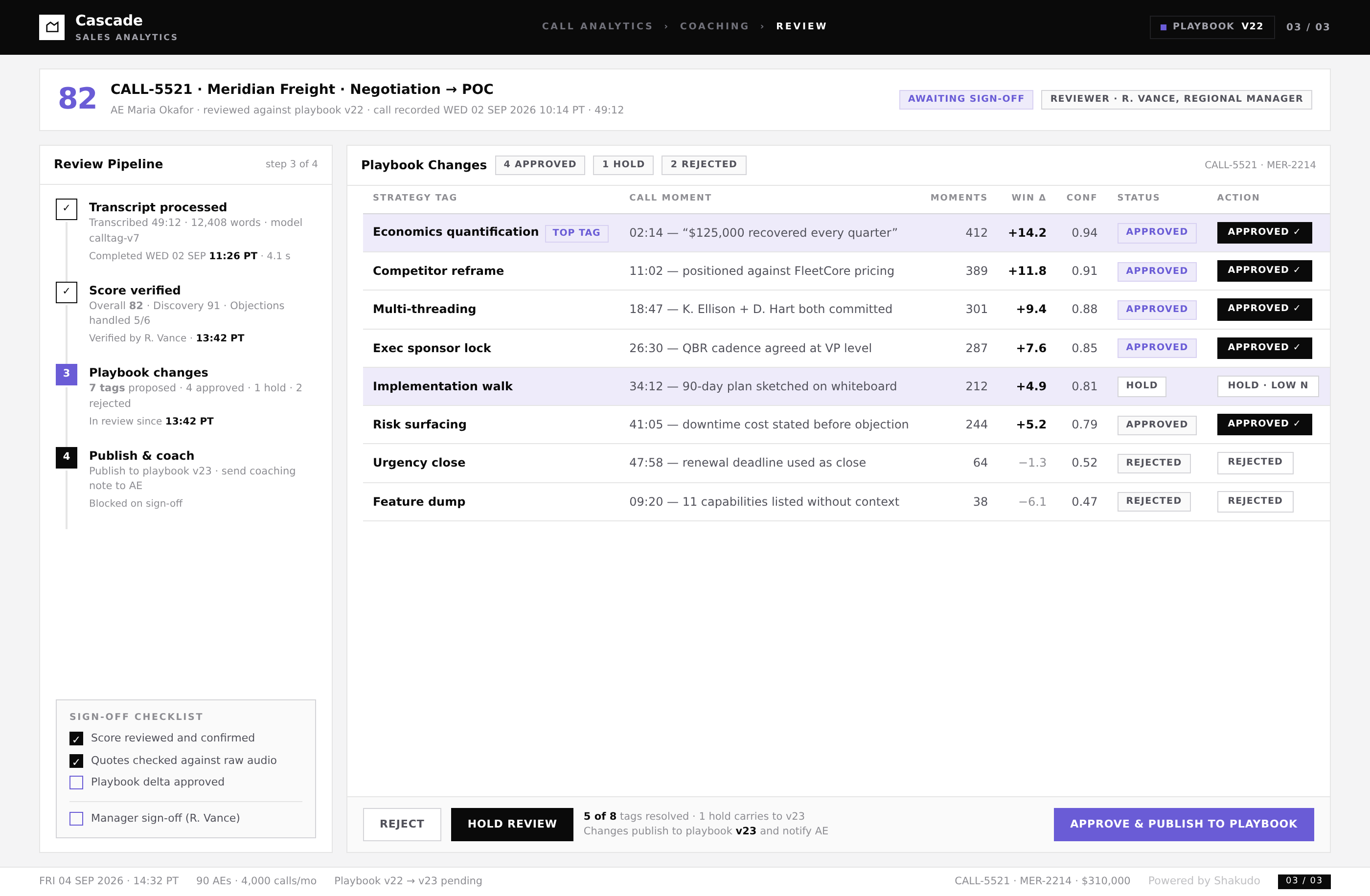
Three screens from a live run: the call queue, the transcript analysis, and the playbook update.
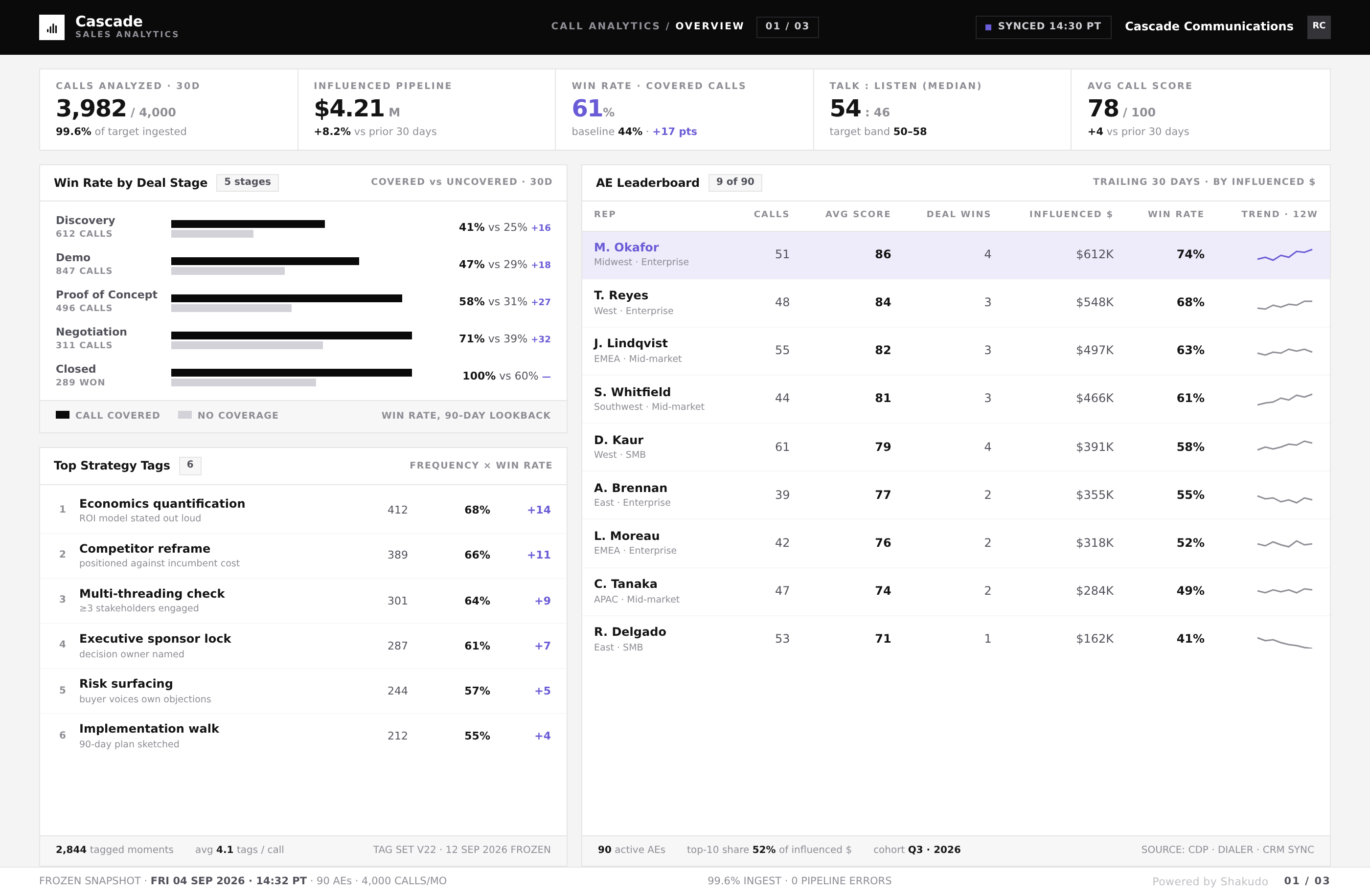
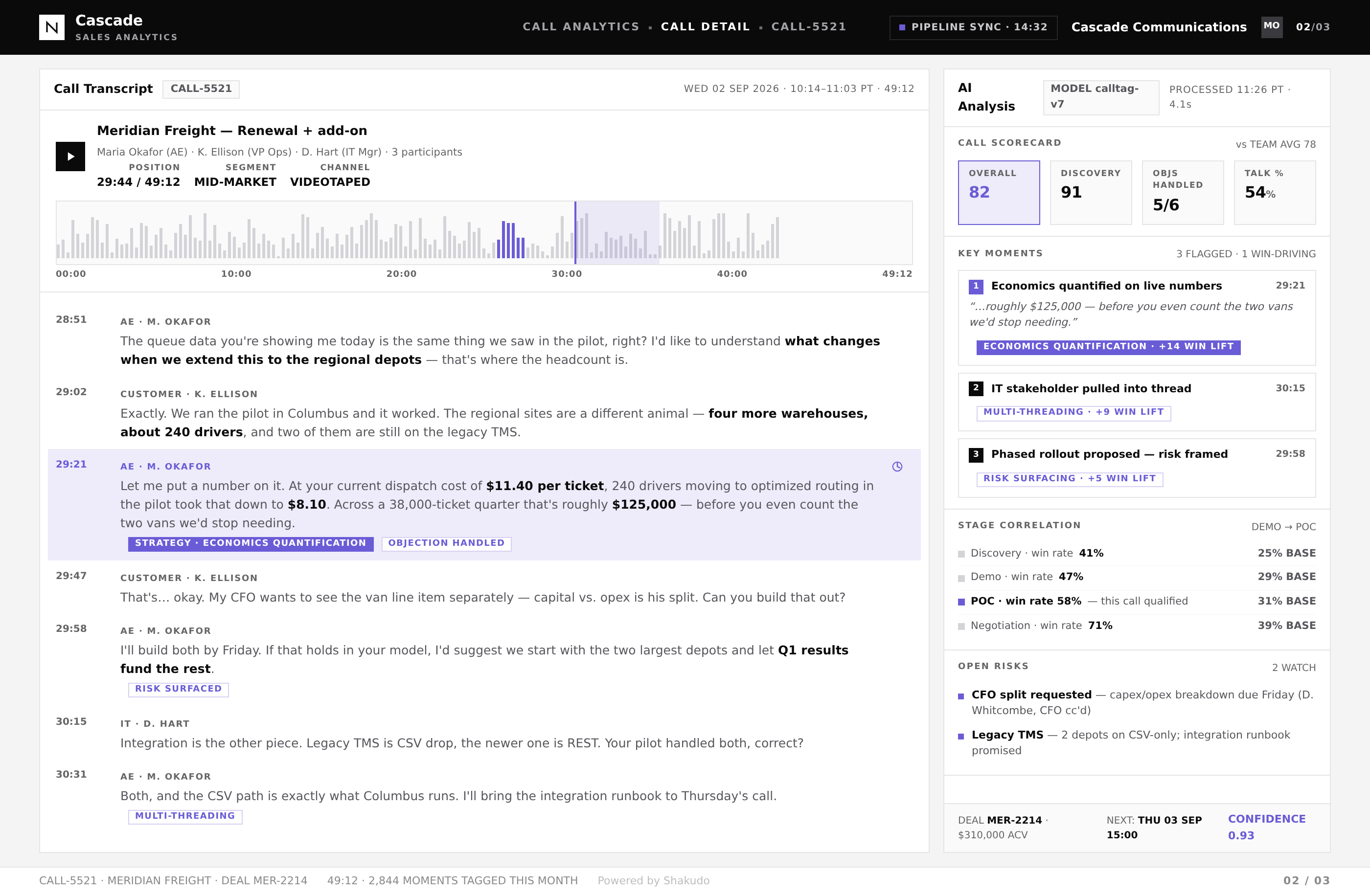
1–2 / 3
A sales manager can listen to a handful of calls a week. A transcript analysis pipeline can score every call, every rep, every week, and the gap between those two numbers is where winning strategies live. The analysis runs in the customer's environment, where the call recordings, the CRM, and the win-loss data already live, and the call data never leaves.
Most sales coaching runs on anecdotes. The manager hears three great calls, hears five mediocre ones, and the feedback cycle is limited to what a person can actually listen to. That sample size is small enough that one lucky deal or one bad week changes the picture. A transcript analysis pipeline removes the listening bottleneck: every call becomes a structured record of what happened, so patterns across hundreds of calls surface instead of impressions across a dozen.
For every call, the pipeline extracts a fixed set of fields: sentiment, talk-to-listen ratio, discovery depth, objection handling, next-step commitment, competitor mentions, and a score against the team's own rubric. Those fields are stored, searchable, and dashboard-ready, which turns call review from a sampling exercise into a measurement system. A PDF report per call makes the output usable in one-on-one coaching without anyone opening a data tool.
The pipeline is deployed in the customer's environment. Call recordings are transcribed where the recordings already live, the transcripts are scored, and the structured output feeds the dashboards and reports the team actually uses. Nothing is sent to a third-party SaaS queue, which matters for a business that treats its call data as sensitive. The platform keeps running after the engagement, and the team can add new fields, new rubric criteria, and new report types as the program matures.
The rubric is the unit of analysis, and it is customer-defined. A team that wins on technical depth scores discovery depth differently from a team that wins on relationship and cadence. Every call is scored against the same rubric, so the numbers are comparable across reps and over time, and the rubric itself becomes the documented expression of what a winning call looks like. When the team updates the rubric after a win-loss review, every past call can be rescored and the trend line stays honest.
The coaching loop is the payoff. Calls are scored against one shared rubric, the top scorers on the criteria that correlate with wins are identified, and those calls become the coaching material: the exact discovery sequence, the objection response, the next-step commitment. Instead of guessing which behaviors predict a win, the team sees them in the data and replicates them deliberately.
The same in-environment analysis pattern applies to other conversational data, such as a knowledge base that answers questions over internal documents. Where the transcripts are is where the analysis runs, so the call data never leaves the environment.
A transcript analysis pipeline fits organizations where call volume makes manual review impossible and where call data is sensitive enough that third-party processing is off the table: inside sales teams running hundreds of calls a week, field sales organizations that want call review standardized across regions, and customer success teams that want the same scoring discipline on onboarding and renewal calls.
The pipeline extracts a fixed set of structured fields per call: sentiment, talk-to-listen ratio, discovery depth, objection handling, next-step commitment, competitor mentions, and the rubric score. Every field is stored and searchable, so a manager can query across the whole call history instead of re-listening to individual calls.
A small set of leading indicators tends to matter most: talk-to-listen ratio, discovery density, objection response quality, and whether a concrete next step was set. The winning set differs by team, so the pipeline measures the full field set against the team's own win and loss reviews rather than against a generic benchmark, and the rubric is updated as the correlation evidence builds.
Score every call against one shared rubric, then look at the reps who consistently score highest on the criteria that correlate with closed-won outcomes. The individual calls behind those scores become the coaching material, and the rubric keeps the comparison fair across every rep and every week.
Call recordings, customer conversations, and pricing conversations are among the most sensitive data a sales organization holds. A deployed pipeline transcribes, scores, and reports inside the environment where that data already lives, so nothing is shipped to a third-party SaaS for processing, and the platform keeps running after the engagement ends.
When the goal is a coaching system that covers every call, a conversation with Shakudo is the fastest way to see what the pipeline would score on the team's own transcripts.

Shakudo's AI-powered sales call analysis platform transforms conversational data into strategic assets. By leveraging advanced natural language processing and machine learning algorithms, this solution automatically analyzes and extracts key insights from sales call transcripts. Shakudo uniquely enables rapid deployment of these sophisticated AI tools within existing sales workflows, empowering organizations to identify successful patterns, improve sales techniques, and drive higher conversion rates.










"What drew me in is simple. When developers ship production-ready code this quickly, how can I have environments spun up fast enough? Shakudo is how we close that gap."



"Shakudo does not just provide the platform. It is a real partnership. They are always there to help and execute our vision faster and the right way. It is like a co-team working together to achieve our goals."