Shakudo
Use Case
AI Drug Development Pipeline - Data Model for Accelerated FDA Approval
SEE IN ACTION







Three screens from a live run: the pipeline overview, a candidate deep-dive, and the advance decision.
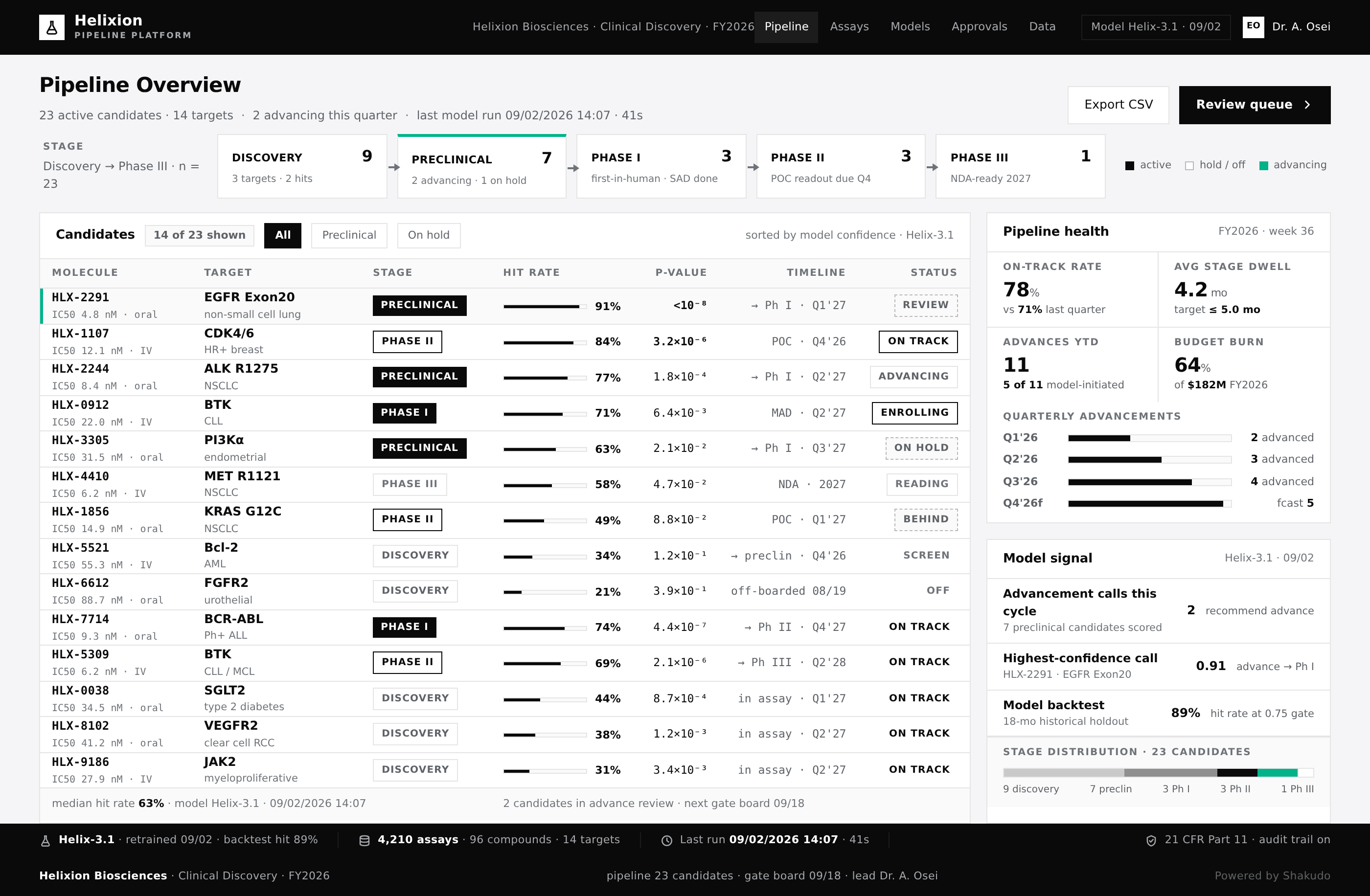
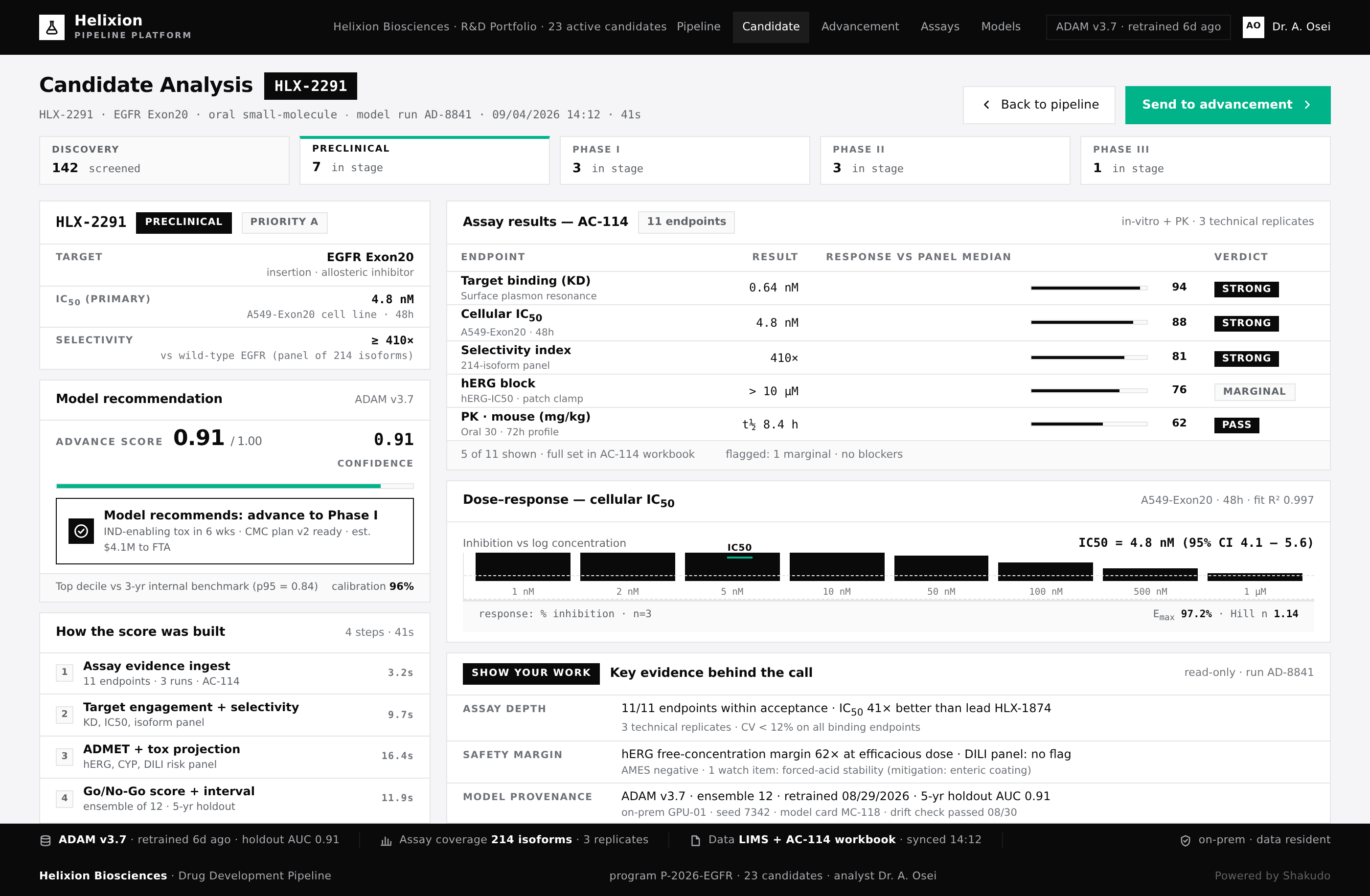
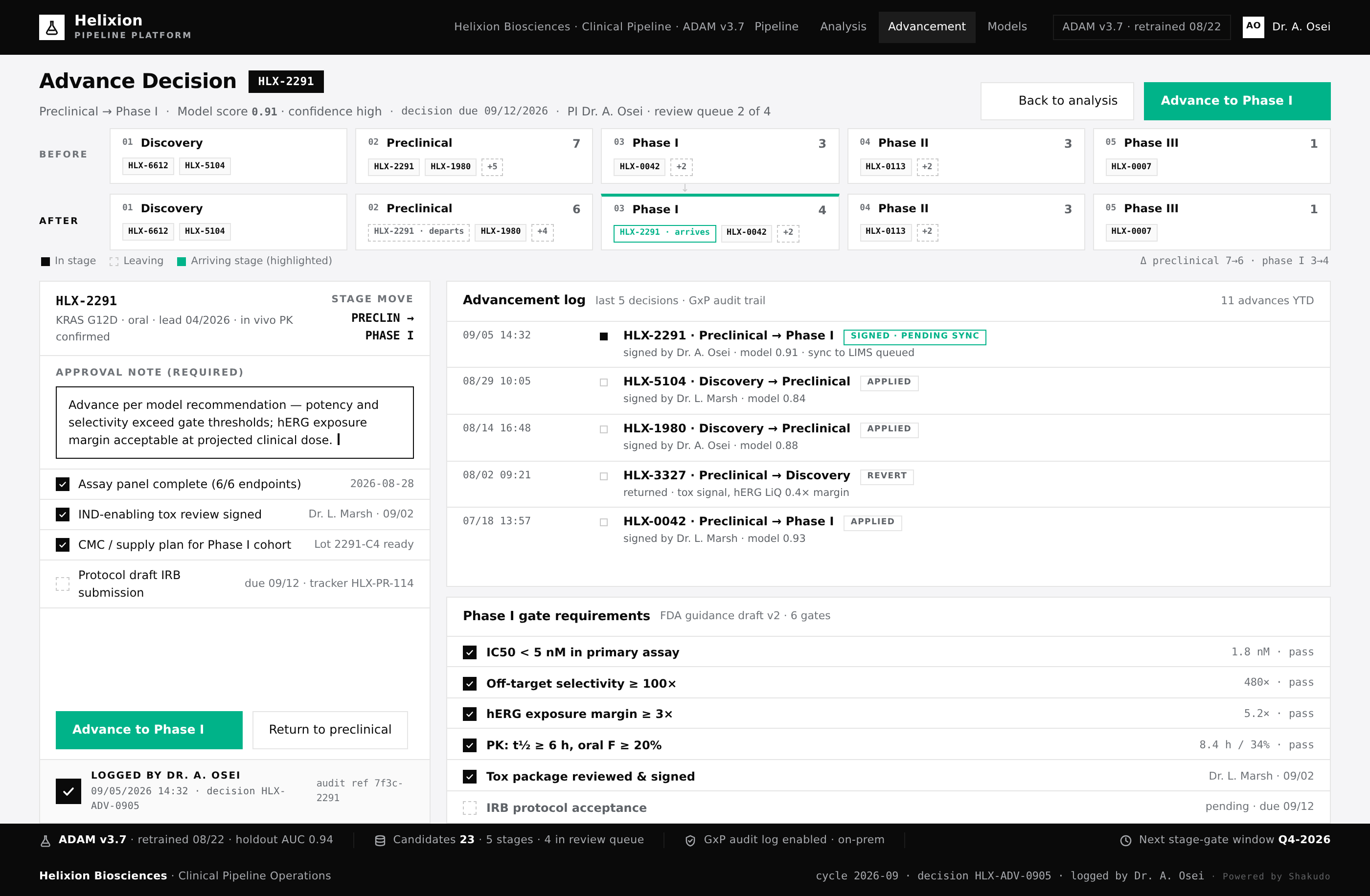
1–2 / 3
Drug development generates data at every stage: target screening, preclinical studies, CRO reports, clinical trial results, stability data, and the regulatory documents that tie it all together. That data lives in a dozen places and a dozen formats, and the documentation that describes it takes longer to write than the experiments it describes. A platform that unifies the pipeline data and drafts the documentation from it removes both bottlenecks at once, and it runs inside the pharma company's own environment, where the data and the intellectual property stay.
Most of the delay in an accelerated drug development program is the data work. It is moving data between CROs, labs, and trial sites, reconciling formats, and writing the regulatory documentation that an FDA submission requires. Every handoff loses time and adds error. Because pharma data is proprietary and often sensitive, the team cannot send it to a general-purpose tool, and the documentation cost stays fixed at every stage of the program.
Shakudo builds a data platform that spans the pipeline, from drug discovery data acquisition through clinical trial data and into the regulatory record. The platform is deployed in the customer's environment. The molecule data, the trial data, and the resulting documents never leave it. For a team under confidentiality agreements or a data governance policy, that is the deciding factor: the platform runs where the data already lives, so it never requires the team to upload its most sensitive IP to a third party.
The same drafting pattern applies to other regulated documentation. See how clinical documentation is generated from raw notes for the medical-records variant of the approach.
The platform fits the teams where the data work is the constraint: a biotech R&D team running a late-stage program, a pharma R&D organization consolidating CRO output, or a small biotech that cannot staff the documentation load a submission demands. The system is buildable infrastructure. The team extends it to new asset classes and new document types as the portfolio grows, and the platform keeps running after the engagement ends.
Several AI document tools can draft regulatory text, but most are general-purpose and require the data to be sent to a third party. A platform that drafts FDA-compliant documents from data already inside the customer's environment, with a versioned audit trail on every output, is a different category, and it is the one that fits pharma data governance.
A CRO runs the experiments. A data platform accelerates the data work around them: integrating CRO output, structuring it, and generating the documents the submission needs. The platform removes the documentation and integration delay that sits on top of the CRO work, while the CRO keeps running the science.
Structure it around the entities that connect the stages: molecule, target, assay, trial, and document. A knowledge graph over those entities lets the team answer cross-stage questions from the graph itself, and it is what lets a document generator cite the exact source data behind each section.
The software that matters for FDA compliance is the one that keeps the record defensible: versioned documents, a logged audit trail, and a lineage from each document section back to the source data. Generation speed is a bonus. The compliance value is in the record left behind.
At minimum: ingestion and mapping of CRO and trial data, a knowledge graph that links the core entities, AI document drafting with human review, a versioned audit trail, and dashboards for program status. It should also run in the customer's environment, so the data and the IP stay in place.
The strongest platforms ingest from many sources and link the results into a queryable graph. For a team that also needs the regulatory documentation generated from that same data, the platform should cover both the discovery data and the document layer in one environment.
When the question is how to accelerate a program without sending its data off-site, a conversation with Shakudo is the fastest way to see what the platform would look like on the team's own pipeline data.
Shakudo enables pharmaceutical companies to streamline their drug development and FDA approval process by unifying clinical trial data, research findings, and regulatory documentation in one secure environment. Our platform integrates advanced AI tools that automate complex data mapping from multiple vendors and CROs, while maintaining strict HIPAA and regulatory compliance. Teams can deploy and manage these tools without specialized technical knowledge, allowing scientists and analysts to focus on drug development rather than data infrastructure.










"What drew me in is simple. When developers ship production-ready code this quickly, how can I have environments spun up fast enough? Shakudo is how we close that gap."



"Shakudo does not just provide the platform. It is a real partnership. They are always there to help and execute our vision faster and the right way. It is like a co-team working together to achieve our goals."