






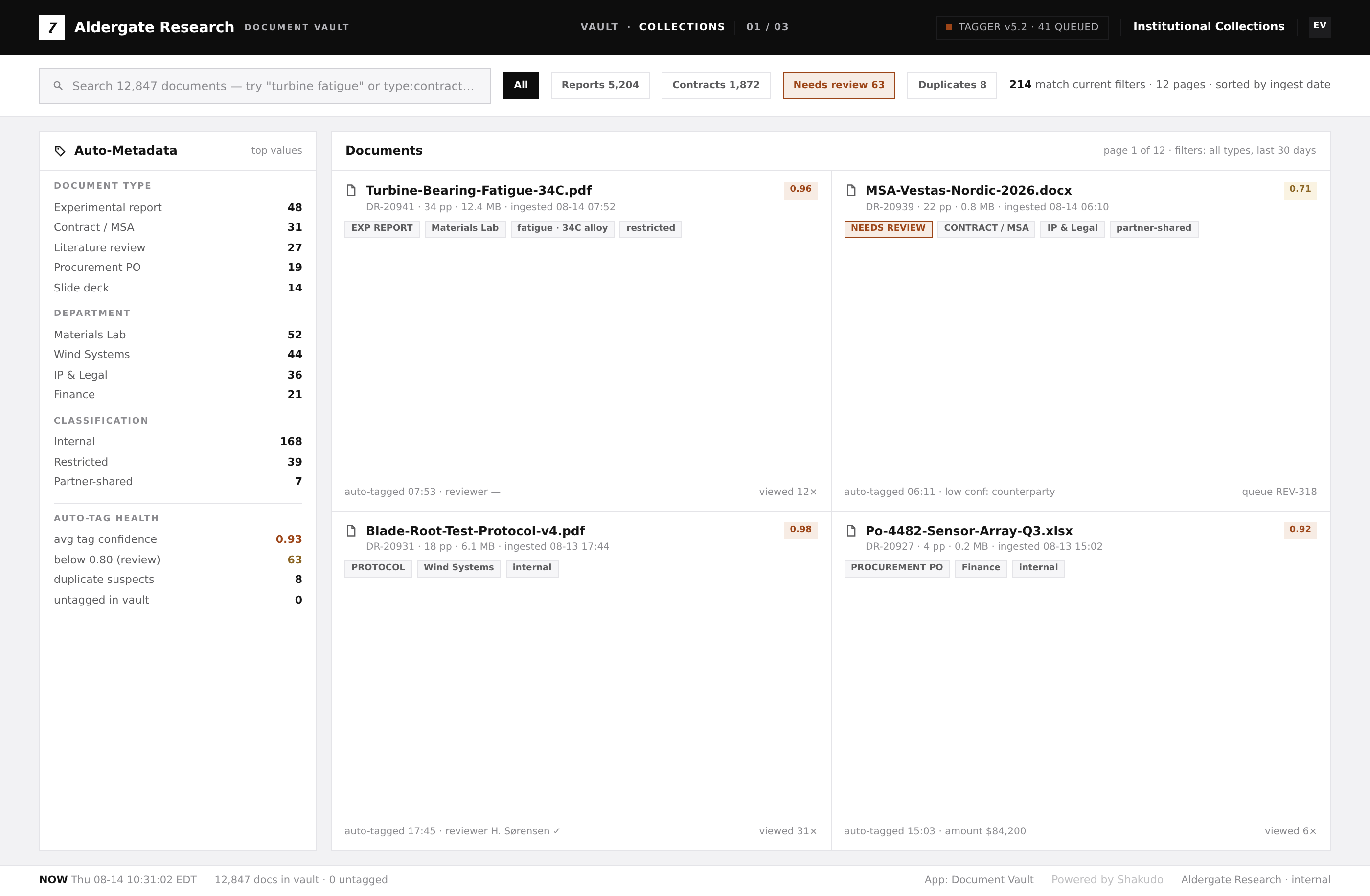
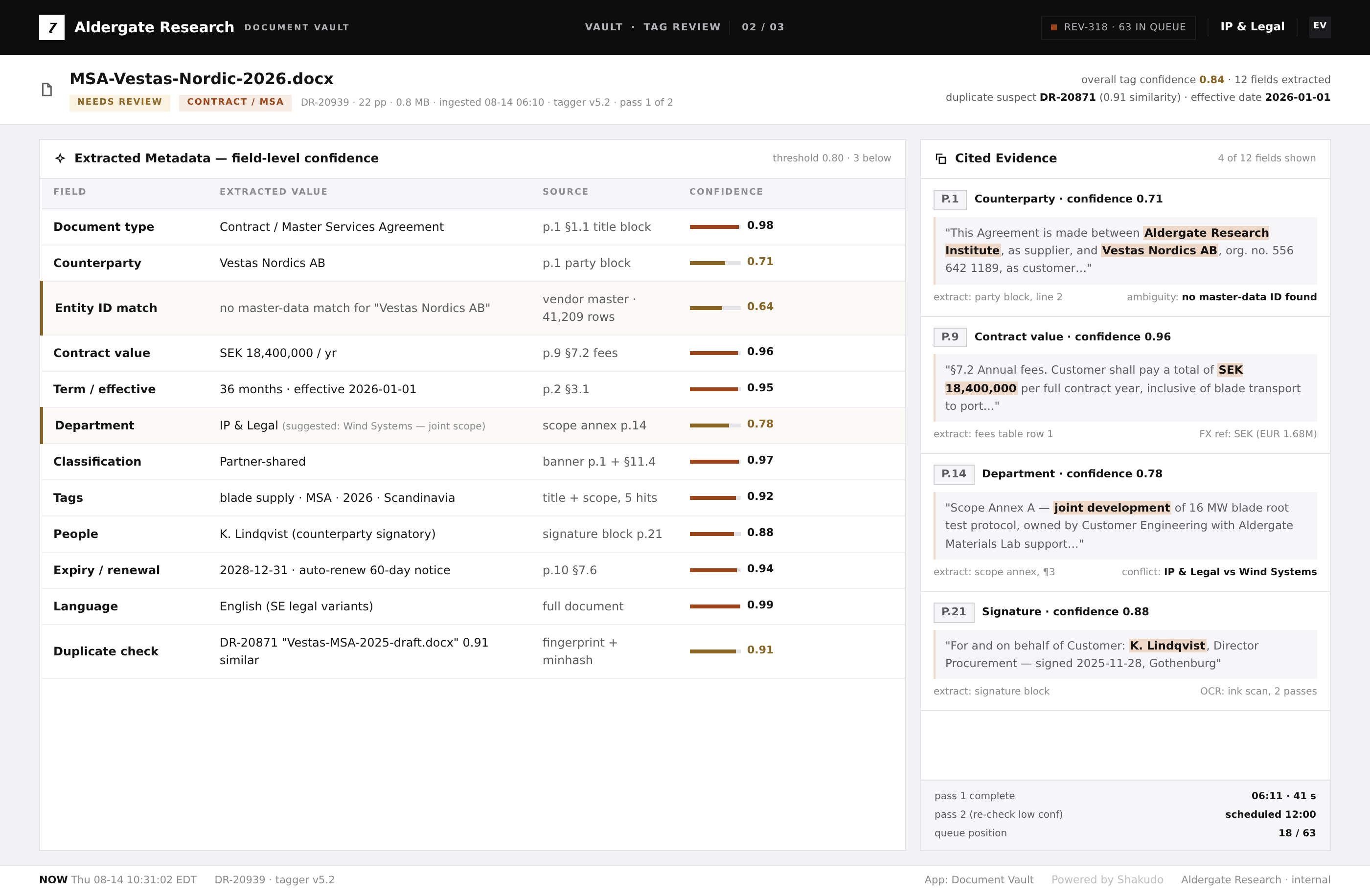
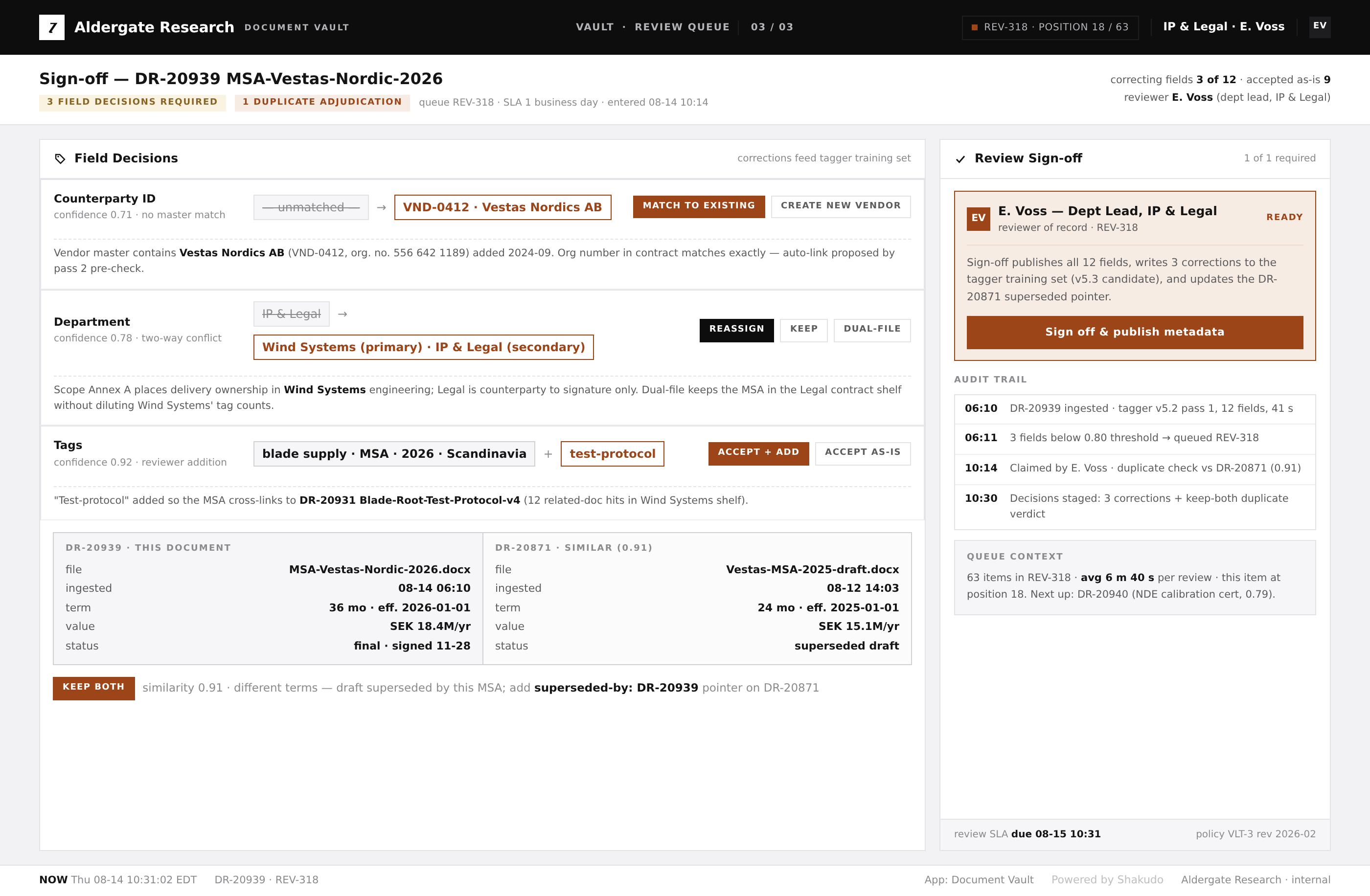
Three screens from a live run: the document queue, the auto-tagged metadata, and the review.
1–2 / 3
Manufacturing engineering teams manage thousands of documents across drawings, specifications, material certificates, and quality records. One industry survey found that 48% of engineers spend at least an hour a day searching for parts and information because data sits scattered across disconnected systems. When documents lack consistent metadata and tags, retrieval becomes a bottleneck that stalls production lines and frustrates audit cycles.
Manufacturing operations generate enormous volumes of engineering documents: CAD drawings, revision histories, supplier specifications, material test reports, and compliance certificates. Without automated tagging, someone must manually open each file, read through it, and assign the right categories. This process is slow, inconsistent, and expensive.
The problem compounds as document libraries grow. Two engineers may tag the same drawing differently, making it impossible to find later. Version control breaks down when files sit in personal folders rather than a centralized repository. One manufacturer found that production stopped for two days while two people searched for a valve assembly drawing that existed on a shared drive nobody had reason to open.
Research shows that manufacturing companies can reduce document retrieval time by 85% when they replace manual tagging and fragmented storage with structured metadata and intelligent search. The hours recovered go back into engineering work rather than file hunting.
The system uses large language models to read engineering documents and pull structured information from unstructured text. When a new drawing or specification enters the system, the model identifies key fields: document type, part number, material grade, revision level, responsible engineer, and applicable project code.
The system then assigns category tags automatically. A material certificate gets tagged with quality assurance, compliance, and supplier records. A CAD revision gets tagged with engineering drawings, version control, and the relevant product line. A batch of 500 incoming supplier certificates is processed and tagged in minutes rather than the days manual entry would require, and the AI catches inconsistencies that humans miss, flagging a certificate that references a different material grade than the drawing specifies. Research shows retrieval time can drop by 85% once structured metadata and intelligent search replace manual tagging and fragmented storage.
Automatic tagging is only half the solution. Manufacturing documents often require formal sign-off before they go into production use. An engineering drawing may need approval from a design lead and a quality manager. A supplier qualification report may require sign-off from procurement and compliance.
The system routes tagged documents through configurable approval chains. When the AI tags a document as a new engineering revision, it creates review tasks for the right approvers based on the document category and project. Approvers see the extracted metadata, the assigned tags, and the document itself in a single interface, and can approve, reject, or request changes.
This keeps humans in the loop without the overhead of manual routing. The workflow engine tracks who approved what and when, creating an audit trail that satisfies ISO and quality management requirements. If an approver is out of office, the system escalates to a designated backup so documents do not stall. Documents stay in their original locations, including shared drives and PLM platforms, while the AI layer adds metadata, tags, and searchable indexes on top.
The system serves manufacturing engineering teams, where drawings, specifications, material certificates, and quality records accumulate across product lines, and the engineers, quality managers, and procurement staff who must find and sign off on them daily.
It also fits quality and compliance teams in manufacturers with ISO and quality management obligations, since the approval workflow creates the audit trail those regimes expect, and works alongside the shared drives and PLM platforms these teams already run.
Modern language models achieve high accuracy on structured engineering documents because these files follow predictable patterns. Part numbers, material grades, and revision codes appear in consistent locations. The system improves over time as it processes more documents, and human reviewers can correct any misclassified tags during the approval step.
Yes. The workflow engine supports conditional routing based on document type, project, risk level, and other metadata fields. A high-risk change may require three approvals while a routine update needs one. The rules are configurable without code changes, so engineering teams can adjust them as requirements evolve.
The solution connects to existing storage systems, including shared drives, PLM platforms, and cloud storage. Documents stay in their original locations while the AI layer adds metadata, tags, and searchable indexes on top. This avoids a painful migration while making existing documents immediately searchable.
A custom document management system with AI tagging typically takes 6 to 12 months to build from scratch. With a platform that provides pre-configured components, deployment drops to weeks. The AI models, workflow engine, and search infrastructure come ready to connect to the existing document sources.
When the goal is a document library your engineers can actually search, a conversation with Shakudo is the fastest way to see it run on your own drawings and certificates. The solution deploys on your own infrastructure, on-prem or in your cloud, a first working pipeline is in place within days, and you can book a demo to watch your own documents get tagged.
AI document management uses machine learning to extract metadata automatically, tag engineering documents by category, and route them through approval workflows. Manufacturing teams reduce document retrieval time by up to 85 percent while maintaining strict version control and compliance.










"What drew me in is simple. When developers ship production-ready code this quickly, how can I have environments spun up fast enough? Shakudo is how we close that gap."


"Shakudo does not just provide the platform. It is a real partnership. They are always there to help and execute our vision faster and the right way. It is like a co-team working together to achieve our goals."