







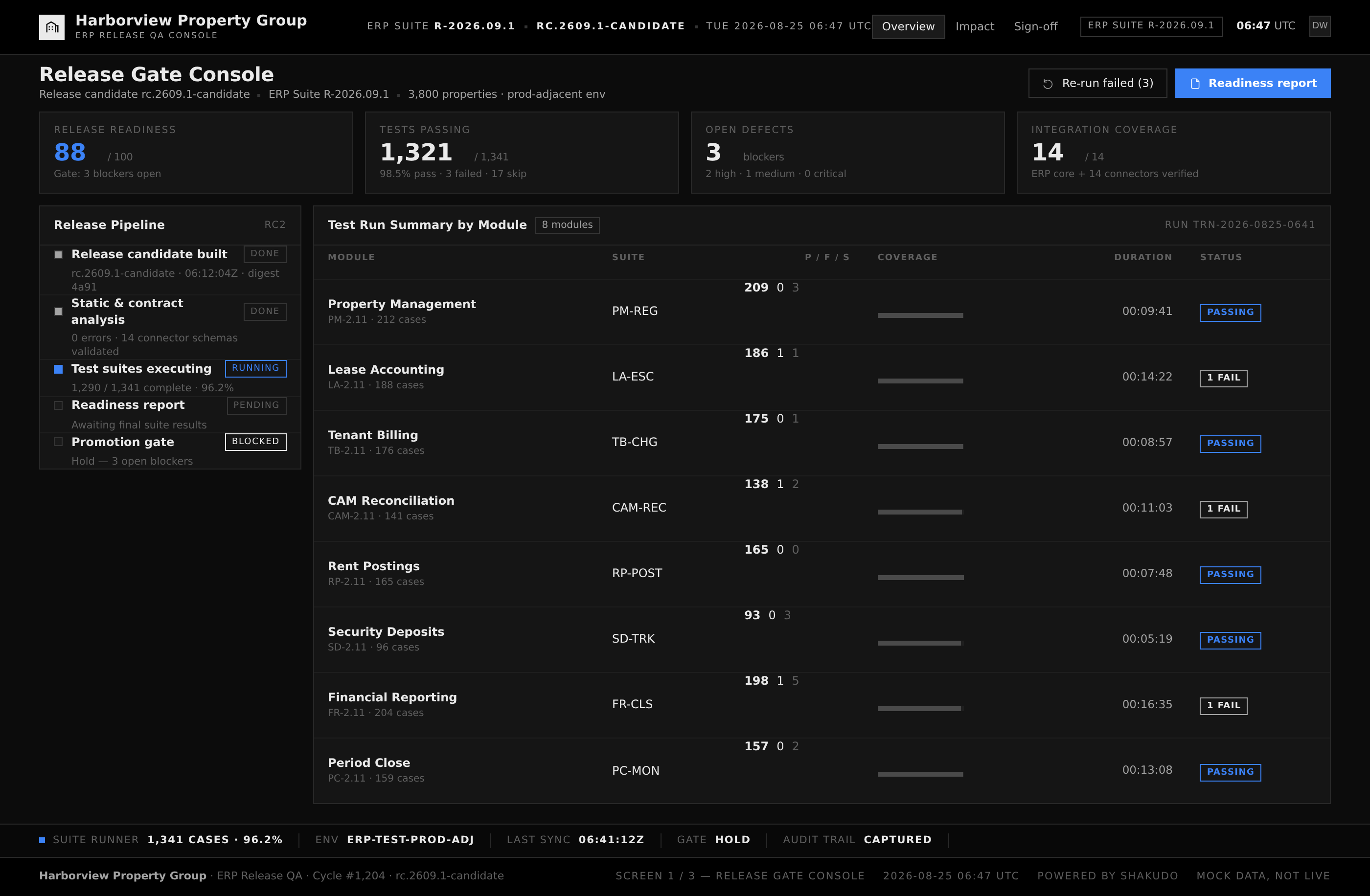
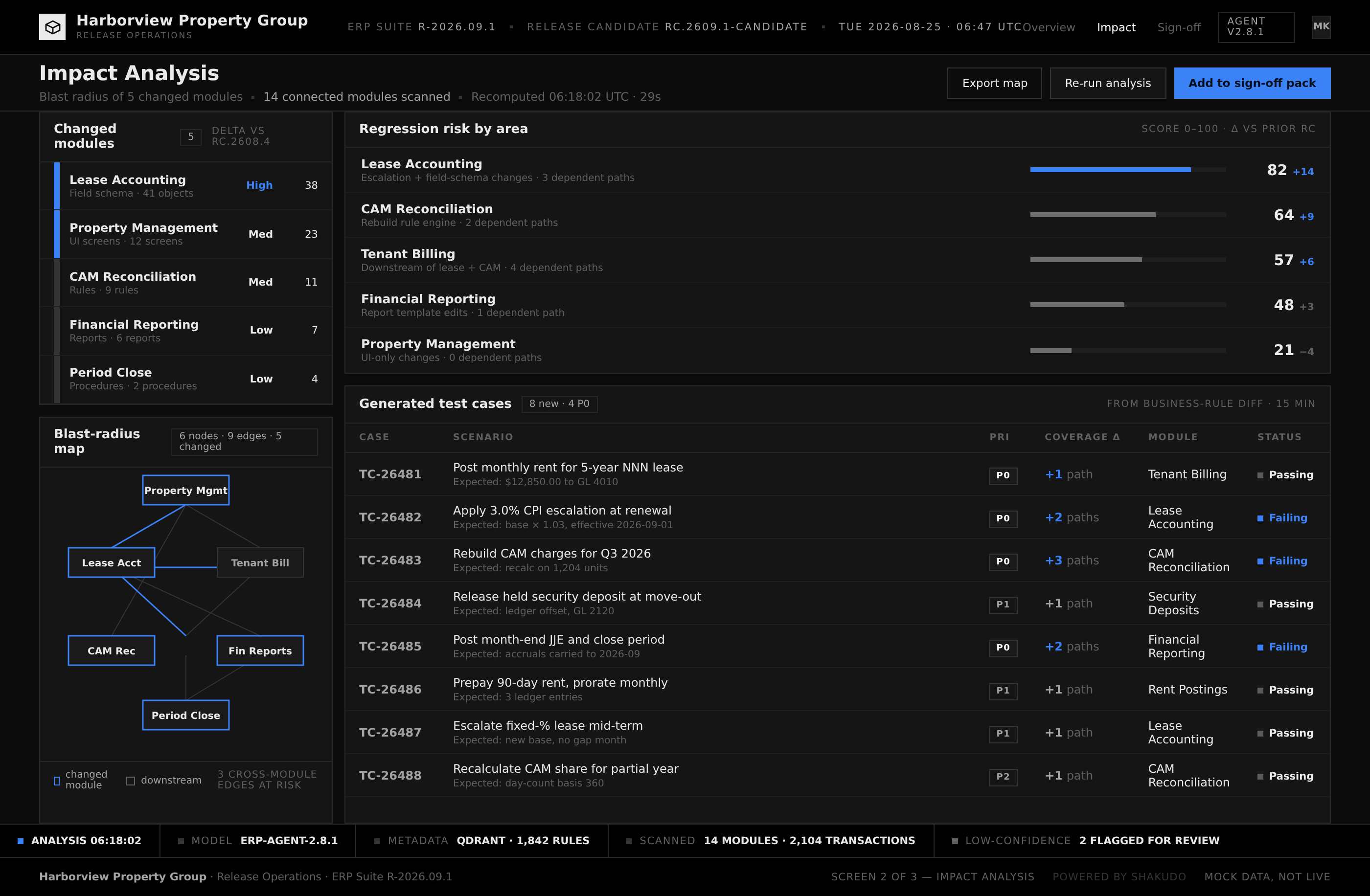
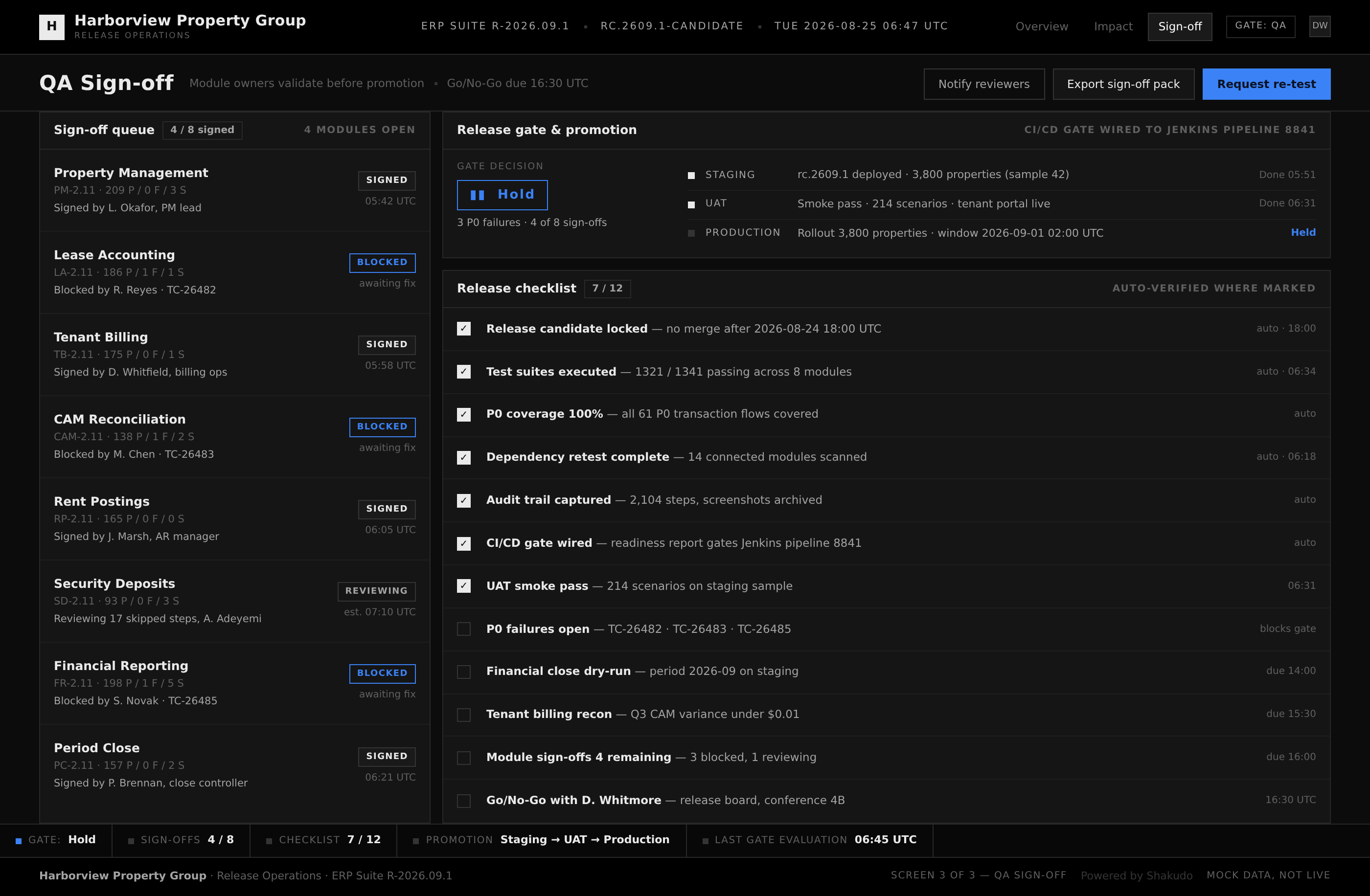
Three screens from a live release: the gate console, the impact analysis, and the QA sign-off.
1–2 / 3
Real estate companies depend on ERP systems to manage property portfolios, lease accounting, tenant billing, and financial reporting across hundreds of buildings. Each ERP release threatens to break critical workflows that process rent payments and calculate lease charges. A failed update can disrupt tenant billing cycles, miscalculate rent escalations, or corrupt financial reports that investors and stakeholders depend on for decisions.
Manual QA teams test each module after every release, executing hundreds of transaction scripts by hand across property management and accounting workflows. The process takes days, delays deployments, and still lets regression bugs reach production. Industry data shows that automated ERP testing can cut test cycle times by up to 90 percent while eliminating human error across testing cycles.
Every ERP release in a real estate company touches interconnected modules. A change in lease accounting can break tenant billing. An update to property management can disrupt CAM charge calculations. Manual QA teams must retest these dependencies after every release, executing transaction scripts one by one across multiple modules and properties. The effort scales linearly with portfolio size and module complexity, which means larger real estate operations face the heaviest testing burden.
The cost of incomplete testing compounds quickly. A regression bug in rent calculation can charge tenants incorrectly for months before anyone notices. A broken lease escalation workflow can underbill across an entire property class. By the time accounting catches the error, the company faces manual corrections, tenant disputes, and audited financial restatements. Manual testing also introduces its own errors. Testers skip steps under deadline pressure, misjudge expected results on complex transactions, or lose track of which modules they have already validated.
AI-driven test automation changes the economics of ERP release validation. Instead of manual scripts, AI agents interpret the intent of each test step and navigate ERP transactions autonomously across modules. The system reads ERP metadata, understands business rules, and validates how transactions move between property management, lease accounting, and billing systems. When fields or screens change between releases, the agents adapt automatically rather than breaking like rigid scripted tests.
Each test run produces a pass or fail status, a detailed execution log, and a screenshot-based audit trail capturing every step. Low-confidence results are flagged for human review rather than passing silently. One organization achieved a 95 percent reduction in test cycle time using AI-powered regression testing, compressing validation from 12 hours to 15 minutes for complex scenarios. Test script creation time dropped by 90 percent as well, since AI generates executable test flows from plain-language descriptions of business processes.
A practical ERP testing pipeline connects to the existing ERP environment and runs automated suites after every release candidate. The pipeline validates critical business processes first: rent posting, lease escalations, security deposit tracking, CAM reconciliations, and financial period closes. Each process is broken into transaction-level test cases that execute across multiple properties and lease types. The system records every result and produces a release readiness report before deployment proceeds.
Security and data privacy matter in real estate ERP testing. Property data, tenant financials, and lease terms are sensitive, so the pipeline runs within controlled environments to keep production-adjacent data inside the network. It integrates with existing CI/CD and release management tools so QA results gate deployment decisions automatically. Over time the test library grows with each release, and the system learns which modules and transaction paths carry the highest regression risk. Teams can expand coverage without adding headcount, since AI handles test generation and maintenance that would otherwise require dedicated automation engineers.
The pipeline fits real estate companies running ERP systems across property portfolios: a portfolio operator managing hundreds of buildings, a property management firm processing rent payments and lease accounting at scale, or any operations team whose ERP release cycle touches tenant billing, CAM reconciliations, and financial reporting and where a single regression can reach tenants and investors.
AI test agents read ERP metadata and understand how transactions flow between modules like property management, lease accounting, and tenant billing. When a release changes one module, the system automatically retests dependent transaction paths across connected modules. This dependency-aware testing catches cross-module regressions that manual testing often misses under deadline pressure.
Yes. AI agents interpret the intent of each test step rather than relying on fixed UI element selectors. When fields, screens, or workflows change between releases, the agents adapt automatically and continue executing. This self-healing behavior reduces test maintenance by over 50 percent compared to traditional scripted automation that breaks when the interface shifts.
Organizations using AI-powered ERP test automation report up to 90 percent reductions in test cycle time. Complex scenarios that took 12 hours to script manually can be generated in 15 minutes. Test accuracy reaches near 100 percent across cycles by eliminating human error. Manual QA time shifts from repetitive execution to reviewing flagged exceptions.
The testing pipeline integrates with standard CI/CD and release management tools through APIs. Automated test suites run after each release candidate and produce a readiness report that gates deployment decisions. Results feed into existing workflows so QA outcomes directly control whether a release proceeds or rolls back.
When the goal is a release pipeline that catches regression bugs before they reach your tenants and investors, a conversation with Shakudo is the fastest way to see automated ERP testing run against your own release candidate. The pipeline runs in your own environment, on-prem or in your cloud, and a first working test cycle is in place within days. Book a demo to watch it validate a release candidate.
Shakudo helps real estate companies automate ERP release testing and validate critical modules after every update. Automated test suites execute transaction flows across property management, lease accounting, and tenant billing to catch regression bugs before deployment, reducing manual QA time by up to 90 percent per cycle.










"What drew me in is simple. When developers ship production-ready code this quickly, how can I have environments spun up fast enough? Shakudo is how we close that gap."



"Shakudo does not just provide the platform. It is a real partnership. They are always there to help and execute our vision faster and the right way. It is like a co-team working together to achieve our goals."