






Three screens from a live run: the workflow board, the run trace, and the exception review.
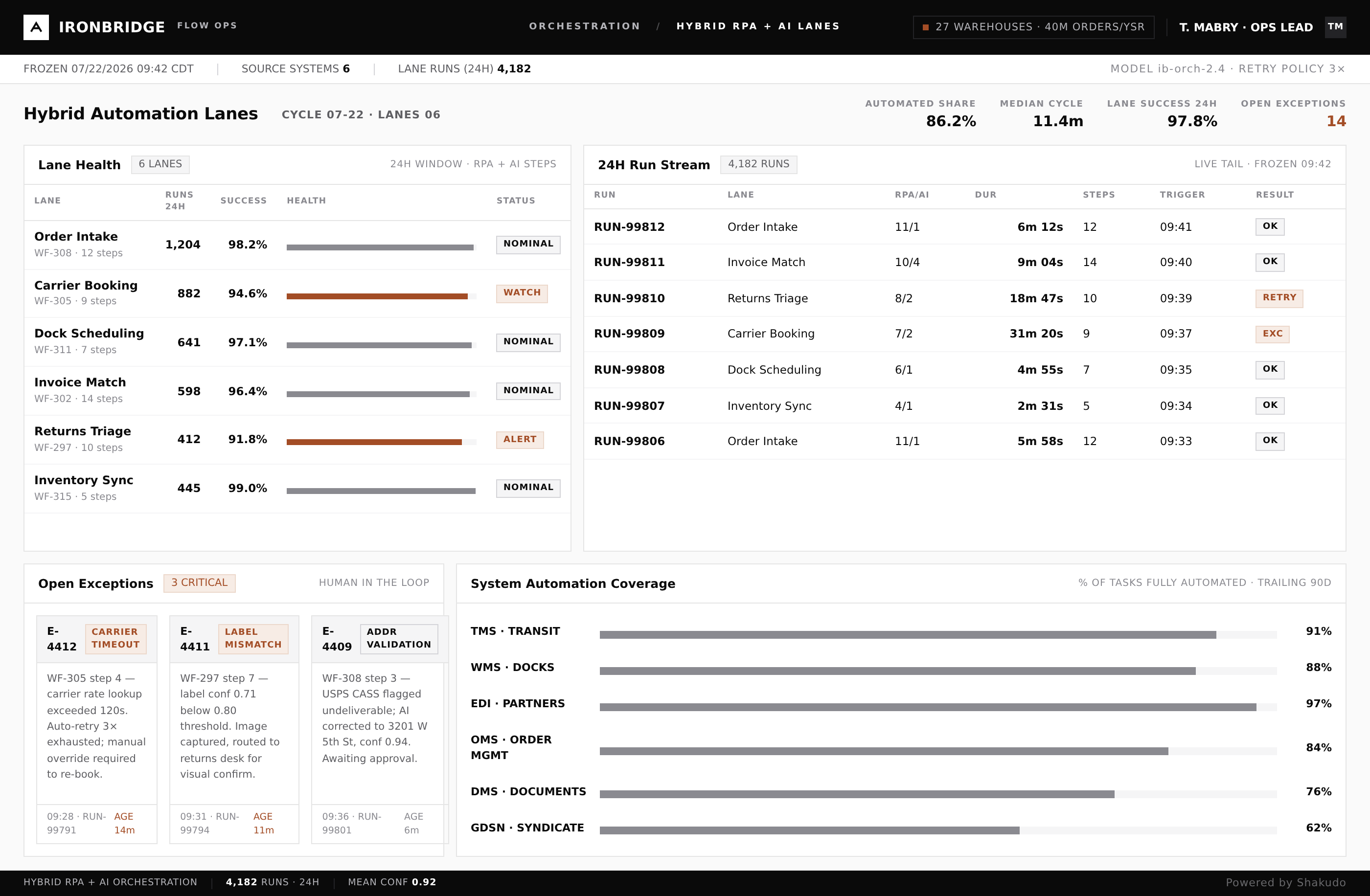
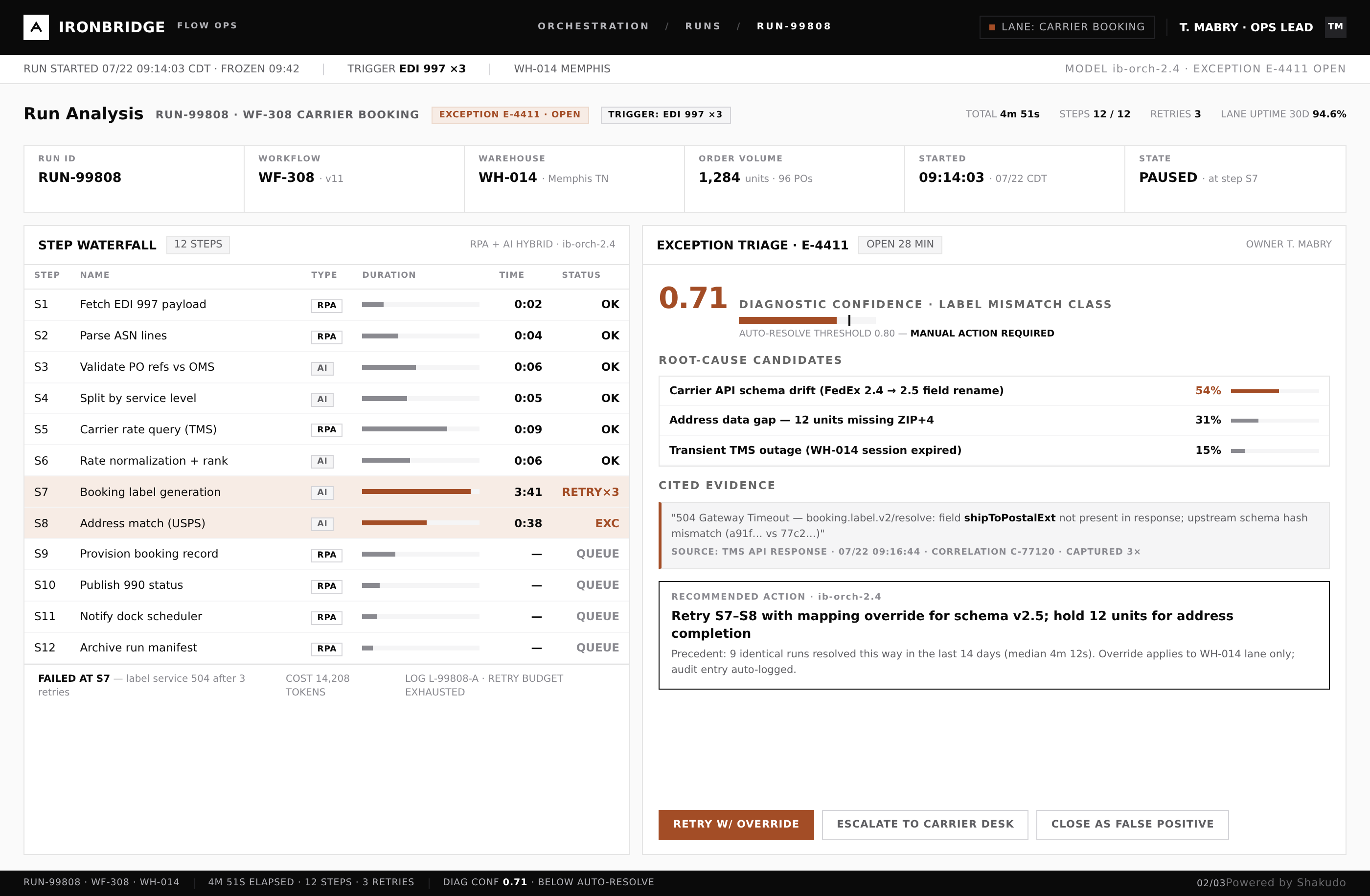
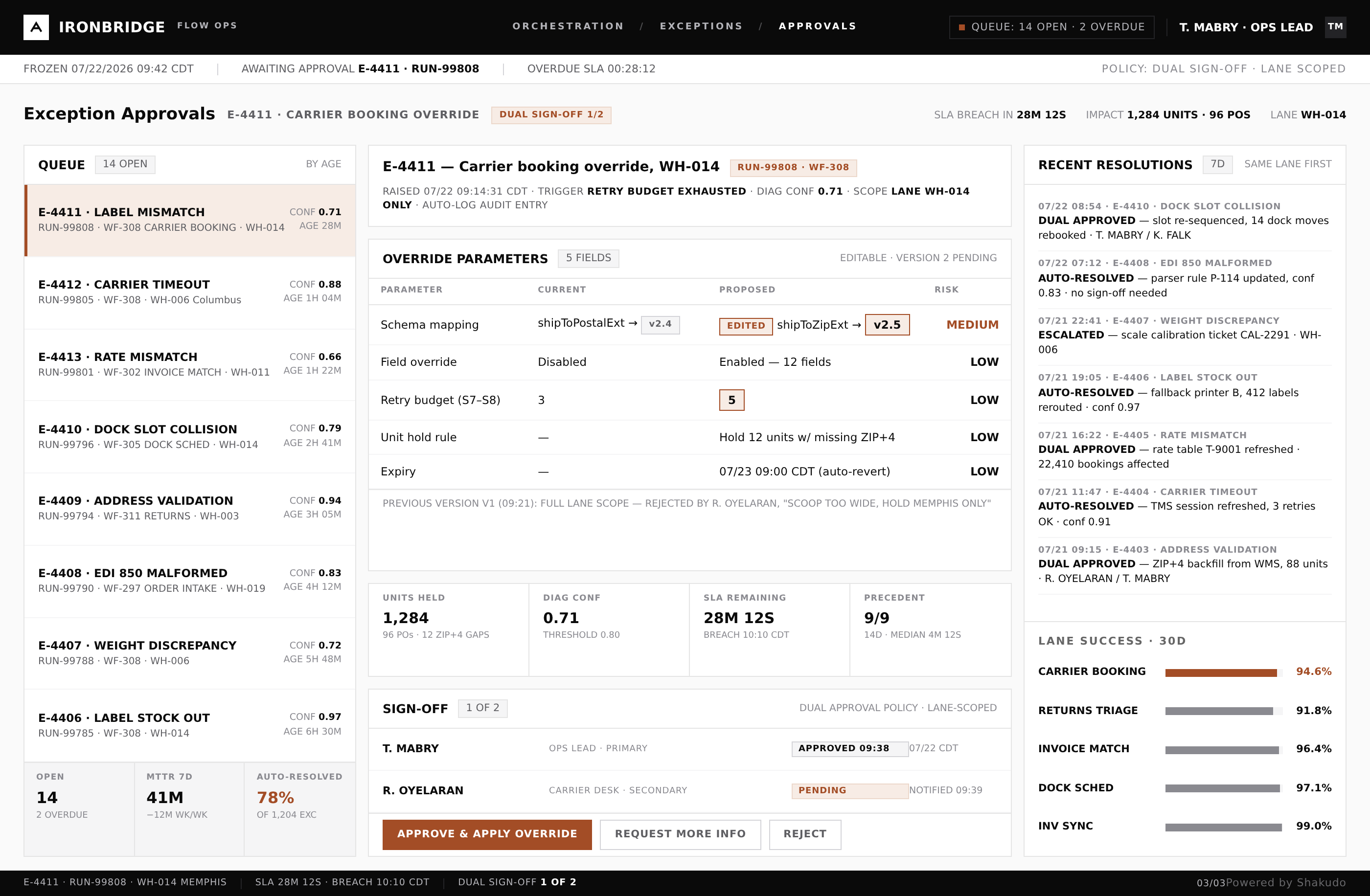
1–2 / 3
Robotic process automation handles high-volume, rules-based tasks with precision, and manufacturing organizations lean on it for order intake, purchase order processing, and production scheduling. Research shows that 30 to 50 percent of initial RPA projects fail, though, because bots stall on unstructured data, changed interfaces, and edge cases outside their programmed logic. Each exception halts the pipeline and generates an IT ticket. A hybrid RPA approach, deterministic bots on the happy path and AI agents on the exception path, is how mature RPA deployments reduce exception backlog without a full rebuild.
Bots excel at following explicit rules. They click buttons, move data between systems, and execute fixed sequences with consistent accuracy. The problem is that real manufacturing processes are rarely clean. Supplier purchase orders arrive with inconsistent part naming. Customer order emails change format without notice. Work orders arrive with missing fields or smudged dates. A minor update to a web application can shift a button position and break a bot that relied on fixed coordinates. Studies of large-scale RPA environments confirm that erratic bot behavior is common, driven by variability in the systems bots interact with.
When a bot encounters a case it cannot process, it stops. The transaction enters an exception queue. A human reviews the failure, resolves it manually, and the bot moves on. For high-volume processes these exceptions accumulate fast. Engineering teams spend significant time monitoring bots, diagnosing failures, and patching workflows. The result is a fragile automation pipeline that requires constant maintenance to stay operational.
A hybrid RPA architecture that keeps your existing bots running the deterministic happy path while AI agents resolve the exception cases that break rule-based automation. The system covers:
The solution is structured around three layers. Existing RPA bots continue handling the deterministic happy path: data entry, system-to-system transfers, and scheduled batch processing. An orchestration layer monitors bot execution and detects exceptions in real time. When a bot fails, the orchestrator routes the case to an AI agent equipped with the relevant business context and document access.
The agents bring probabilistic reasoning to automation. They interpret unstructured input with large language models, extract missing fields, infer values from surrounding context, and apply decision logic. A vector database gives agents access to historical cases and policy documents so each exception is resolved consistently rather than reinvented. Cases the agent resolves with high confidence complete automatically. Lower-confidence cases go to a human reviewer with the agent analysis attached, reducing review time from minutes to seconds. Industry reports indicate that intelligent process automation can reduce cycle times by 60 to 90 percent compared to manual processing, and maintenance costs fall because specialist developers no longer need to hardcode every edge case into the workflow.
This is for manufacturing IT and operations teams that already run RPA bots: automation engineers maintaining the bot fleet, operations managers facing the exception queue, and plant or corporate IT owners accountable for pipeline uptime. It fits organizations where production, procurement, and order management run high-volume repetitive processes, where bots already cover the happy path, and where every unresolved exception consumes engineering time. Teams that need judgment at exception points, not just rule execution, get the most from this architecture.
Hybrid RPA combines deterministic bots with AI agents. Bots handle the rules-based happy path. Agents handle exception cases that require judgment, such as interpreting unstructured data or resolving ambiguous inputs. The two layers work together so the pipeline processes more cases end to end without human intervention.
No. A hybrid architecture preserves existing RPA investments. Bots continue running the deterministic workflows they already handle well. Agents are added at exception points where bots fail. Companies keep their current automation while extending coverage to cases that previously required manual handling.
Agents handle exceptions involving unstructured data, missing fields, changed formats, and ambiguous inputs. Examples include reading invoices with smudged dates, matching purchase orders with inconsistent naming, and interpreting free-text order requests. Agents can also route low-confidence cases to human reviewers with analysis attached.
Deployment time depends on process complexity and the number of exception types. A focused pilot targeting one high-exception workflow can launch in weeks. Scaling across multiple processes follows once the agent logic and orchestration patterns are proven. Existing bots require no changes to participate.
If your bots stall on exception cases and your team spends hours resolving failures, a conversation with Shakudo is the fastest way to see a hybrid design on your own workflows. The pipeline deploys on your infrastructure, on-prem or in your cloud, a first working exception-handling loop is in place within days, and you can book a demo to watch it run.
Hybrid RPA pairs deterministic bots with AI agents that handle the exception cases bots cannot process. A technology company routes failed transactions to agents that reason through ambiguity and complete the work, keeping automation pipelines running without manual intervention.










"What drew me in is simple. When developers ship production-ready code this quickly, how can I have environments spun up fast enough? Shakudo is how we close that gap."


"Shakudo does not just provide the platform. It is a real partnership. They are always there to help and execute our vision faster and the right way. It is like a co-team working together to achieve our goals."