






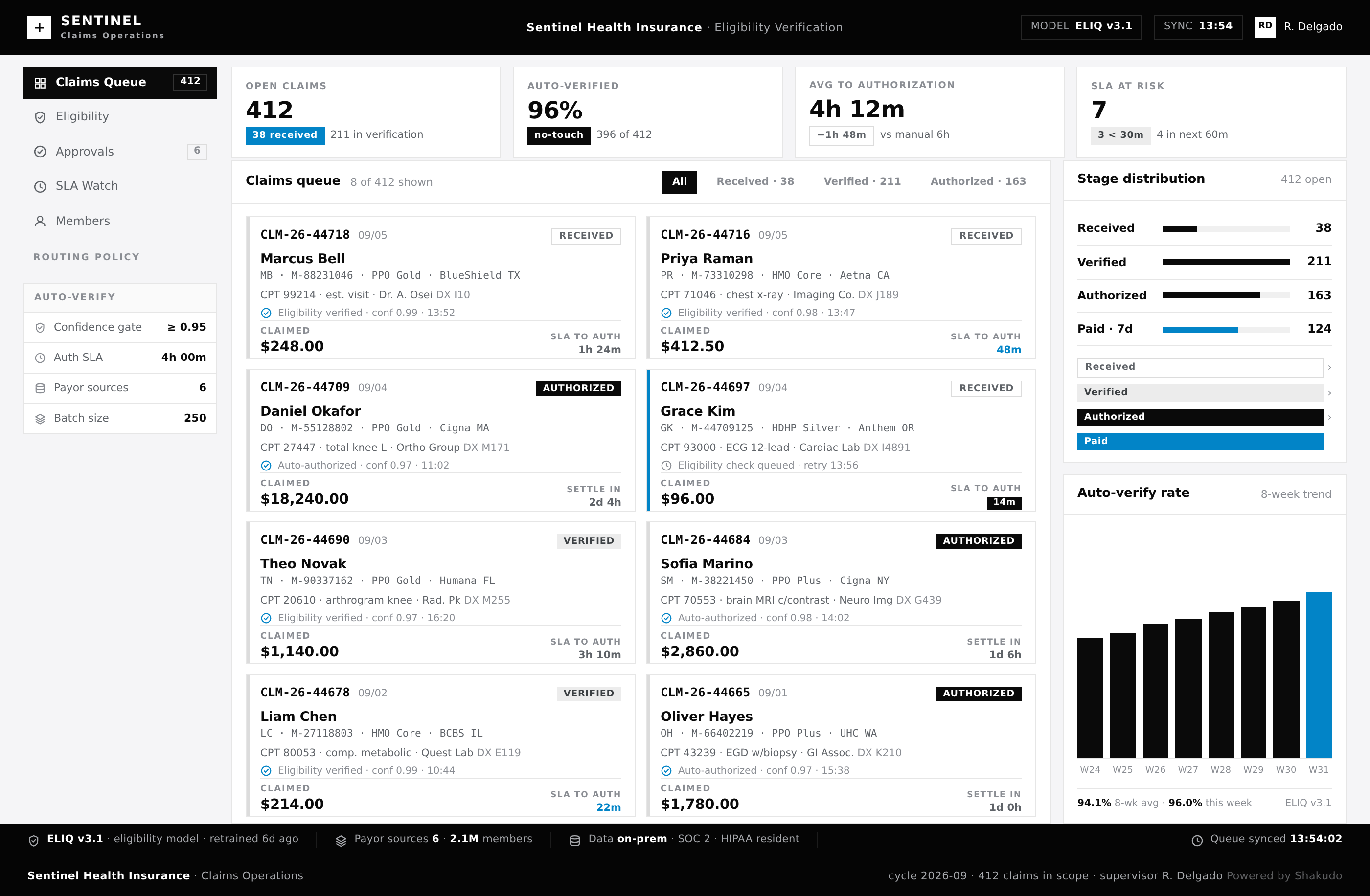
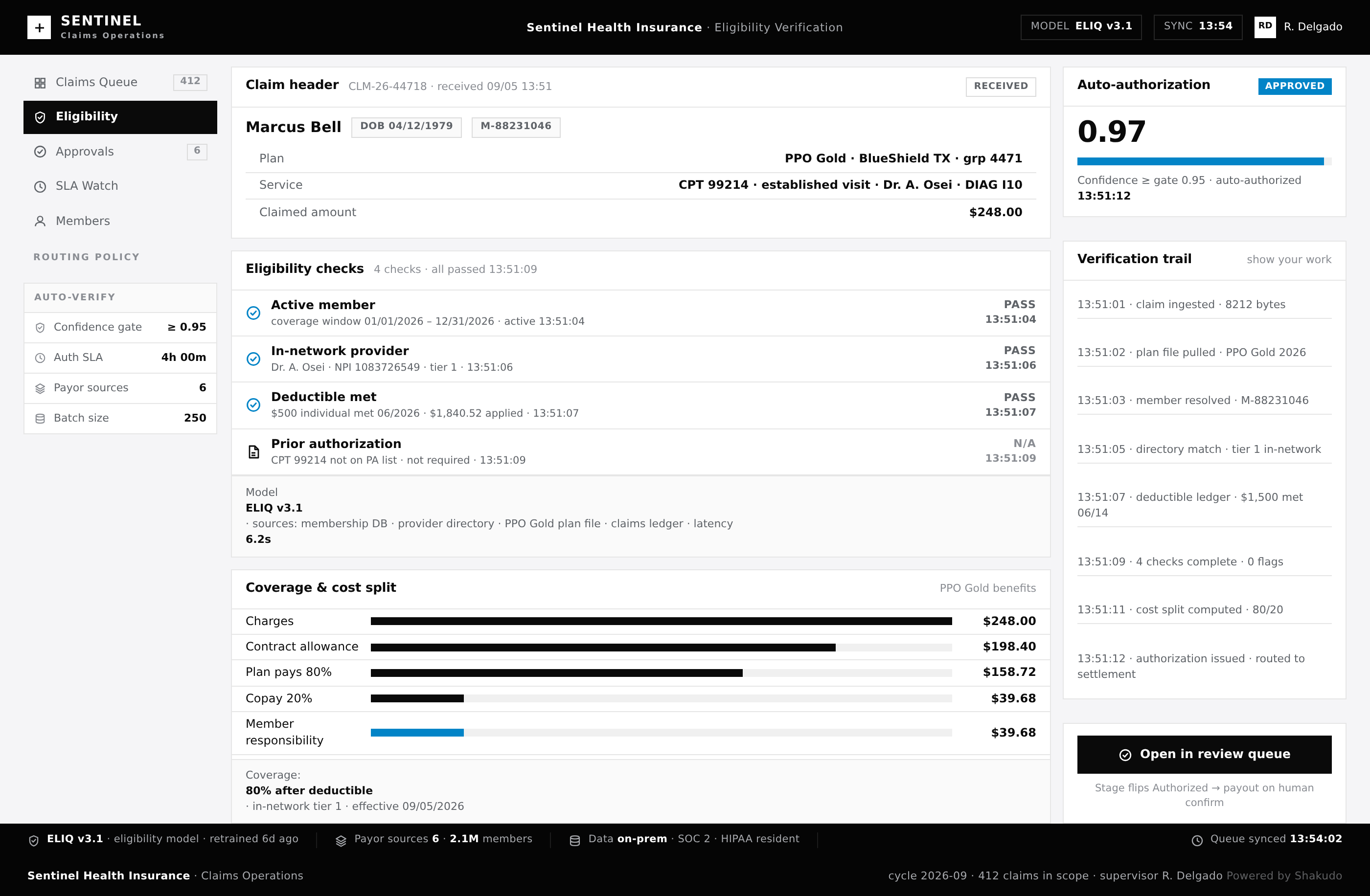
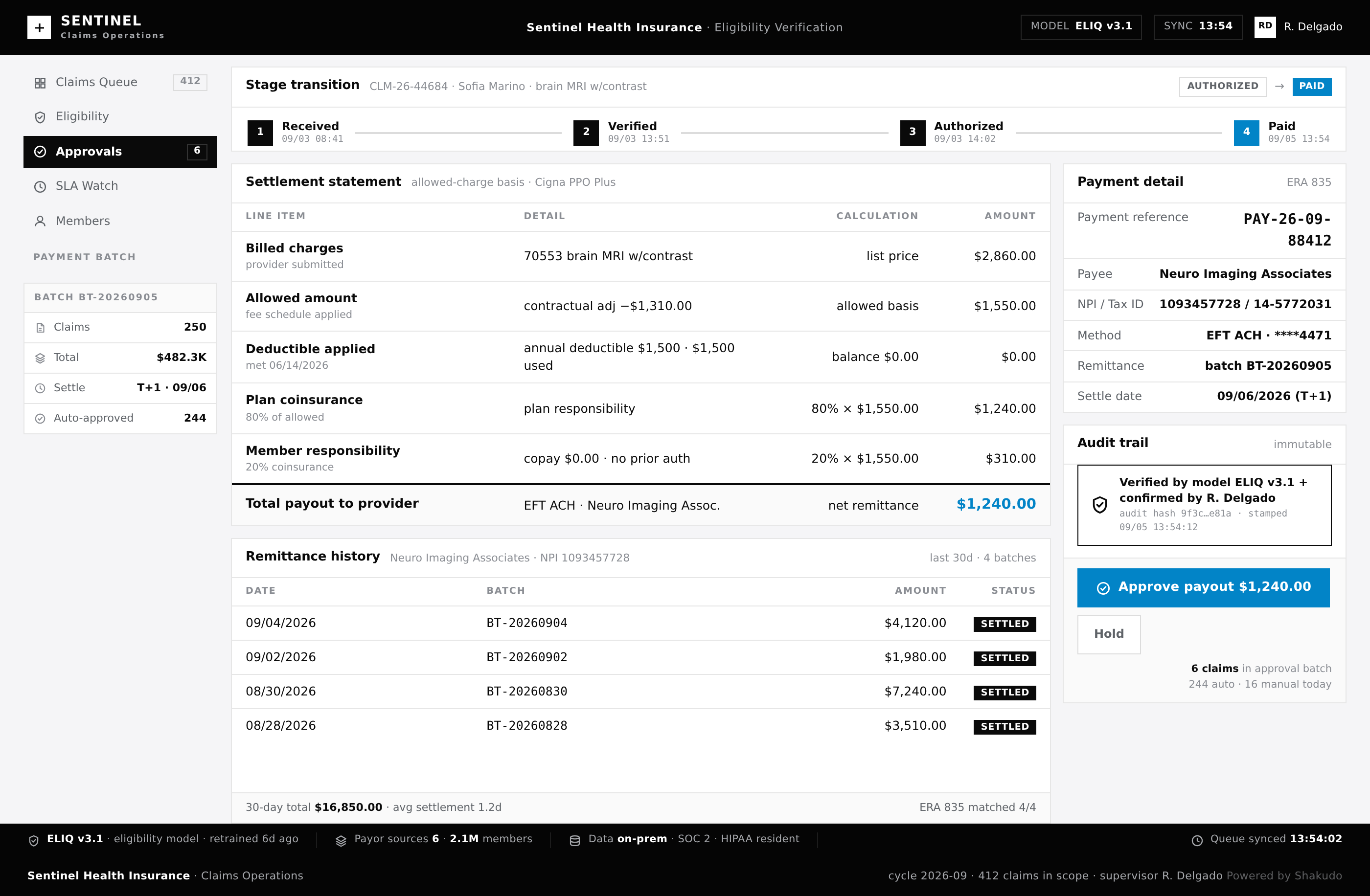
Three screens from a live run: the claims queue, an eligibility verification, and the payout approval.
1–2 / 3
Manual insurance eligibility verification takes 8 to 12 minutes per patient, and roughly 15 to 20 percent of those manual checks contain errors. Half of all claim denials trace back to eligibility mistakes made during intake. For an organization processing thousands of verifications a week, these errors compound into delayed reimbursements and lost revenue.
Claim denials are the top revenue cycle challenge for nearly three-quarters of healthcare organizations, and front-end workflows contribute the most to reimbursement breakdowns. Hospitals face an average of $5 million in annual losses from denied claims, about 5 percent of net patient revenue. Survey data shows 42 percent of organizations report rising denial rates year over year, and 30 percent see 10 to 15 percent of their claims denied.
Much of this stems from manual processes: staff calling payers, navigating portal screens, and transcribing coverage details by hand. A wrong plan code or a missed coordination of benefits at intake triggers a denial weeks later, and reworking a denied claim costs 4 to 5 times more than getting it right the first time. Staff spend hours on hold with payers instead of focusing on complex cases that need human judgment.
A revenue cycle automation pipeline that verifies eligibility, validates coverage, and submits claims with far fewer front-end errors. The measurable outcomes: eligibility checks that take 8 to 12 minutes by hand complete in seconds, eligibility-related denials fall by 38 percent or more at health systems using AI-powered verification, and manual workload on routine checks drops by 60 to 80 percent while human judgment stays on the edge cases.
The pipeline covers the full path from scheduling to submission. Checks run at scheduling, 24 to 48 hours before the visit, and again at check-in. Pre-visit coverage validation flags prior authorization requirements, out-of-network status, and coverage limitations before they become denials. Verified data flows directly into claim submission, with payer-specific formatting applied automatically and rejections routed back for immediate correction instead of a 30-day denial cycle.
The pipeline is built around three capabilities. First, real-time verification: the system queries payer portals and EDI connections at scheduling and check-in to confirm active coverage, plan type, copay amounts, deductibles, and coordination of benefits. Second, coverage validation: the AI compares patient benefits against the scheduled service and flags prior authorization needs, out-of-network status, and coverage limitations before the visit. Third, claims submission: workflow bots pull the validated eligibility data, populate the claim form, apply payer-specific formatting rules, and submit electronically, logging confirmations and routing rejections for immediate correction.
Human-in-the-loop checkpoints remain in the design. The system handles routine checks and validation; staff review flagged items like coordination of benefits, self-pay determinations, and unusual coverage scenarios. Integration uses API-based connections to payer portals and real-time eligibility transactions, and teams typically start with a small set of high-volume payers and expand coverage over time.
The pipeline is built on a practical, open stack. Python provides the core service logic for verification, validation, and submission steps. LangChain structures the reasoning that turns payer responses into standardized coverage fields. OpenAI models perform the natural language extraction and the benefit-versus-service comparisons that catch coverage problems before a visit. Pinecone stores payer-specific rules, benefit catalogs, and historical verification cases so the system applies consistent logic across payers. n8n wires the bot executions: eligibility queries, claim submission steps, and reviewer notifications in an auditable pipeline. Streamlit provides the review interface where staff resolve flagged coverage cases.
This is for revenue cycle teams in healthcare organizations that process high volumes of patient verifications: registration and front-desk teams running check-in, eligibility specialists reconciling coverage, and revenue cycle leaders accountable for denial rates and reimbursement timing. It fits organizations where payers, plan types, and coordination of benefits make manual verification slow and error-prone, and where a denial rate trend is a standing financial exposure. A healthcare services firm with this profile used the pipeline to verify eligibility, check coverage, and submit claims without the manual errors that drive rework.
Manual verification takes 8 to 12 minutes per patient. Staff call payers or navigate portals, transcribe coverage details, and check prior authorization requirements. Automated verification completes the same checks in seconds by querying payer systems directly and structuring the response with AI.
Half of all claim denials trace back to eligibility errors. Front-end mistakes during registration and intake are the leading cause of reimbursement breakdowns: wrong plan codes, missed coordination of benefits, and outdated coverage information that manual checks fail to catch.
Organizations using AI-powered eligibility verification have reduced denials by 38 percent or more. The exact improvement depends on current denial rates, payer mix, and workflow maturity. Most organizations see meaningful results within the first 90 days as real-time checks replace manual verification errors.
Yes. The pipeline integrates with practice management software, electronic health records, and clearinghouse platforms through APIs and EDI transactions. Workflow bots connect to payer portals for eligibility checks and claims submission. The system fits into existing revenue cycle workflows without replacing core systems.
When the goal is a revenue cycle that verifies coverage right the first time, a conversation with Shakudo is the fastest way to see it on your own payer data. The pipeline deploys on your infrastructure, on-prem or in your cloud, a first working pipeline is in place within days, and you can book a demo to watch it run.
AI automates patient eligibility checks, coverage validation, and claims submission for healthcare organizations. The solution reduces manual errors, cuts verification time, and improves first-pass claim acceptance rates.










"What drew me in is simple. When developers ship production-ready code this quickly, how can I have environments spun up fast enough? Shakudo is how we close that gap."



"Shakudo does not just provide the platform. It is a real partnership. They are always there to help and execute our vision faster and the right way. It is like a co-team working together to achieve our goals."