






Three screens from a live LTV model: the overview, the driver analysis, and the budget allocation review.
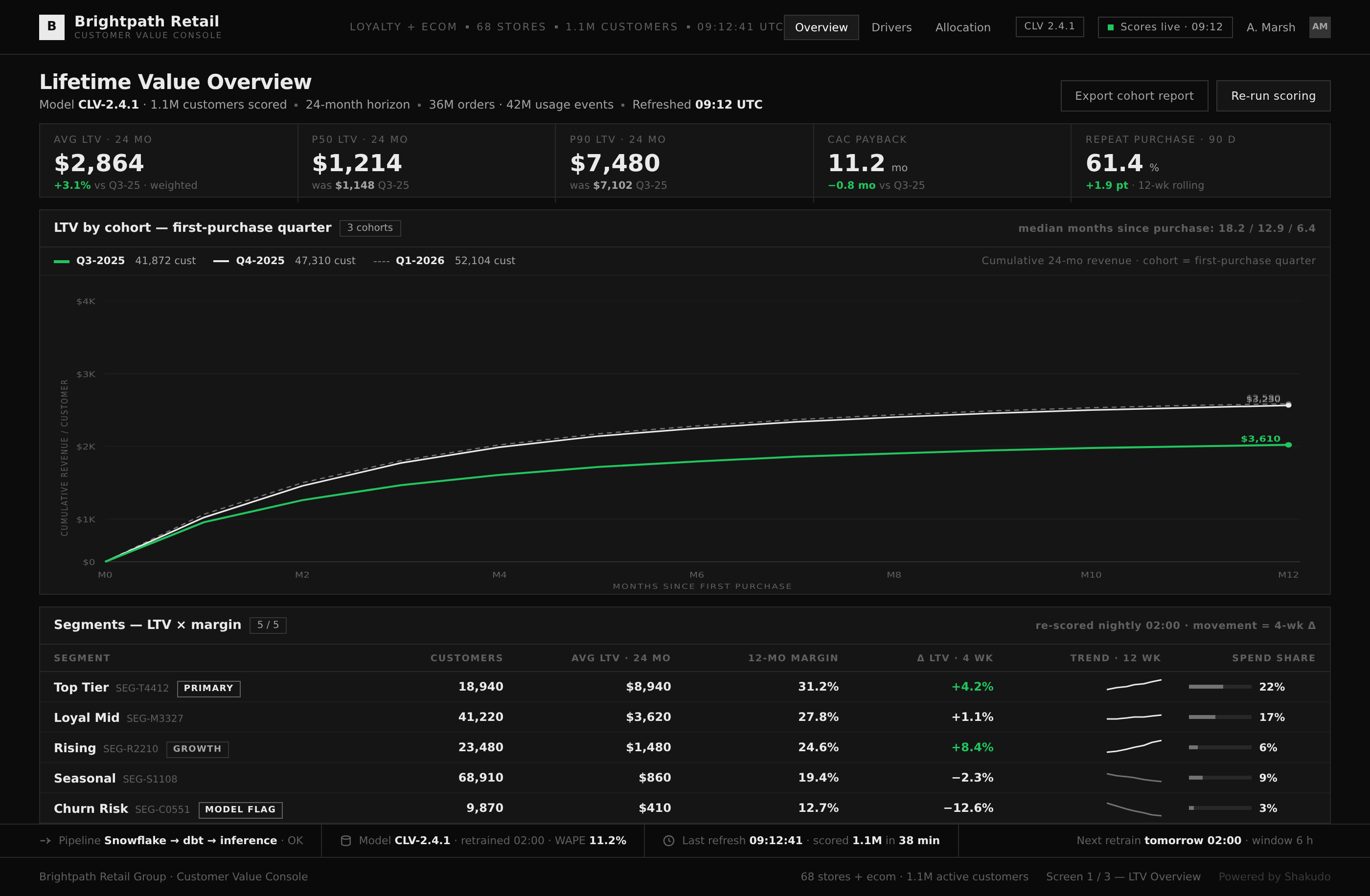
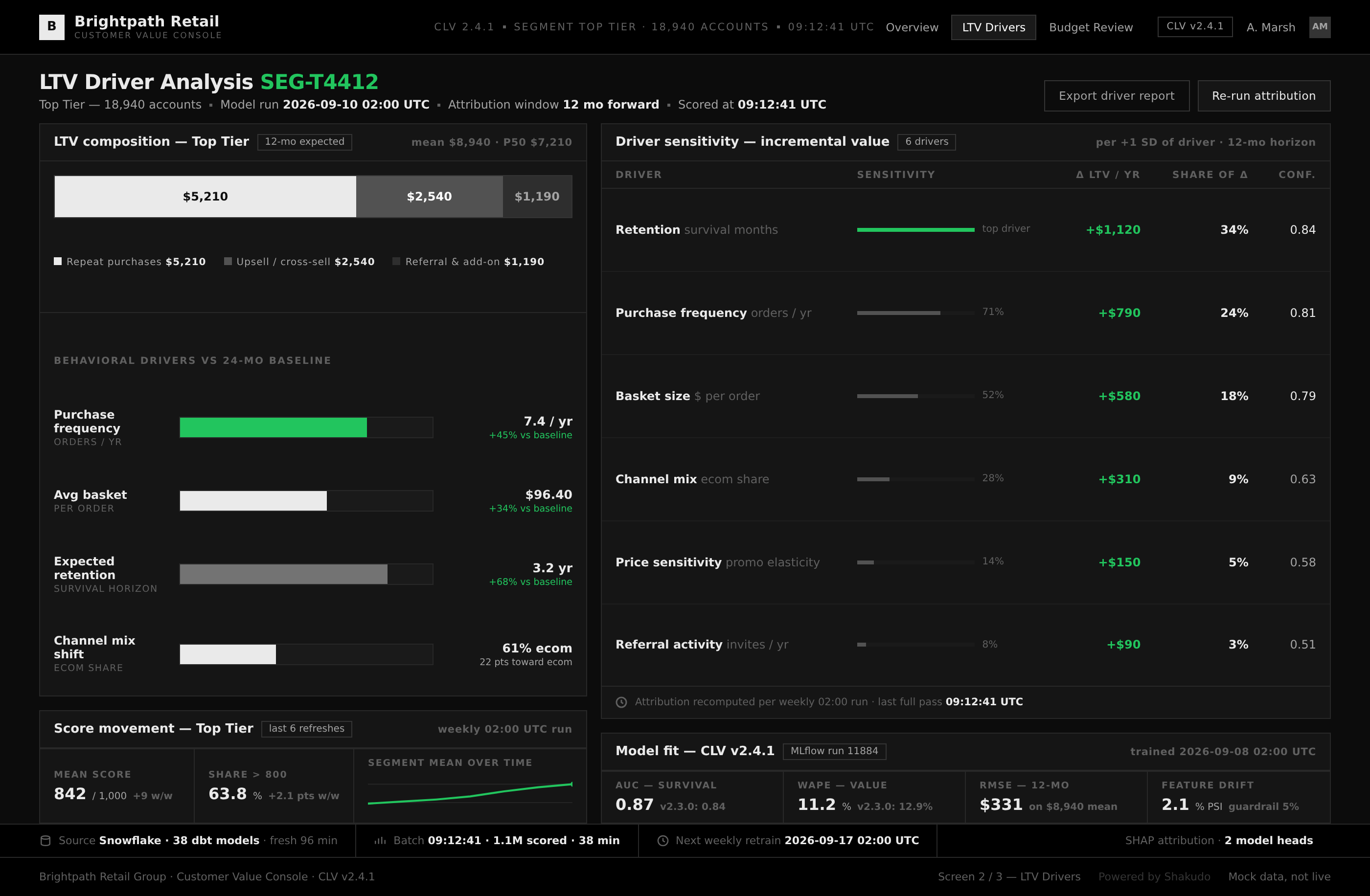
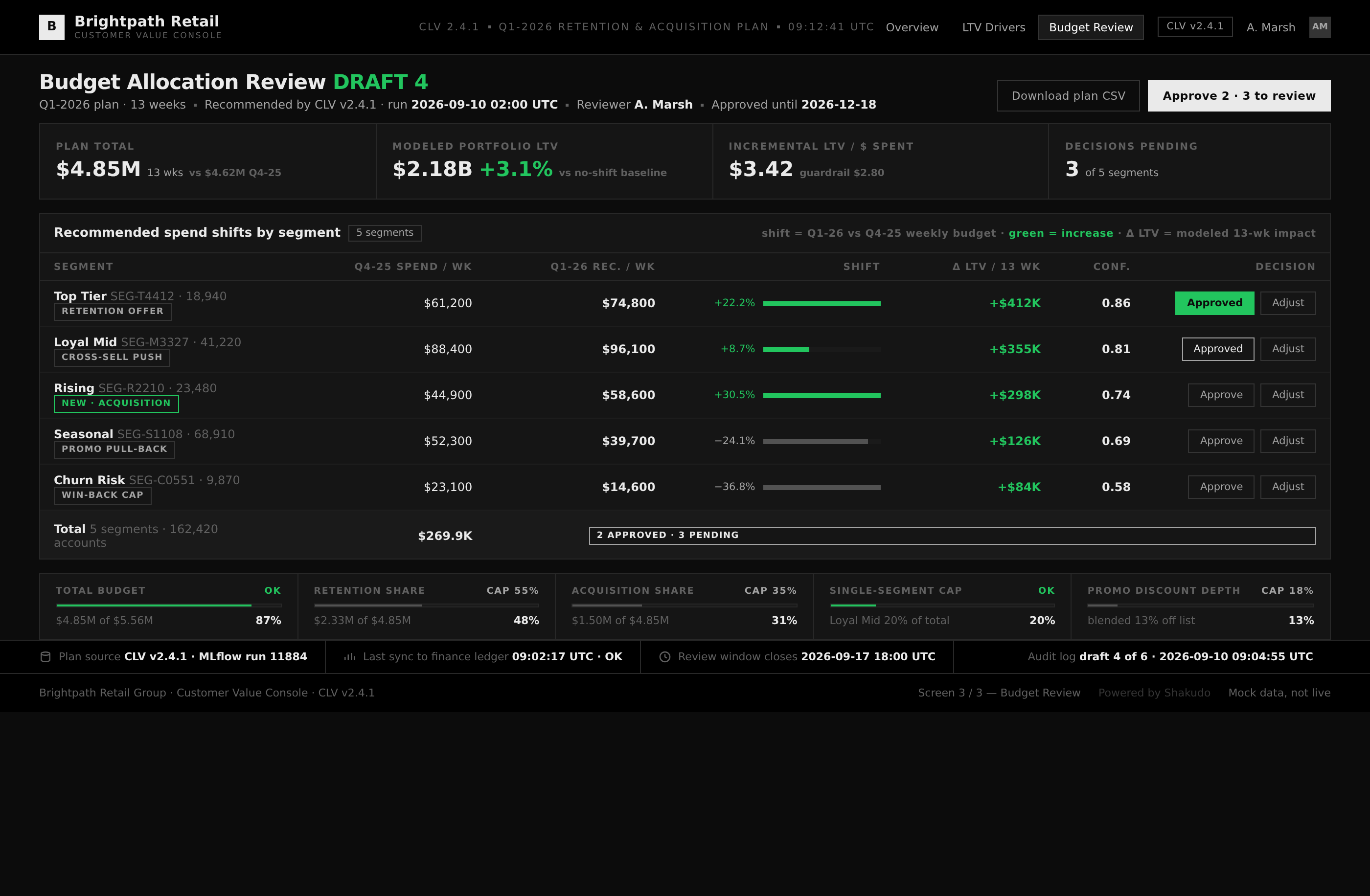
1–2 / 3
Customer value is usually measured as a number that goes stale. The last CLV model was trained on last year's orders, the segmentation was built on assumptions, and the marketing budget still follows the old picture. The customers who are about to churn are treated the same as the customers who will double their spend, and the retention budget follows last year's cohorts into this year's decisions.
A CLV model trained on the company's own data fixes the picture. The model reads the order history and the usage signals, predicts each customer's future value, and updates the score as behavior changes. Marketing spend, retention effort, and resource allocation all follow the live numbers.
Shakudo deploys a customer lifetime value analytics platform. Snowflake holds the customer data at scale, and dbt transforms the raw order and usage records into the clean inputs the model needs. PyTorch runs the machine learning models that predict future customer behavior and value. Metabase turns the predictions into visualizations that every stakeholder can read. MLflow keeps the models current as markets and behavior shift, and Windmill runs the workflows that keep the whole pipeline moving. The result is a live picture of the customer base, a CLV score per customer, and the targeting, retention, and allocation decisions that follow from it. The score updates as the customer base moves, so the segmentation and the spend plan stay current.
The platform runs in the company's own environment. Order and usage data is commercial data, and it stays on the company's infrastructure from ingestion through model inference. Snowflake ingests and stores the data, dbt builds the analysis layer, and the PyTorch models train on the company's own order and usage history. The CLV score updates as new behavior lands, so the segmentation reflects the current customer base, and Windmill automates the refresh so the picture never goes stale again.
Revenue, marketing, and analytics teams that manage customer relationships on data older than a quarter. Financial services firms, subscription businesses, and any company whose retention budget follows a static forecast fit the use case best. The platform works wherever the customer data already lives in a warehouse, and the dashboards reach every stakeholder who needs the number.
The model trains on the company's own order and usage data in Snowflake, so the score reflects the actual customer base. PyTorch re-trains as new behavior lands, and MLflow keeps the model current, so the prediction tracks the customers as they change. The number updates with the behavior, and the team watches the movement in Metabase.
Yes. Metabase visualizes the CLV predictions and their movement across the customer base, so stakeholders can watch the scores shift as behavior changes. The dashboards make the insight accessible to the whole team on the same view the analysts use to build the model.
Building a CLV optimization system from scratch typically takes several months of development. Shakudo deploys the full platform, from the data layer to the prediction models, within hours of the first data connection, so the first live CLV score arrives quickly and the first segmentation built on it lands the same week.
For teams that allocate retention spend on a CLV number that goes stale, a live model trained on the company's own data keeps the score current and the spend pointed at real value. Retention and acquisition budgets start from the same live number. Book a demo and see the CLV pipeline run on real customer data.
Shakudo revolutionizes Customer Lifetime Value (CLV) analysis by providing a comprehensive, AI-powered solution for businesses. This platform seamlessly integrates advanced analytics tools, enabling organizations to accurately calculate, predict, and optimize CLV metrics with unprecedented ease and accuracy.










"What drew me in is simple. When developers ship production-ready code this quickly, how can I have environments spun up fast enough? Shakudo is how we close that gap."



"Shakudo does not just provide the platform. It is a real partnership. They are always there to help and execute our vision faster and the right way. It is like a co-team working together to achieve our goals."