






Three screens from a live review: the risk overview, the anomaly deep-dive, and the reviewer disposition.
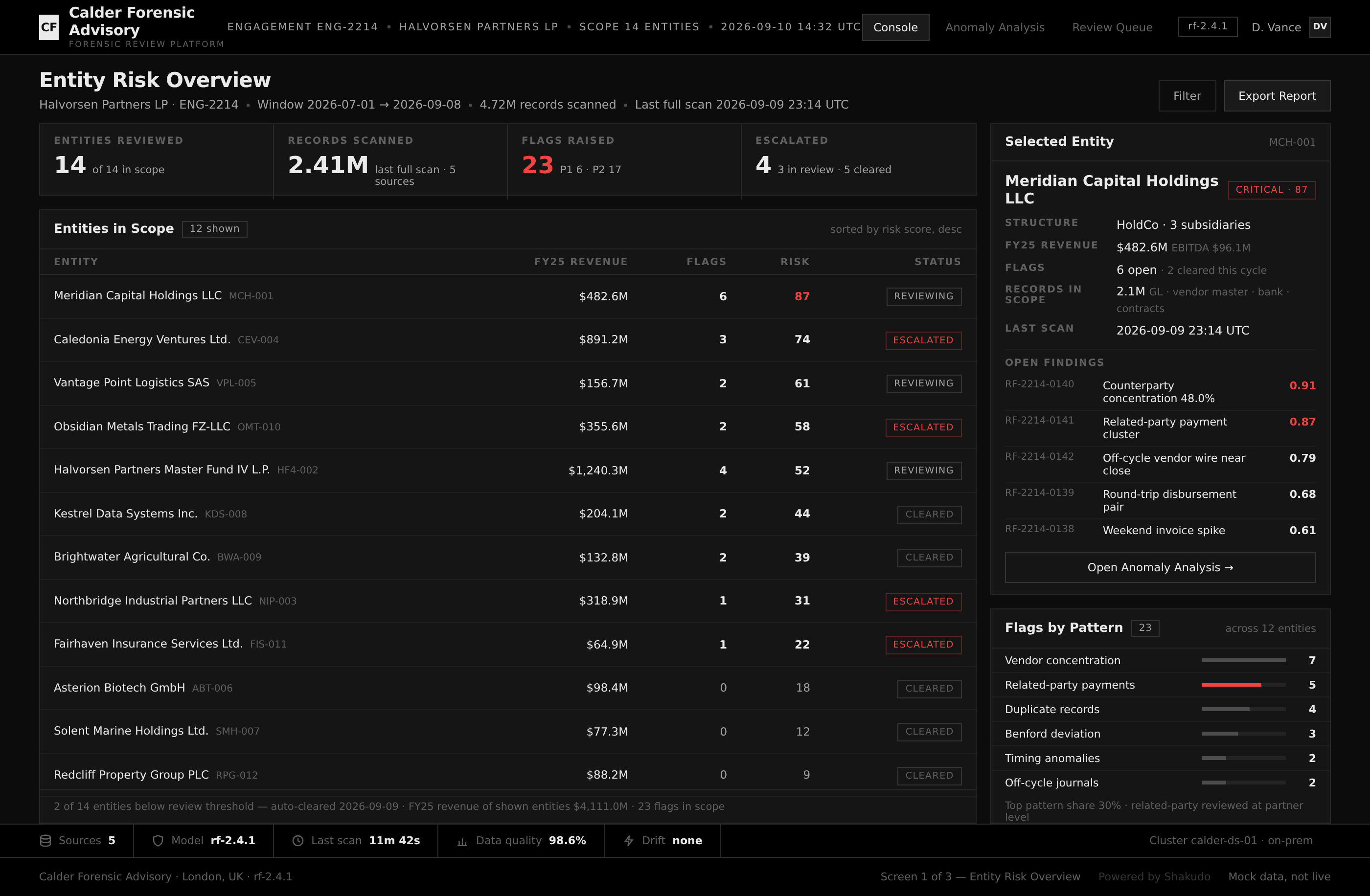
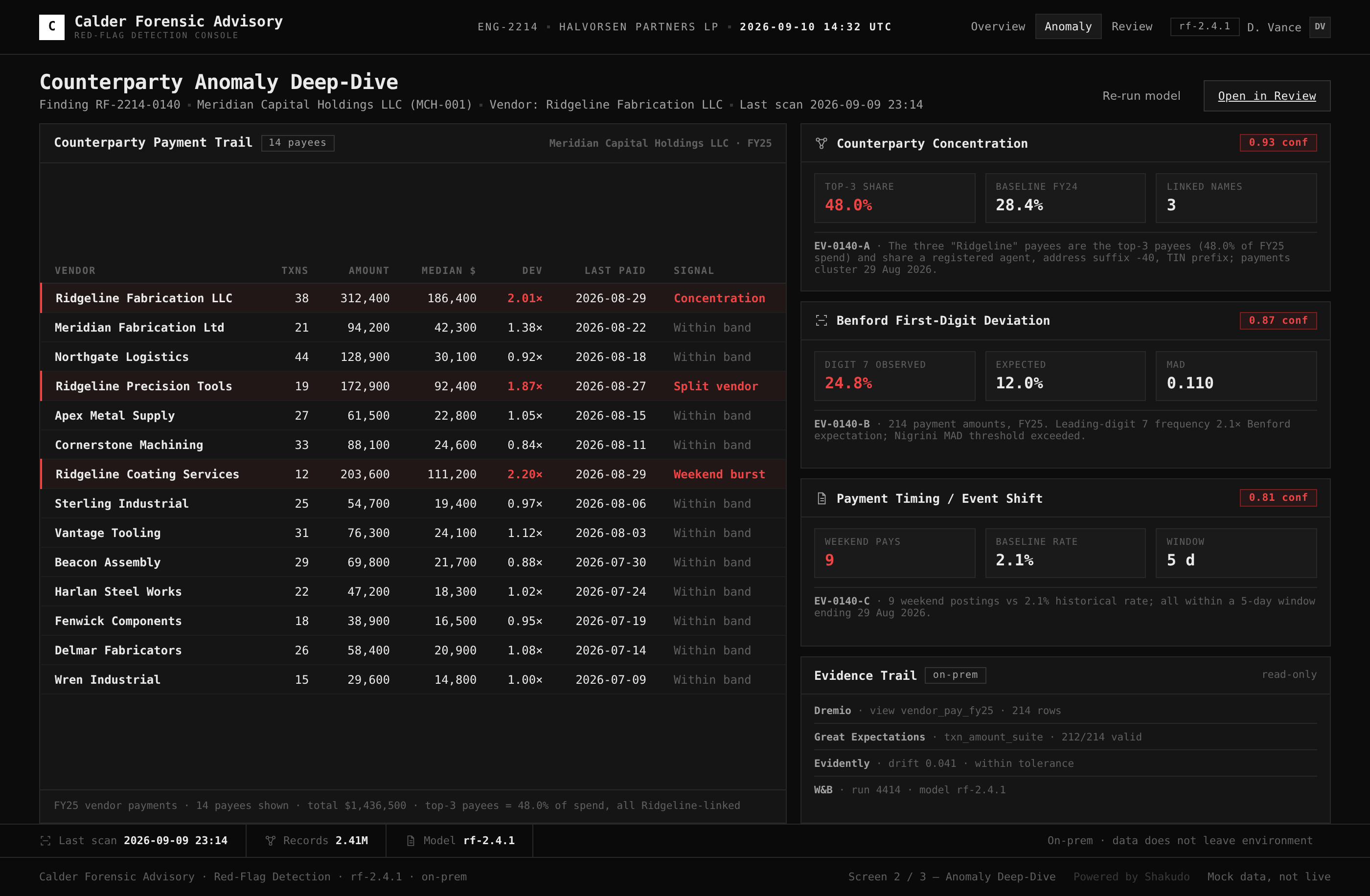
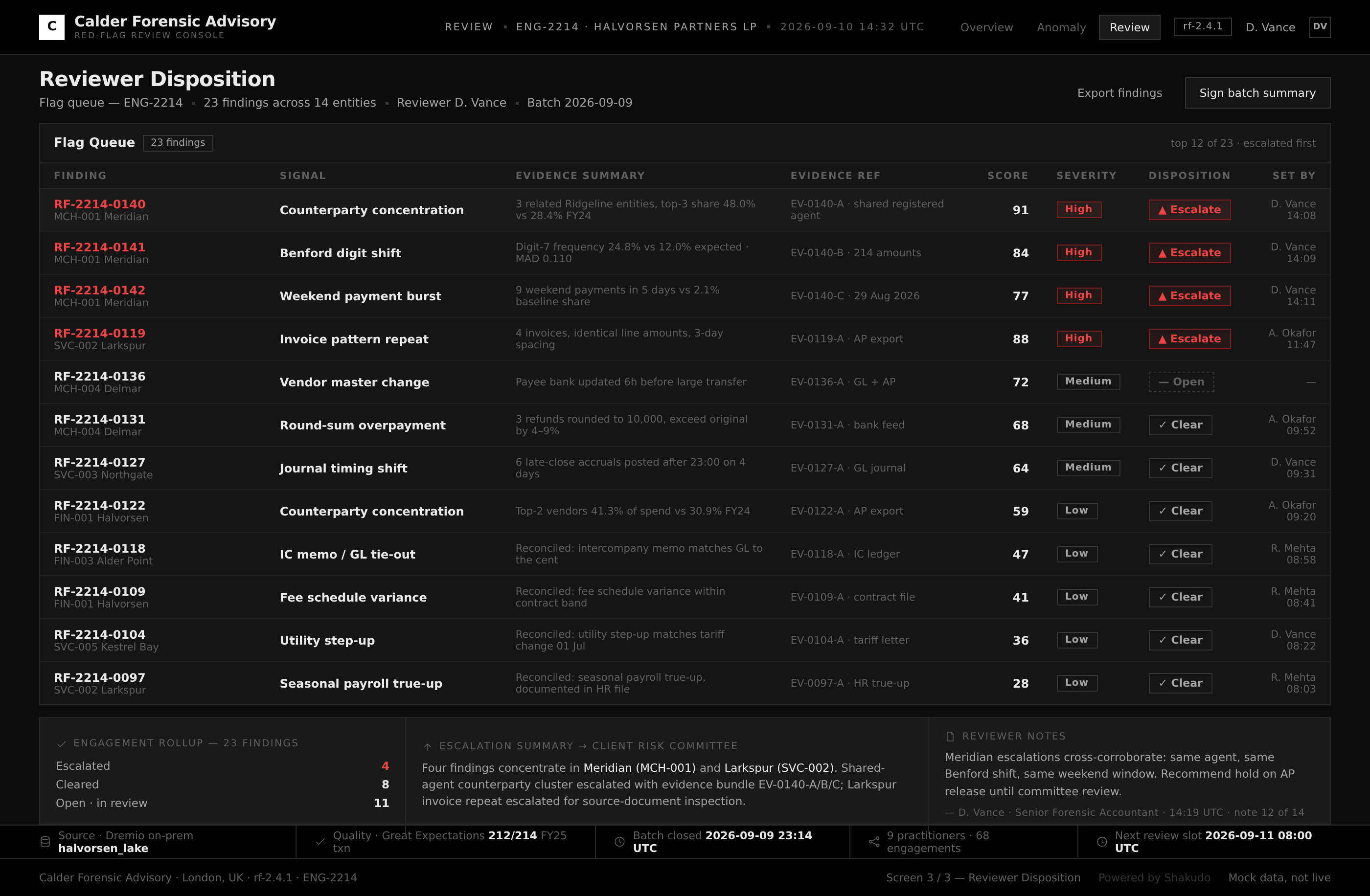
1–2 / 3
Every company accumulates data that quietly hides problems. Financial records, operational logs, vendor files, and compliance documents all carry signals that a single analyst can never check by hand. Errors, fraud, and compliance gaps often sit in that data for months before anyone notices. When they surface, they surface as losses, fines, or outages.
Traditional checks are manual. Analysts sample the data, set fixed threshold rules, and work through the alerts that come back. Subtle patterns get missed. A figure that looks normal on its own can be part of a combination of signals that together point to a real risk. Building an anomaly detection system in-house typically takes six to twelve months. AI red-flag detection exists to find those patterns before they cost the company money.
Shakudo deploys an AI system that scans financial records, operational logs, and vendor files continuously. The AI models detect subtle anomalies across multiple dimensions, so the system catches combinations of signals that each look normal in isolation. Every finding arrives with a risk score and a priority, so the risk team works on the issues that matter first. Risks get flagged before they escalate into unexpected financial losses, compliance breaches, or operational disruptions. A system that takes a data team six to twelve months to build in-house is operational in weeks. The company protects shareholder value, holds regulatory compliance, and keeps business continuity intact without standing up a custom detection pipeline.
Because the AI runs entirely on the company's own infrastructure, it can read the financial records, vendor files, and operational data that the business cannot hand to a cloud AI vendor. That is what makes this detection possible in the first place. Sensitive corporate data often cannot leave the environment, and most cloud risk tools require it to. Sovereign AI on the company's own infrastructure closes that gap. The platform stays on the customer's infrastructure, so the AI is fully owned and controlled from model to memory, and the detection keeps working as new data sources come online.
Risk, compliance, and internal audit teams at financial services firms and other data-heavy organizations that need to monitor large volumes of corporate data for hidden problems. A strong fit for teams whose data cannot leave the company's own environment and who want detection coverage that outpaces manual review.
A red flag is a pattern that looks normal to a human but is abnormal to a model. An unusual vendor payment amount, a shift in the timing of operational events, a record that breaks a historical pattern. The PyTorch models detect these across multiple dimensions, so a single odd value becomes a finding when the signals combine.
Evidently watches for model performance drops and data drift, so the team sees the moment detection quality changes. Great Expectations validates data quality at every stage of the pipeline, and W&B tracks each model iteration so the team can compare versions. New data sources and updated detection algorithms roll in as the business evolves.
An in-house build of a comprehensive anomaly detection system typically takes six to twelve months. With Shakudo, the system is operational in weeks, so the company gets detection coverage at the start of the project, a year earlier than a custom build delivers.
For risk management, that means a hidden anomaly that used to surface as a loss now surfaces as a flagged record in time to act. Book a demo and see AI anomaly detection scan the data the company already holds.
Shakudo delivers a powerful solution for identifying subtle yet significant anomalies in vast corporate datasets. By leveraging sophisticated machine learning algorithms, this platform automatically scans financial records, operational data, and compliance documents to detect potential red flags. Shakudo's unique approach enables organizations to proactively address risks before they escalate into major issues.










"What drew me in is simple. When developers ship production-ready code this quickly, how can I have environments spun up fast enough? Shakudo is how we close that gap."



"Shakudo does not just provide the platform. It is a real partnership. They are always there to help and execute our vision faster and the right way. It is like a co-team working together to achieve our goals."