






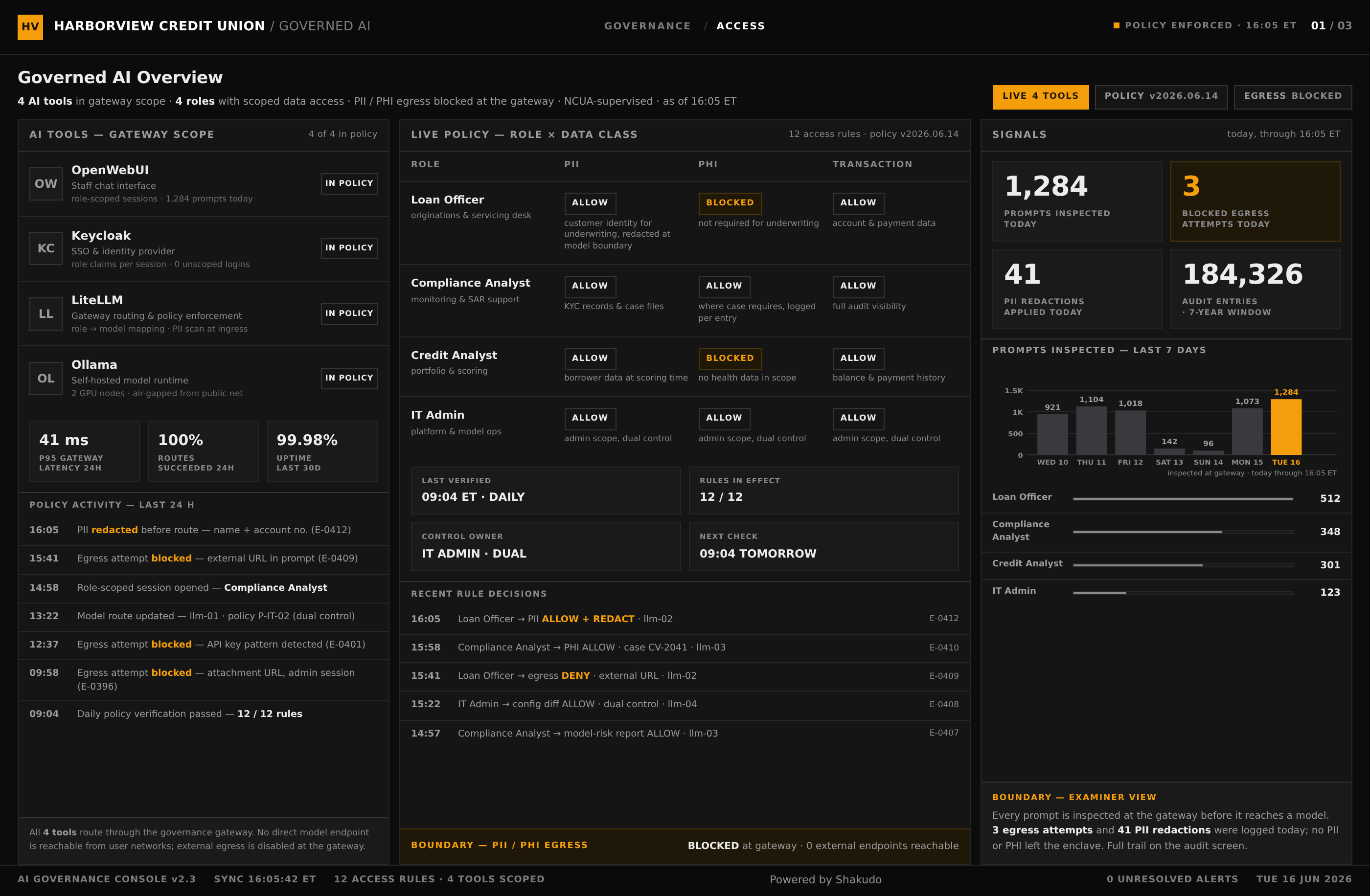
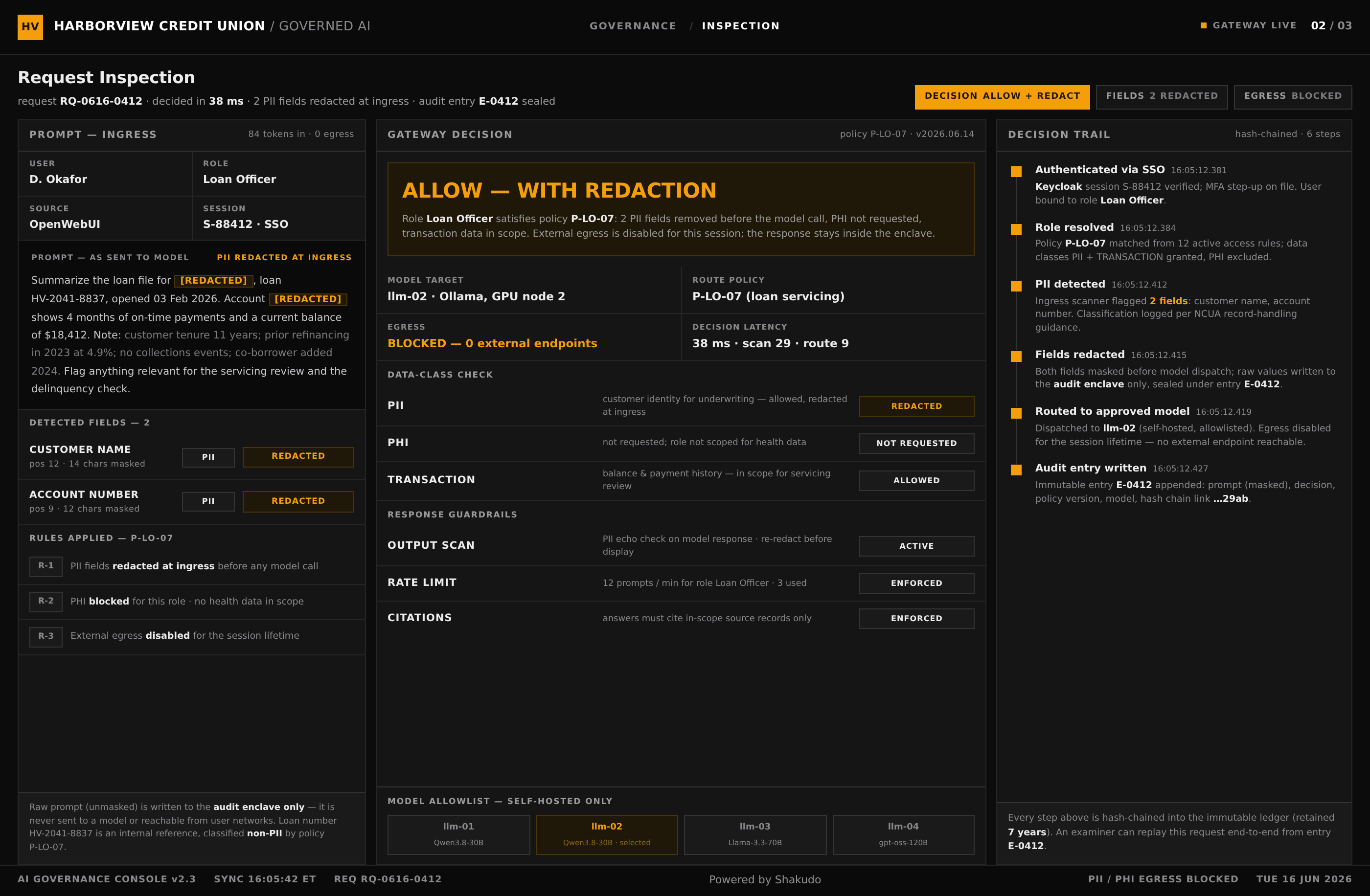
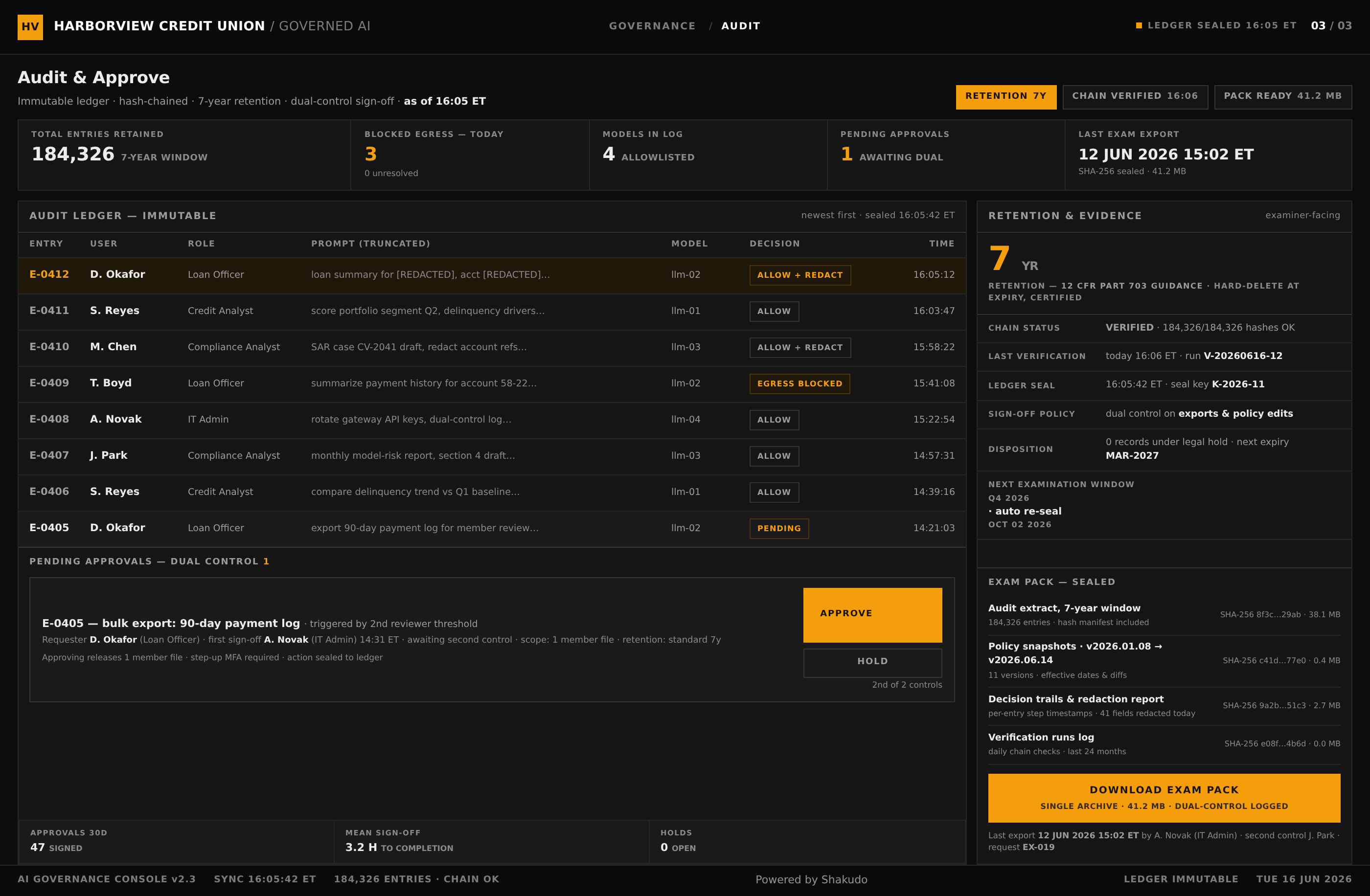
Three screens from a live governed-AI run at a credit union: the access overview, the gateway inspection, and the exam-ready audit log.
1–2 / 3
Staff are already using AI. A loan officer summarizes a credit application in ChatGPT. A compliance analyst drafts a board memo in Claude. Each prompt that carries a customer name, an account number, or a health record leaves the firm's boundary and lands under a third party's terms. For a regulated institution, that is not a productivity question. It is a data egress event, and the firm cannot see it, stop it, or show an examiner that it controlled it.
Governed enterprise AI access closes that gap. A single internal interface connects to every model through one governance layer that authenticates the user, applies the access rule, inspects the data, and logs the interaction, all inside the firm own infrastructure. Staff get the AI they use today. The firm gets the evidence a regulator expects. This is the AI risk management framework a regulated firm needs, operationalized as a control that runs on every request instead of a document that is written once a year.
Shakudo deploys a governed AI hub inside the customer's environment. OpenWebUI is the interface staff use, a familiar chat and document workspace where prompts, files, and conversation history live. Keycloak provides single sign-on and the role definitions that drive access. LiteLLM runs as the gateway engine, the layer that authenticates each request, enforces the role-based access policy, inspects prompts and responses for sensitive data, and routes the request to the approved model. PostgreSQL stores the immutable audit log. Redis holds session and rate state. Ollama runs the open-source models on the firm's own hardware. The result is one access policy across every model, one audit trail an examiner can read, and no regulated data leaving the boundary. The staff experience stays simple. The compliance evidence is produced on every interaction.
The deployment has three layers, and the governance layer is the one that carries the control. OpenWebUI presents the interface and hands each request to the gateway. The gateway authenticates the user against Keycloak, looks up the role, and applies the access rule for that role. It inspects the prompt for PII and PHI patterns, blocks or redacts what is not permitted for that role, and records the decision. It routes the request to the approved model through Ollama or a private endpoint, inspects the response the same way, and writes the full record to PostgreSQL: user, role, prompt, response, model, and timestamp. Nothing in the path sends regulated data to a public model. Because the models run on the firm's hardware and the gateway enforces the boundary on every request, the access policy, the data boundary, and the audit trail hold together as one system.
IT and compliance leaders at credit unions, regional banks, insurance companies, and other regulated financial institutions that want staff to use AI without losing control of the data. The fit is strongest where the institution handles PII or PHI, answers to an NCUA or state exam, and needs the AI evidence to exist as part of normal operation rather than as a pre-exam assembly. The system runs on the firm own infrastructure, so the data stays inside the boundary the regulator requires.
The interface looks and works like the tools staff already use. They type a prompt, upload a document, and get a response, the same way. The difference is that the request passes through a gateway that enforces the access rule and logs the interaction before it reaches a model. The convenience stays, and the control is added at a layer staff never have to think about.
Every interaction is logged with the user, the role, the prompt, the response, the model, and the timestamp. The log is written to PostgreSQL and retained to the institution's schedule, which for a credit union is typically seven years for transaction records. An examiner can pull any period and see exactly who did what, with which model, and what the access decision was.
No. The gateway routes to whichever models the firm approves, open or closed. The access policy, the data inspection, and the audit trail apply to the request and the response, not to a specific model. A firm can run open-source models on its own hardware through Ollama and route other workloads to a private endpoint, with the same control in front of both.
Shakudo brings the full stack, from the interface to the gateway to the local model runtime, up and running in days. The identity provider, the access policy, the audit log, and the first working model arrive as one governed system, so the firm is not assembling it from parts over a quarter. The first governed interaction is live in the same week the deployment lands.
When the goal is governed AI access that survives an NCUA or state exam, a conversation with Shakudo is the fastest way to see it on your own data. The deployment runs on the firm own infrastructure, a first governed interaction is live within days, and the audit trail starts accumulating from day one. Book a demo to see the governed hub run on a sample of your data.
Shakudo gives regulated teams a single governed path to AI. One interface, one access policy, and one audit trail across every model and agent, all inside the firm own infrastructure.










"What drew me in is simple. When developers ship production-ready code this quickly, how can I have environments spun up fast enough? Shakudo is how we close that gap."



"Shakudo does not just provide the platform. It is a real partnership. They are always there to help and execute our vision faster and the right way. It is like a co-team working together to achieve our goals."