






Three screens from a live retention cycle: the at-risk board, the driver analysis, and the save-offer approval.
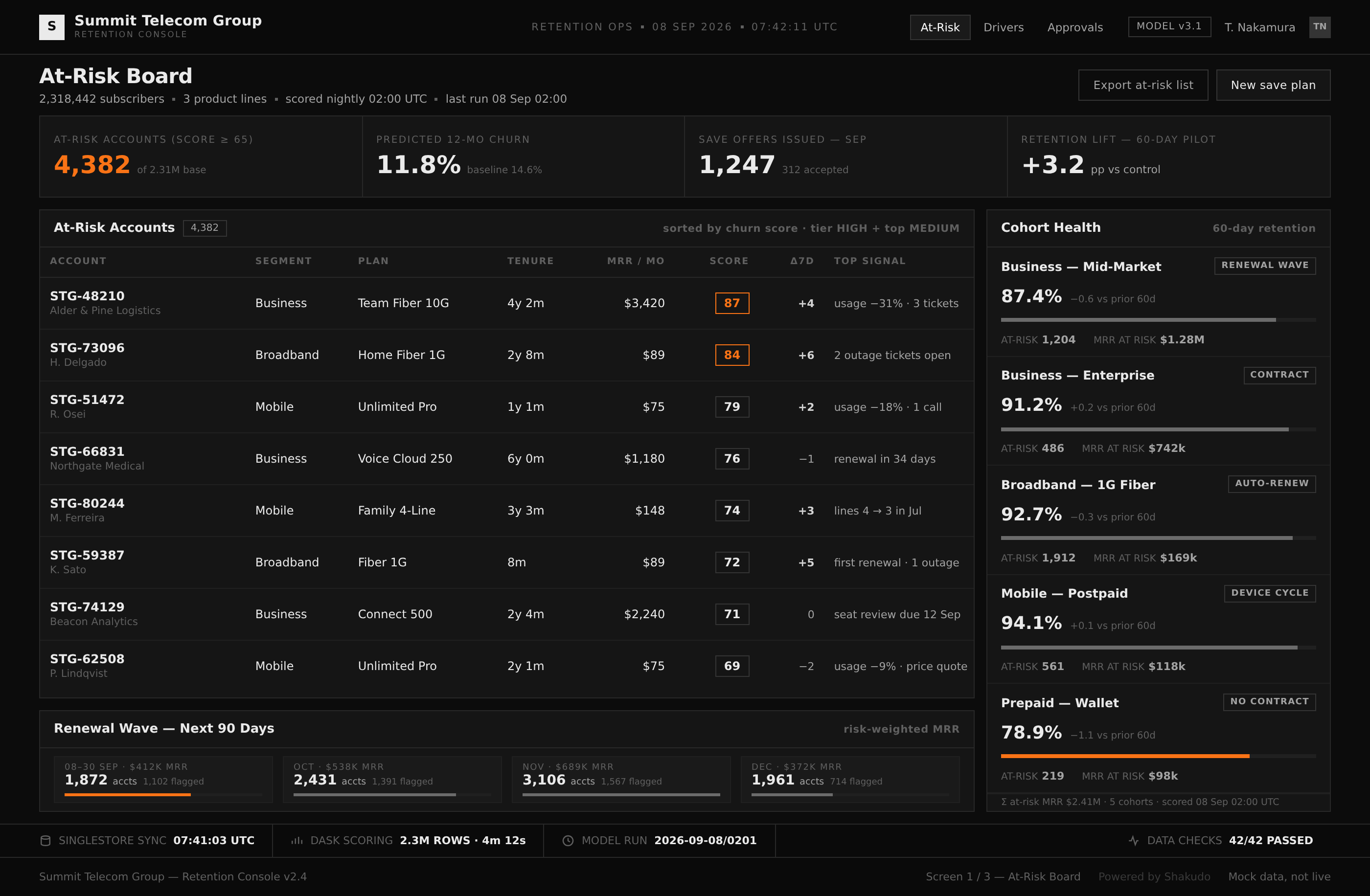
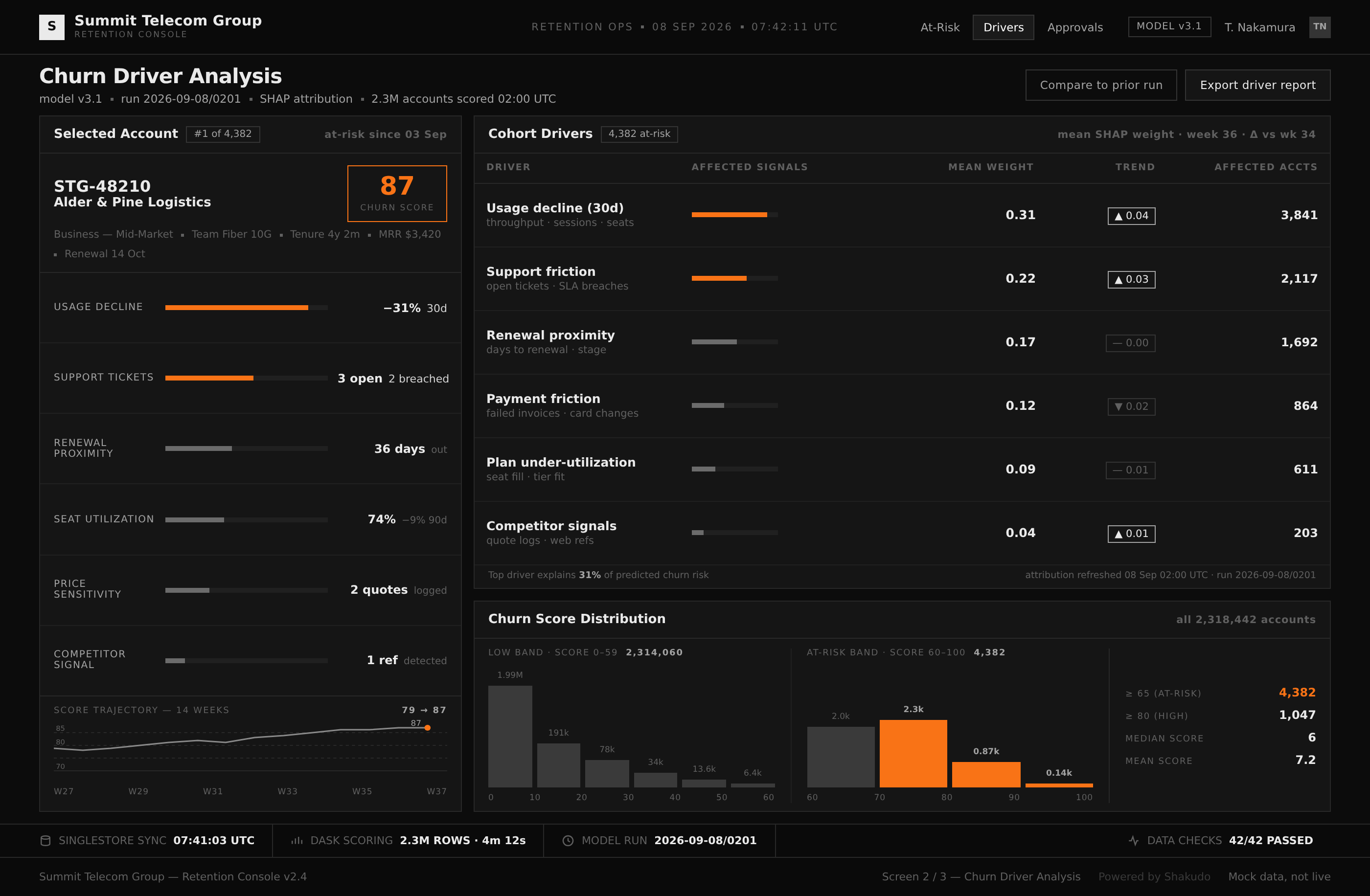
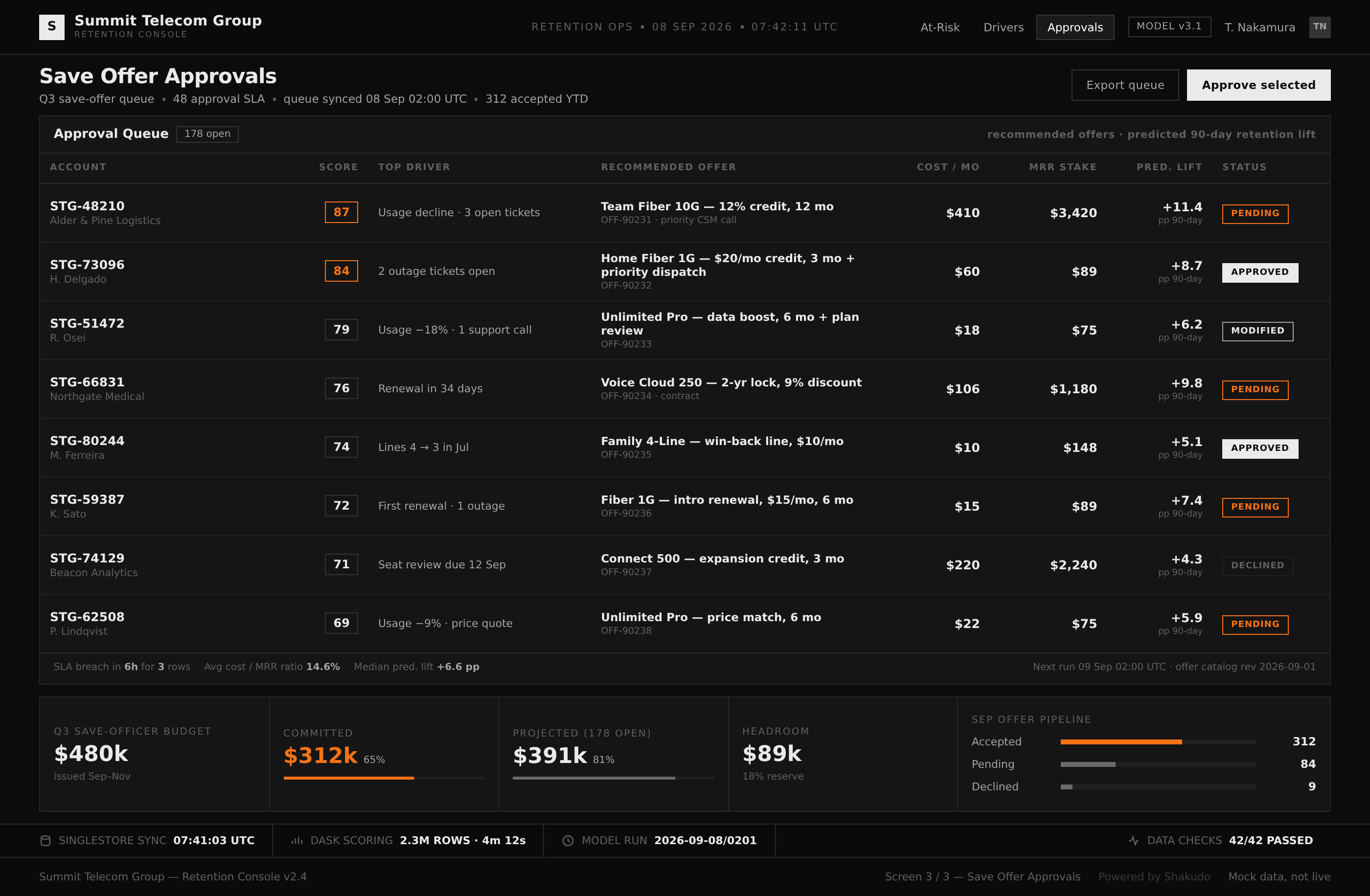
1–2 / 3
Customer churn is the quiet tax on a growing business. Every account that leaves takes its revenue with it, and the cost of winning a replacement runs several times the cost of keeping the one that was there. The at-risk signal usually shows up late. Usage drops for a few weeks, the support tickets go quiet, the renewal date gets close, and by then the account is already deciding. Churn prediction exists to move that signal earlier, so the team acts while the account can still be saved.
A retention model that works needs the full picture. It needs usage data, support tickets, billing history, and account health, together with the small changes that no single metric catches on its own. Building that system in-house typically takes 4 to 6 months of data engineering and modeling work. A predictive retention stack on Shakudo deploys in days. The first at-risk list is live in the same week, before the next renewal wave arrives.
Shakudo deploys an AI retention system that scores every account for churn risk. The model reads usage trends, support activity, and billing history together, and it ranks the accounts by how likely they are to leave. The sales and customer success teams get an at-risk list that refreshes on a schedule the business sets, with the signals behind each score. Retention outreach moves from a gut check at the renewal date to a plan that starts weeks earlier. The accounts that need a call get the call, and the team stops spending retention effort on accounts that were safe all along. Customer lifetime value rises as a direct result, because the saves that were possible actually happen.
The system runs in the customer's own environment, so the usage, support, and billing data never leaves it. That matters for a retention model, because the most predictive signals are the internal ones a public AI vendor would never see. Dask processes the full customer dataset in a distributed fashion, so the model scores every account even as the base grows. PyTorch trains the deep learning models that find the churn patterns in that data. Great Expectations validates the data quality at each stage, so a bad feed never poisons a score. MLflow manages the model lifecycle from training to production, and the retraining runs on a schedule the team sets. Metabase turns the scores into the retention dashboards the whole team reads. SingleStore keeps the scores queryable in real time, so the at-risk list is current the moment a call starts.
Revenue, sales, and customer success teams at subscription and SaaS businesses where churn directly moves the bottom line. It fits the operations leaders who need a retention KPI they can act on weekly, the CSMs who want an early list before the renewal surprise, and the data team that owns the models in-house. The stack suits a business with a real usage and billing history behind it, because the model learns from that history and gets sharper with every score.
It is a three-step loop. First, the model scores every account for churn risk from the usage, support, and billing data. Second, the at-risk list goes to the owner of each account, with the signals behind the score, so the outreach is specific. Third, the team tracks what the intervention changed, and the model learns from the outcome. The insights are used in the weekly workflow, where they change the call the CSM makes, and the loop tightens with every cycle.
Churn risk moves. An account that was safe in May can drift in June as the usage drops or the support friction builds. A list that only refreshes at the renewal date is already stale by the time the team reads it. The system re-scores on a schedule the business sets, and the refresh is fast because the pipeline is in place. The team works from a list that reflects this week, which is when the save is still possible.
Building a custom predictive retention system typically takes 4 to 6 months of engineering and modeling. On Shakudo, the same stack deploys in days, and the first at-risk list is live in the same week. The model starts on the customer's own usage and billing history, so the scores reflect the accounts actually in the book from day one.
For revenue teams, that means the at-risk account gets a call weeks before the renewal, with the reason for the risk already in hand. Book a demo and see predictive retention move the save to before the account is at risk.
Shakudo revolutionizes customer retention by leveraging advanced predictive analytics. This solution empowers organizations to identify at-risk customers, personalize retention strategies, and maximize lifetime value through a seamless, scalable AI-driven approach.










"What drew me in is simple. When developers ship production-ready code this quickly, how can I have environments spun up fast enough? Shakudo is how we close that gap."



"Shakudo does not just provide the platform. It is a real partnership. They are always there to help and execute our vision faster and the right way. It is like a co-team working together to achieve our goals."