






Three screens from a live run: the media mix overview, a channel drill-down, and budget reallocation.
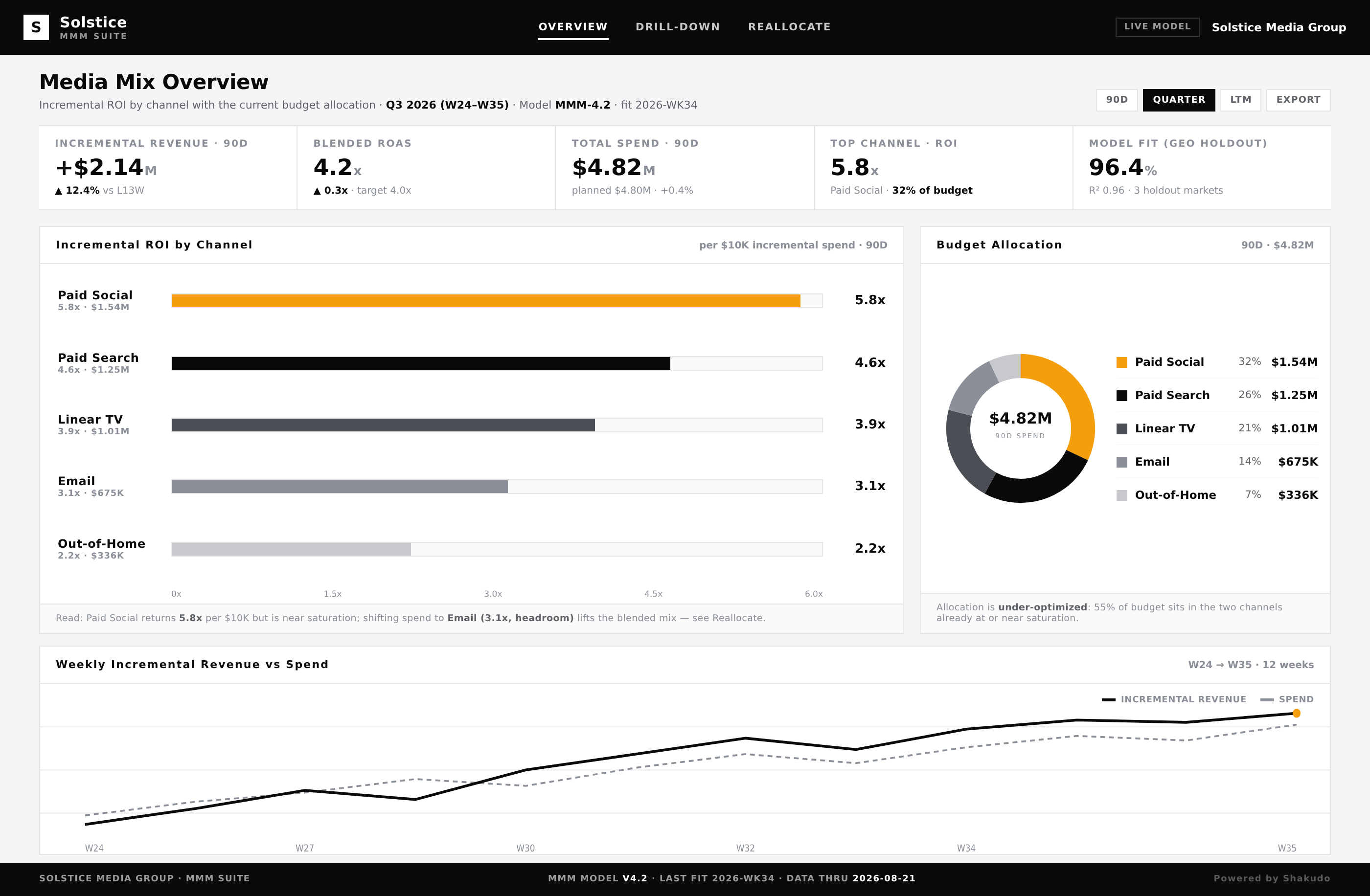
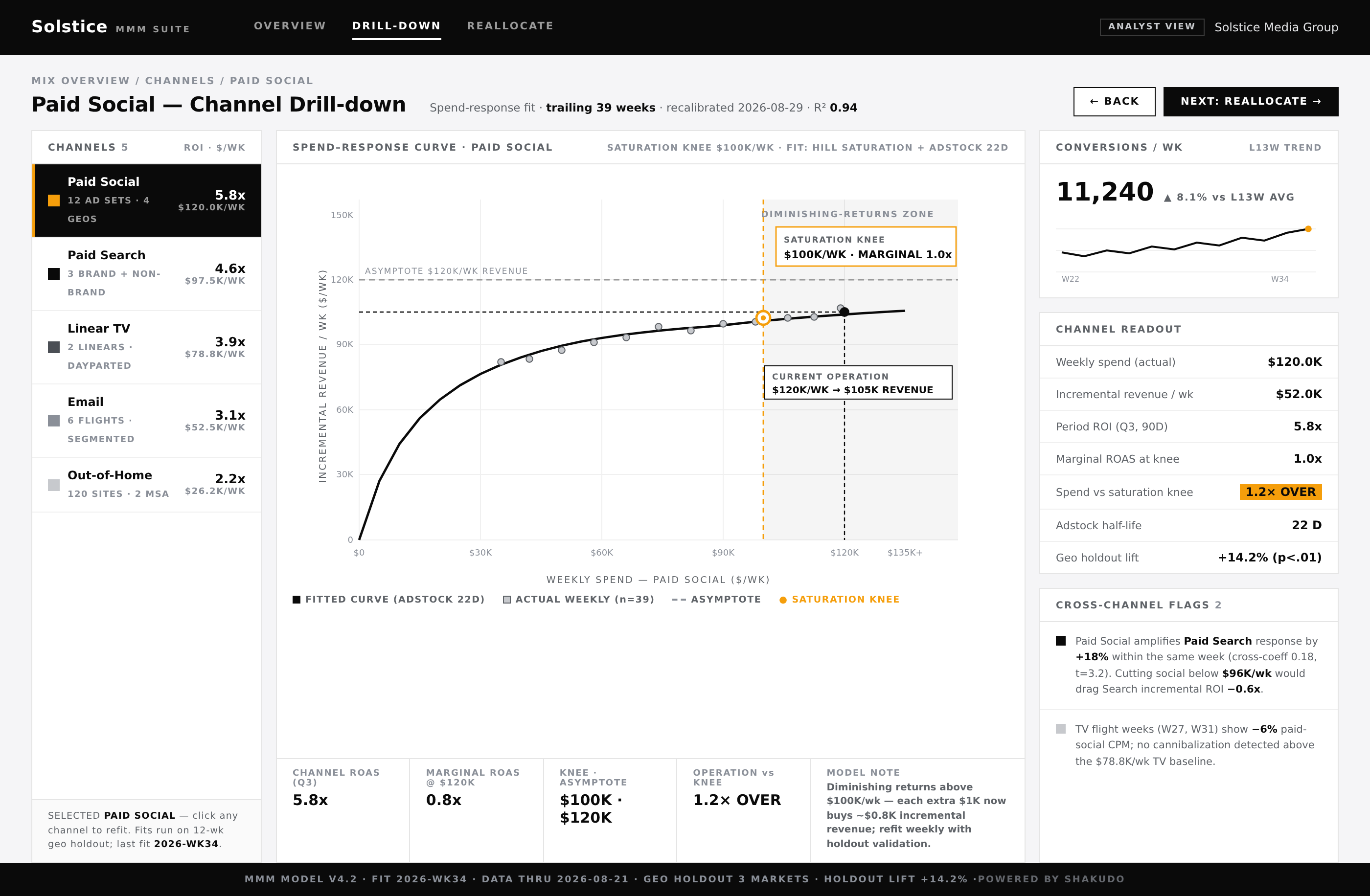
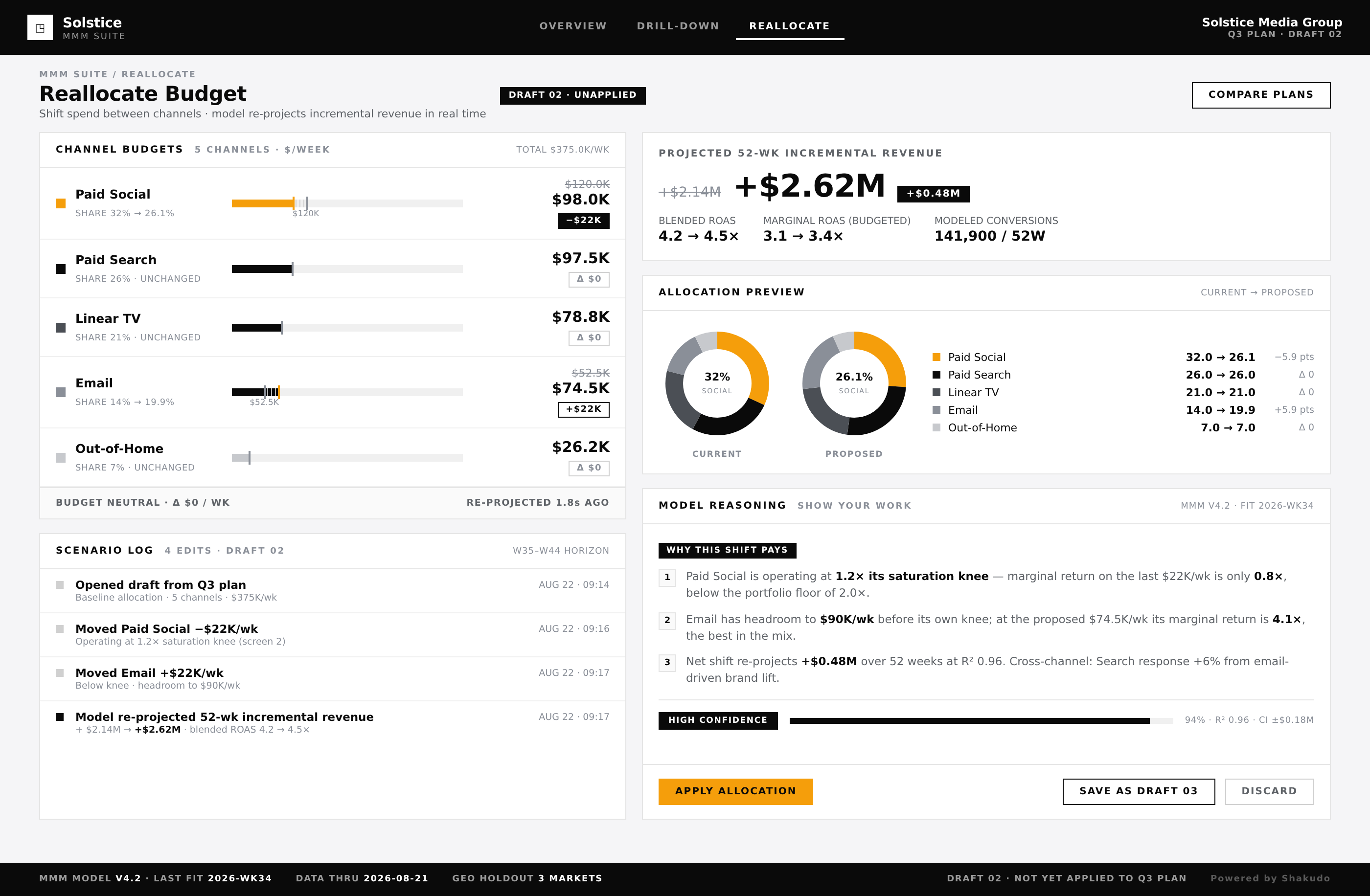
1–2 / 3
A marketing budget spread across paid search, paid social, email, content, and video is a hard thing to read. Each channel reports its own numbers, and each one makes a claim on the next quarter's budget. The team that wins the budget meeting is the one that can say which channel actually drove the revenue, and how much more it would have driven with more spend. That answer comes from a media mix model, and the model has to be built on the business's own data to mean anything.
Media mix modeling is a data problem with a long setup. It needs months of channel spend, conversion, and revenue data joined together, and it needs a model that can separate the channels' effects from each other. Building that system from scratch takes weeks or even months of analytics work. A dedicated media mix modeling stack on Shakudo deploys almost instantly, and the first channel-level read is available the same week.
Shakudo deploys a media mix modeling system that attributes revenue to the channels the marketing team actually runs. The model measures each channel's contribution to the revenue and to the customer it brings, and it estimates how that contribution changes as the spend moves. The budget meeting gets a number it can use. The team sees which channels are earning their share and which are not, and it can reallocate the spend toward the channels the model says will return more. Campaign performance improves as the budget follows the data, and the marketing ROI the team reports is one the model can stand behind.
The model runs on the company's own data, in the environment the company controls. Dask processes the full historical dataset in a distributed fashion, so months of channel spend and conversion data fit in one model run. XGBoost trains the predictive models that separate each channel's effect from the others and estimate the revenue each one drives. Cube.js provides the analytics layer that joins the spend, conversion, and revenue data into the queries the model and the dashboards read. MLflow tracks every experiment, so the team can see which model version is live and what it scored. Metabase turns the results into the dashboards the budget meeting reads. Windmill orchestrates the workflow, from the data in to the recommendation out. The model re-runs as new data lands, so the channel read tracks the current market.
Marketing and growth teams at multi-channel businesses that run paid and owned channels at a scale where the budget allocation is a real decision. It fits the marketing leader who has to defend the next quarter's budget with a number, the growth team that wants to know which channel to fund next, and the analytics team that owns the models in-house. The stack suits a business with several months of channel spend and conversion history behind it, because the model learns from that history and the attribution gets sharper with every month it covers.
It is the practice of using a model to measure how each marketing channel contributes to revenue, and to estimate how that contribution changes as the spend moves. The model is built on the business's own spend, conversion, and revenue data. The output is a channel-level read that tells the team where the next dollar of budget returns the most, and the team reallocates the budget toward the channels that earn their share. The budget follows the model's estimate, with the channel-level reasoning in hand for the budget meeting.
The model runs in the company's own environment, which is the part that makes the attribution honest. The data stays where the company keeps it, and the model is built on the spend and conversion history that only the company holds. Shakudo deploys the full stack in days, so the team gets the working model without a months-long build. The team keeps ownership of the model and the data it runs on, and it re-runs as new channel data lands.
Traditionally, setting up a comprehensive media mix system takes weeks or even months of analytics work. On Shakudo, the stack deploys almost instantly, and the first channel-level read is available the same week. The model starts on the history the team already has, and the attribution sharpens as each new month of spend and conversion data lands in the pipeline.
For marketing teams, that means the budget meeting gets a channel-level number it can defend, and the next quarter's spend follows the data. Book a demo and see media mix modeling put a number on every channel in the budget.
Shakudo revolutionizes marketing strategies by enabling sophisticated media mix modeling and optimization. This solution integrates advanced analytics tools to accurately measure and predict the impact of various marketing channels on business outcomes. By providing a scalable platform for deploying and managing these complex models, Shakudo empowers organizations to allocate marketing budgets more effectively, optimize campaign performance, and achieve higher returns on marketing investments.










"What drew me in is simple. When developers ship production-ready code this quickly, how can I have environments spun up fast enough? Shakudo is how we close that gap."



"Shakudo does not just provide the platform. It is a real partnership. They are always there to help and execute our vision faster and the right way. It is like a co-team working together to achieve our goals."