







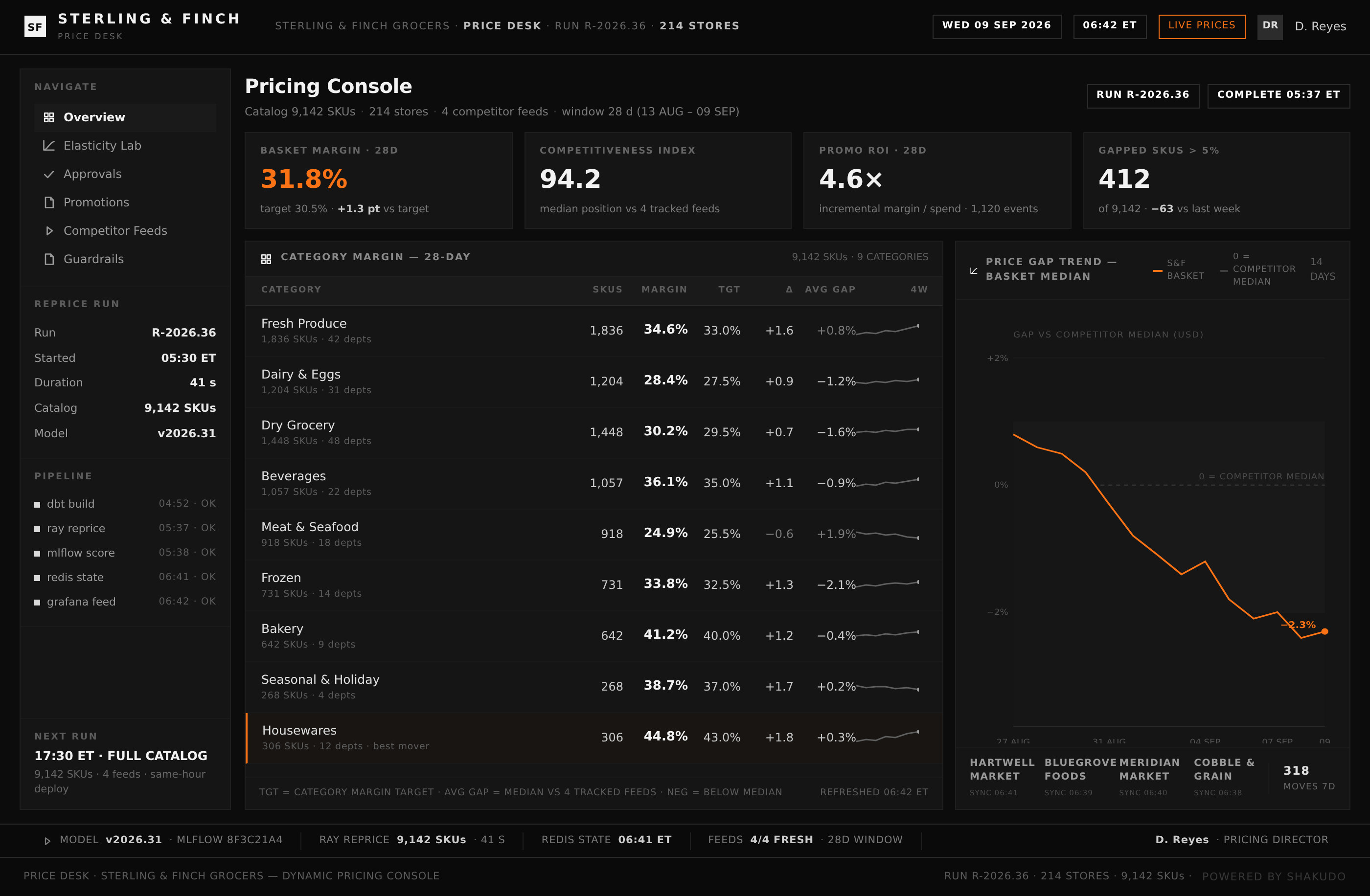
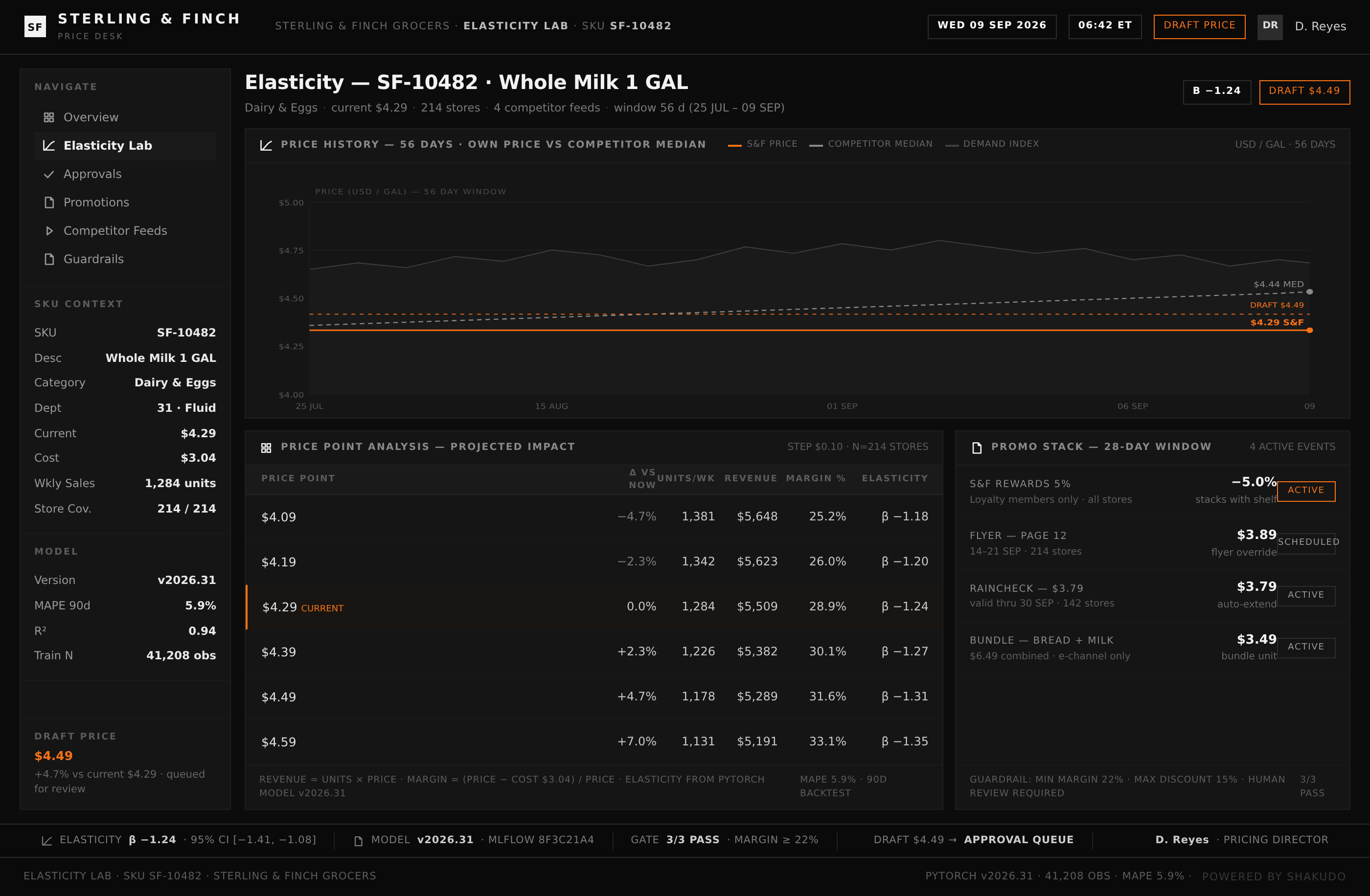
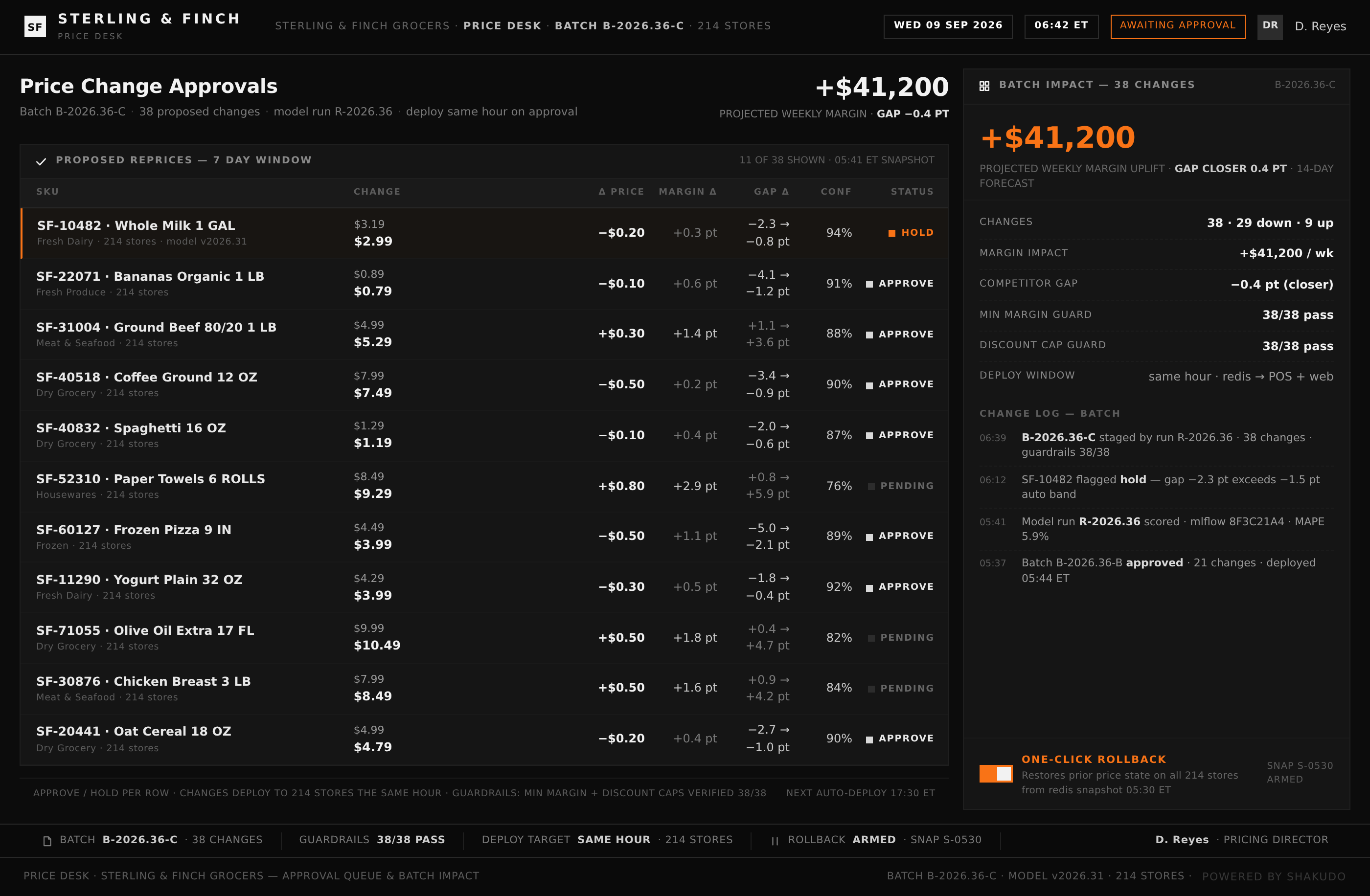
Three screens from a live pricing review: the console, the elasticity analysis, and the change approval.
1–2 / 3
Price set too high and the demand that should move a product stalls. Price set too low and the margin that funds the rest of the business quietly gives up. Retailers manage price across thousands of products, dozens of channels, and competitors who change their own prices several times a day. Manual price review cannot keep up with that pace. The teams that win do it with a pricing model that reads the same demand and competitor signals the market is giving right now, and updates price on the back of them.
Dynamic pricing at retail scale is a data and compute problem. It needs sales history, inventory position, and competitor price feeds joined into a model that can recompute across the catalog and ship the new prices before the signal fades. Building that pipeline and the governance around it from scratch takes a retail data team months. A dedicated AI pricing stack shortens that build to a fraction of the time, and the model runs where the retailer's own sales data belongs.
Shakudo deploys an AI pricing system that finds the price point that balances demand and margin for each product. The model reads sales history, inventory position, and competitor pricing, and proposes price adjustments across the catalog. Retailers move from a monthly price review to a continuous one. The margin that the old static prices left on the table comes back, and the products that were overpriced start moving. The pricing team keeps the final call, and the model works in the guardrails they set.
The stack runs on the retailer's own environment, where the sales and inventory data stays. dbt cleans and joins the sales, inventory, and competitor price sources into the tables the model reads. Ray scales the computation across the full catalog, so a reprice passes over every product in one run. PyTorch trains the AI models that estimate how price moves demand for each product. MLflow tracks each model run, so the pricing team can see which version is live and what it scored. Grafana shows the price and margin movement in real time. Redis holds the current price state and serves the updates fast, so a new price reaches the channel the same hour it is approved.
Retailers and e-commerce operators who run a wide catalog, face active competitor pricing, and want dynamic pricing with the governance to match. It suits pricing teams, category managers, and revenue leaders who need the model to hold inside a set of rules, minimum margins, discount caps, and a review step, and who want the price to move on the market's signal.
The model works inside rules the pricing team sets. Minimum margins, maximum discount caps, and a human review step before a price moves. The governance lives in the pipeline, so a price that breaks a rule never reaches the channel. Grafana keeps a running view of every price change, so the team can audit what the model did and why. The human keeps the final decision.
The same hour the adjustment is approved. Ray recomputes the catalog, PyTorch estimates the demand response, and Redis serves the new price to the channel the same hour. The model runs on a schedule the retailer sets, and each run covers the full catalog, so the price tracks the demand and competitor signal across the whole range.
No. The model proposes the price and the reason for it, and the team approves it inside the guardrails they set. MLflow keeps a record of each model run and its score, so the team can see what the model learned and when to override it. The human judgment stays in the loop for every move that matters.
For retail, that means a price that moves with the market's own signal across the whole catalog. Book a demo and see AI pricing find the price point that holds the margin and moves the demand.
Shakudo revolutionizes retail pricing strategies by leveraging advanced AI and data analytics. This solution enables real-time price adjustments, competitive analysis, and demand forecasting, allowing retailers to maximize profits and stay ahead in a rapidly changing market landscape.










"What drew me in is simple. When developers ship production-ready code this quickly, how can I have environments spun up fast enough? Shakudo is how we close that gap."



"Shakudo does not just provide the platform. It is a real partnership. They are always there to help and execute our vision faster and the right way. It is like a co-team working together to achieve our goals."