






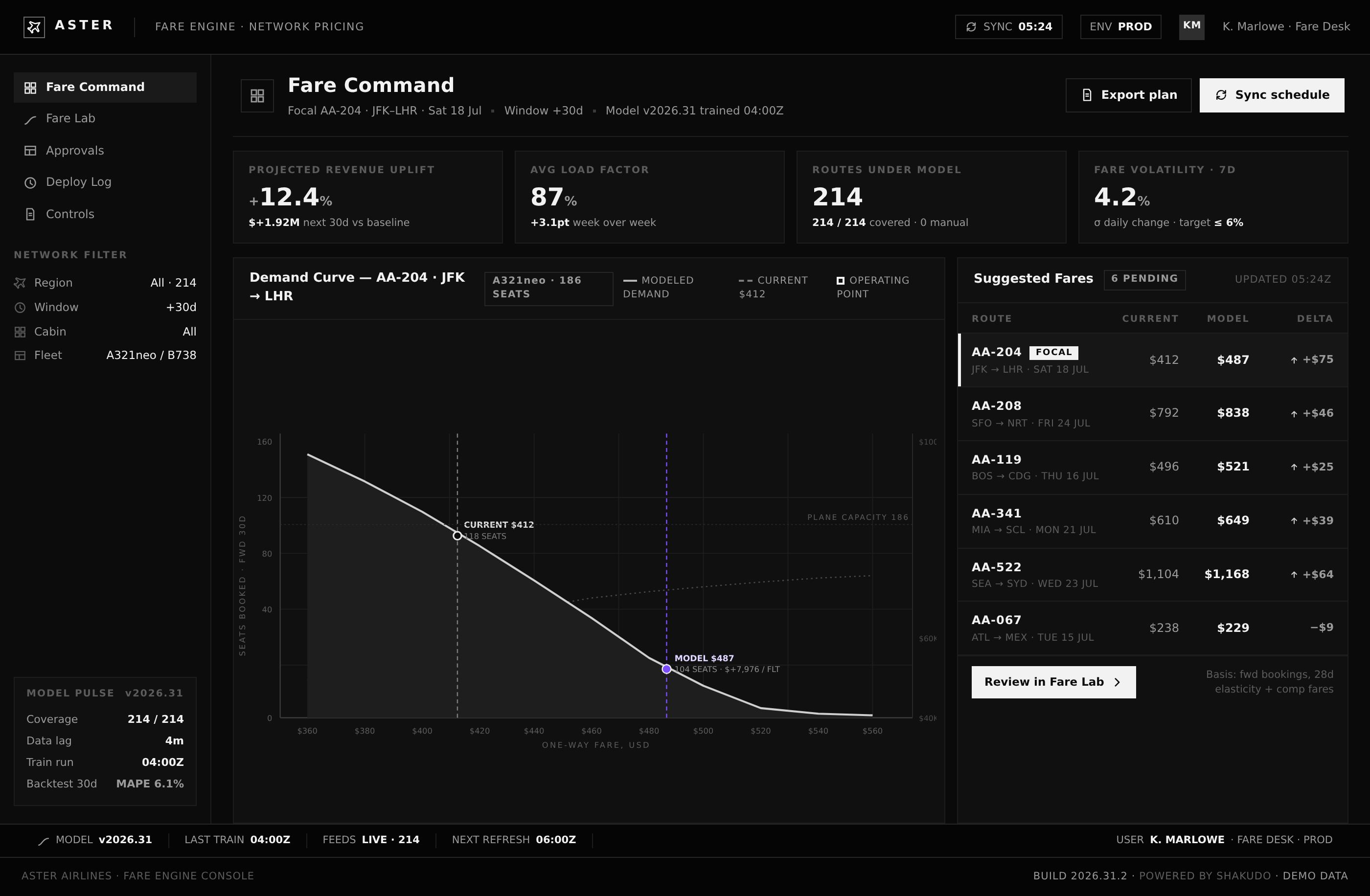
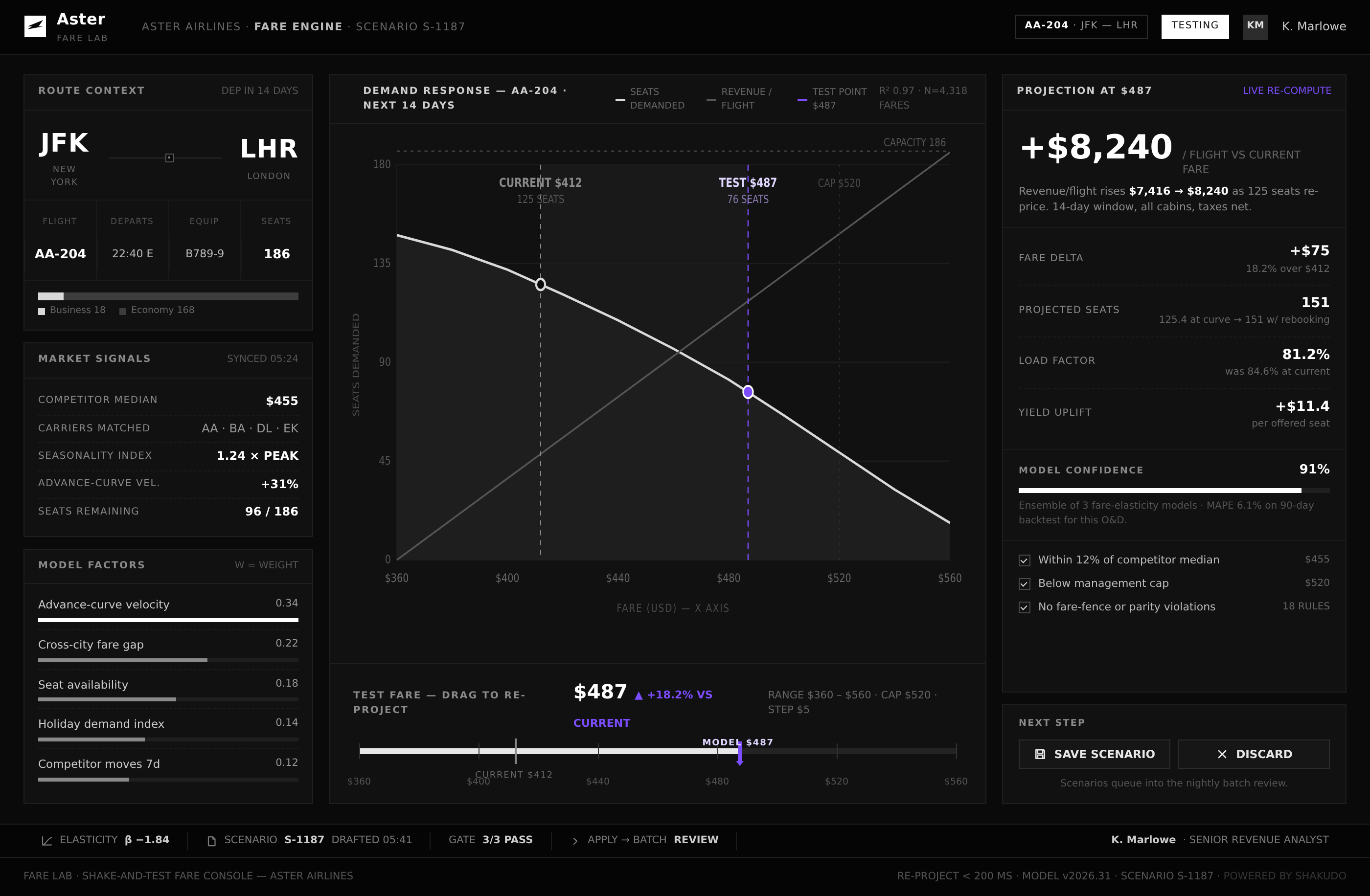
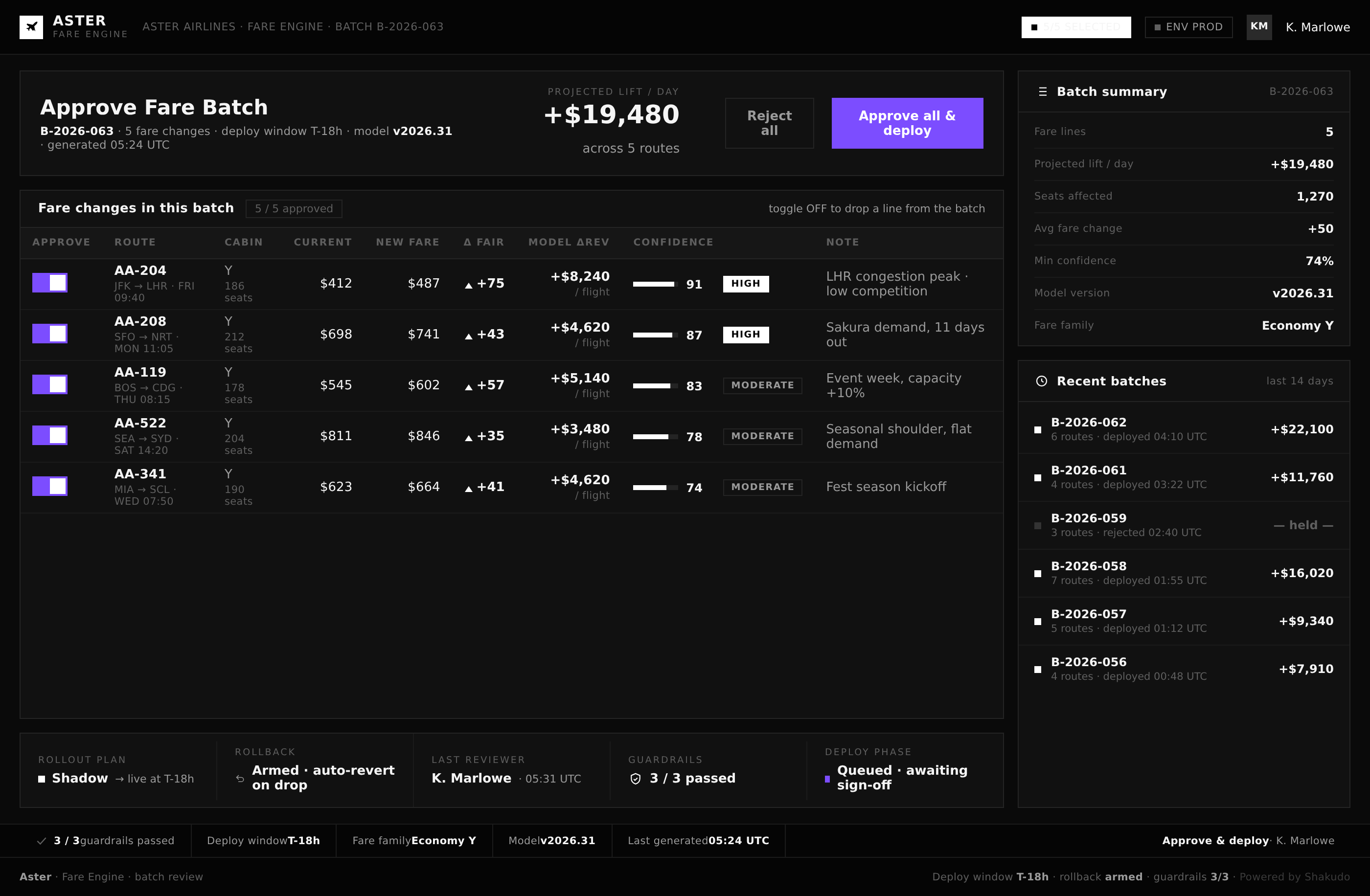
Three screens from a live run: the fare command, an in-flight fare adjustment, and the batch approval.
1–2 / 3
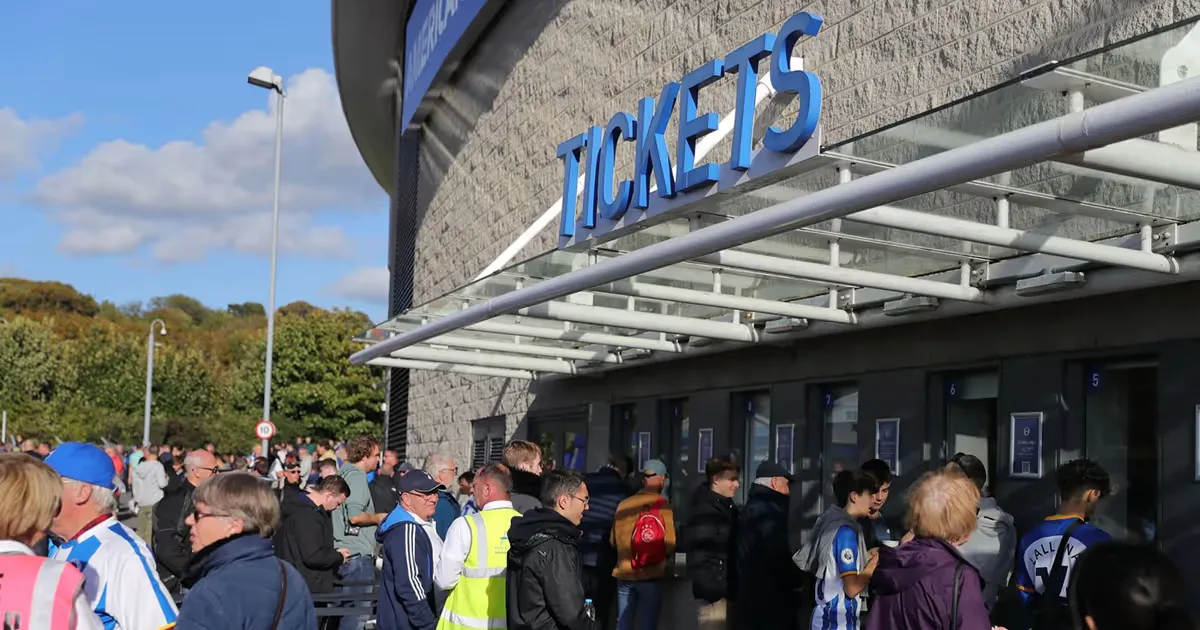
Every event sells differently. A home opener and a midseason matchup have different demand, different ticket velocity, different price ceilings, and a single static price cannot capture any of it. A dynamic demand model prices each tier from the actual demand signal, retrained as the season unfolds, and runs inside the customer's environment where the ticketing data lives.
Static pricing sets one price per tier and changes it slowly, on a manual calendar. High-demand events underprice and leave seats on the table, low-demand events overprice and push fans to secondary markets, and pricing decisions lean on last season's results and gut feel. There is no way to test a pricing strategy against last year's data before committing, and when a price does change, the pricing team cannot say which signal drove it.
A demand model turns ticketing history into a forecast. Before on-sale, it estimates demand for each event, tier, and time window: event ticket demand forecasting grounded in the operator's own sales data, comparable events, and market signals. The forecast feeds a recommended price band for every tier, and the strategy is checked against guardrails before it runs.
The guardrails matter as much as the model. Price floors and ceilings, league and venue policies, limits on how fast a price can move, and a human approval step before any strategy goes live. When the strategy runs, every price change is logged with the signal that drove it, so the pricing team can explain any price to a fan, a board, or a league office.
Shakudo builds the demand model inside the customer's environment.
The same demand-modeling pattern carries to other pricing problems, such as property valuation, where models retrain as markets shift. At every step, the ticketing data never leaves the customer's environment.
A dynamic demand model fits the operators where pricing volume makes the manual work unmanageable: a major venue operator running a full season, an event series organizer with dozens of dates and cities, or a ticketing company that wants the pricing engine to run on the customer's own infrastructure. The system is buildable infrastructure: the team extends it to new event types, new markets, and new data sources as the portfolio grows, and the platform keeps running after the engagement ends.
Several major platforms run AI pricing programs, including Ticketmaster and Live Nation, Vivenu, SeatGeekIQ, Kiwi Navi, Spektrix, RightsHelper, and Turnit. Most offer it as a SaaS module, where the ticketing data is sent to a third party. A different category is an in-environment demand model: the forecast runs on the operator's own infrastructure, and the pricing data stays where the ticketing system already lives.
Dynamic ticket pricing software adjusts prices from a live demand forecast instead of a fixed schedule. A demand model estimates how many fans will buy at what price for each event and tier, recommends price bands within guardrails, and applies the changes on an approved cadence. The software is the pipeline that connects the forecast to the box office, with a log of every price change.
The forecast trains on the operator's own history: past sell-through by event, tier, and day before the event, plus comparable events and market signals. A model trained on that data can estimate on-sale velocity weeks in advance, which sets the starting price band and the reprice triggers for the on-sale window.
Yes. Price changes can run automatically within configured guardrails: floors and ceilings, a maximum change per reprice window, and pause conditions for sensitive dates. A human approves the strategy and the guardrail set before automation starts, and every automated change is logged with the signal that drove it.
The model can replay last season's demand under a new pricing strategy and estimate the revenue difference before anything goes live. That what-if step is where guardrails get tuned: the pricing team sees the fan-facing impact of a strategy on the events where it would hurt, and adjusts before on-sale.
When the question is how a venue, a series, or a ticketing platform should price a season, a conversation with Shakudo is the fastest way to see what the demand model would look like on the operator's own data.
Shakudo's AI-powered ticket pricing optimization solution transforms revenue management for entertainment venues and event organizers. By leveraging advanced machine learning algorithms and real-time market data, this solution dynamically adjusts ticket prices based on demand forecasts, competitor pricing, and other relevant factors. Shakudo uniquely enables rapid deployment and seamless integration of these sophisticated pricing tools within existing ticketing platforms, empowering businesses to maximize revenue while maintaining customer satisfaction.










"What drew me in is simple. When developers ship production-ready code this quickly, how can I have environments spun up fast enough? Shakudo is how we close that gap."



"Shakudo does not just provide the platform. It is a real partnership. They are always there to help and execute our vision faster and the right way. It is like a co-team working together to achieve our goals."