






Three screens from a live scoring run: the score board, the factor analysis, and the action queue.
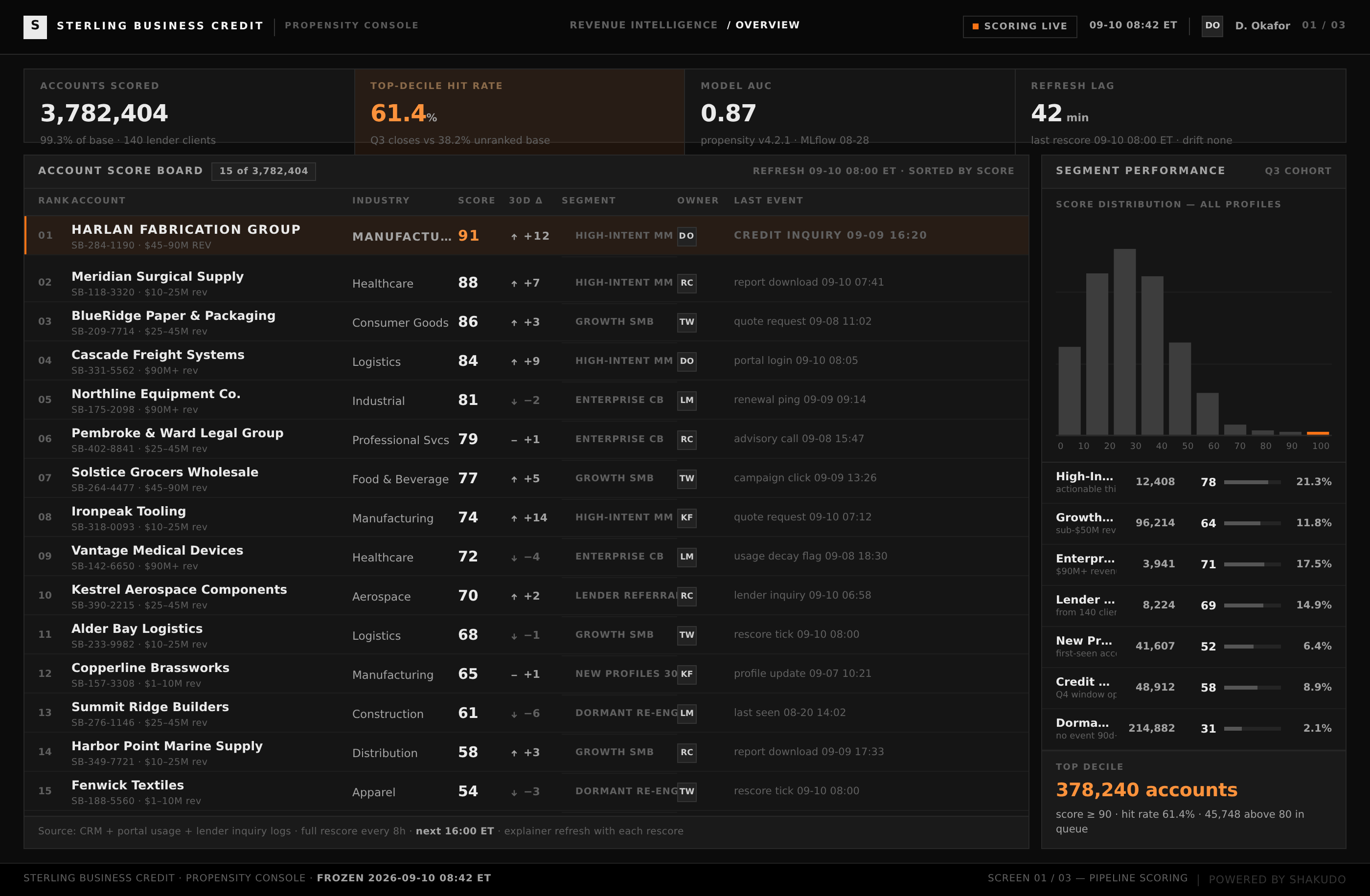
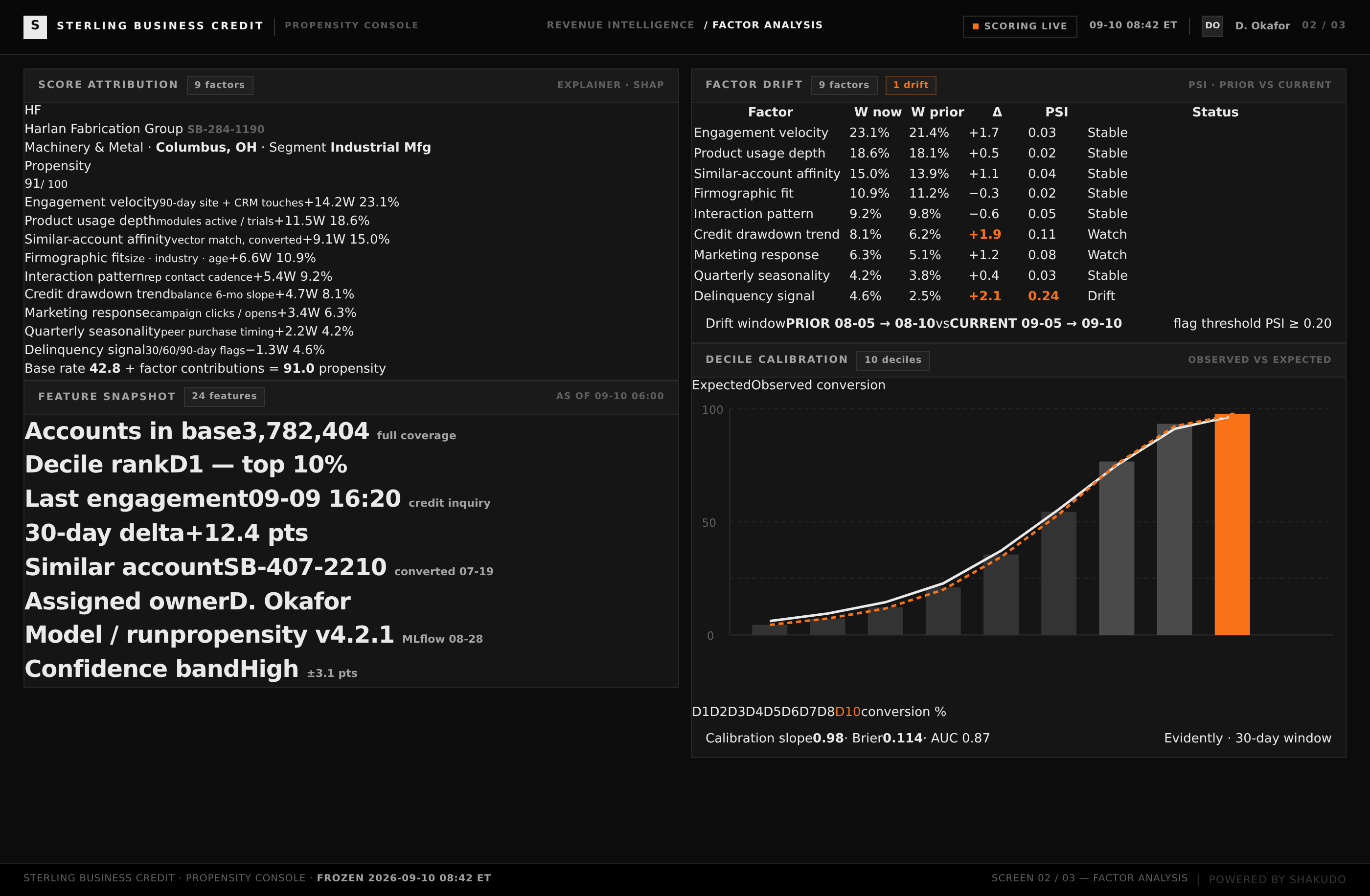
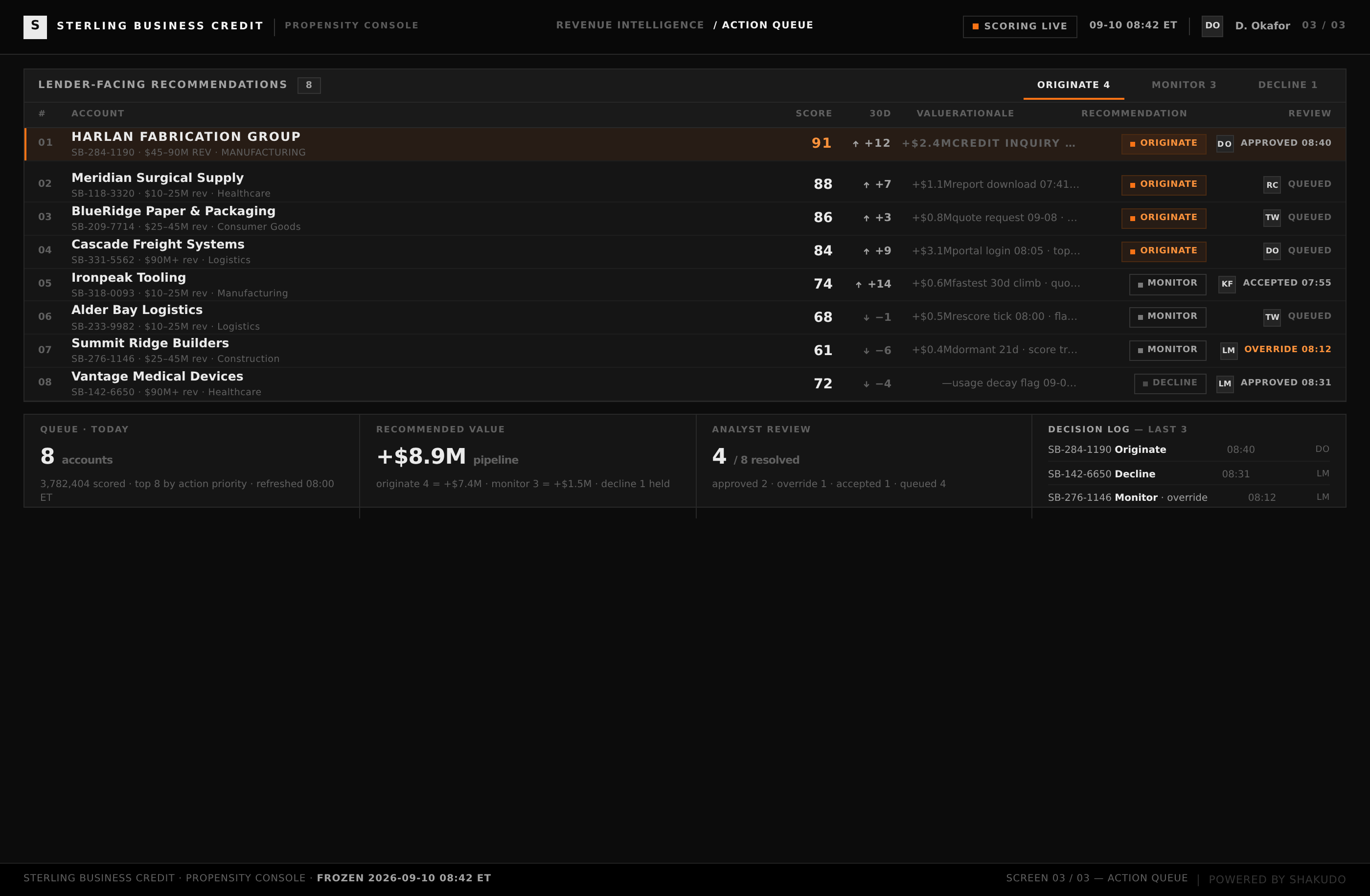
1–2 / 3
Sales teams work the whole pipeline at once. Some accounts will buy this quarter. Many will not. A few will never buy. Treating every account the same burns the sales team's time and the marketing budget on low-probability accounts, and the cost shows up as a low win rate and a flat pipeline quarter after quarter.
Propensity to buy scoring puts a number on each account. The AI reads the same signals the sales team reads manually, engagement history, product usage, firmographics, and interaction patterns, and ranks every account by the chance it converts this quarter. Sales calls the top of the list first. Marketing targets the same accounts. Building a similar system in-house often takes 3 to 6 months. With Shakudo, the platform deploys within days, and the first scores land on the dashboard in the first week.
Shakudo deploys a predictive scoring platform that scores every account and lead for propensity to buy. Sales focuses on the accounts with the highest scores, and marketing targets the same accounts in the same period. Conversion rates rise, and customer lifetime value climbs because the team works the pipeline that will actually convert. The model re-scores as new data arrives, so the ranking stays current with the market, and the team sees which signals moved each account up or down.
The platform ingests CRM, product, and marketing data and turns it into a feature set the model can read. PyTorch runs the deep learning models that predict purchase probability at the account level, not a coarse lead-level guess. Dask scales the data processing to the full customer base, so the model trains on every account, not a sample. Milvus stores the customer embeddings that power similarity and segmentation queries, so a new account can be matched against the accounts that have already converted. MLflow manages the model lifecycle, so the team can retrain, compare, and promote models without a rebuild. Evidently monitors performance in production, so the score stays accurate as the market shifts, and drift gets flagged before it quietly degrades the ranking. The AI scores every account, re-scores as new data arrives, and explains which signals drove each score.
Revenue, sales, and marketing teams at B2B and B2C companies with a real pipeline and a CRM worth mining. The core users are sales leaders and demand gen managers, supported by the data team that maintains the feature set and the model monitoring.
It ranks every account by the chance it converts in the current period. The top of the list is where the team spends the day. The score explains which signals drove the rank, so a rep can see why an account moved up or down and adjust the approach accordingly.
A rule engine applies fixed thresholds and goes stale as the market shifts. The AI model learns from conversion outcomes, re-scores as new data arrives, and adapts to what actually predicts a purchase in the current market. MLflow keeps the model lifecycle under version control, and Evidently flags drift before it quietly degrades the score the team relies on.
Shakudo deploys the platform within days. In-house builds take 3 to 6 months of modeling, integration, and monitoring. With Shakudo, the first scores land on the dashboard in the first week, and the team starts working the top of the list almost immediately, with Evidently watching the model behind the rankings.
For sales and marketing, that means the pipeline the team works is the one that converts. Book a demo and see AI propensity scoring lift conversion rates and customer lifetime value.
Shakudo revolutionizes sales strategies by leveraging advanced predictive analytics to score customer propensity to buy. This solution integrates cutting-edge AI tools, enabling organizations to identify high-potential leads, optimize marketing efforts, and significantly increase conversion rates. By providing a seamless, scalable platform for deploying and managing these sophisticated analytics tools, Shakudo empowers businesses to stay ahead in a competitive market landscape.










"What drew me in is simple. When developers ship production-ready code this quickly, how can I have environments spun up fast enough? Shakudo is how we close that gap."



"Shakudo does not just provide the platform. It is a real partnership. They are always there to help and execute our vision faster and the right way. It is like a co-team working together to achieve our goals."