What Is an AI Factory?

Your pilot worked, the board approved the full buildout, and now the question is whether the next hundred models run on rented capacity or on infrastructure the organization owns. Every new team that wants a model, a new data source, or a new latency target arrives as a separate project with its own GPUs, its own pipeline, and its own way of measuring cost. That sprawl, and the bill it generates, is the day-to-day problem an AI factory exists to end.
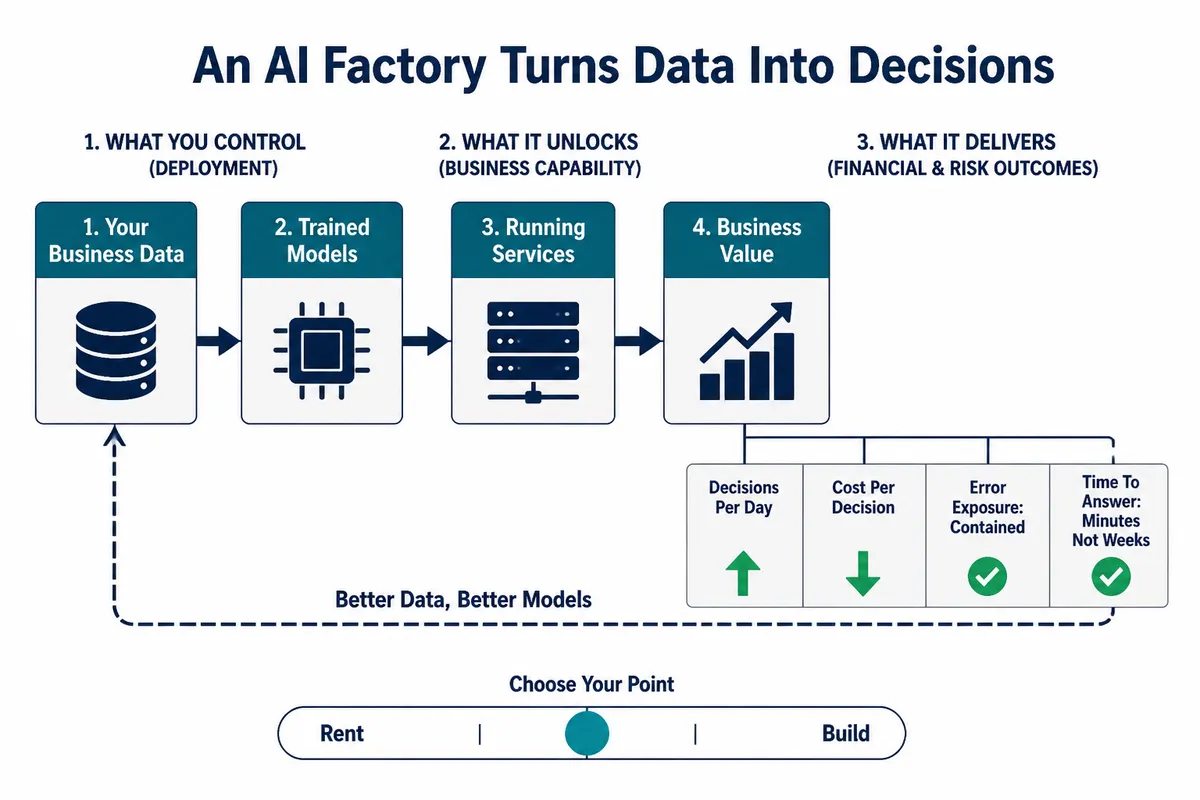
An AI factory is purpose-built computing infrastructure that runs the full AI life cycle — from raw data through trained models to high-volume inference — as one integrated system. The term was popularized by NVIDIA, and the definition the industry most often cites comes from its glossary: specialized infrastructure whose “primary product is intelligence, measured by token throughput.” This guide explains what an AI factory actually is, its four component layers, how to rent versus build versus run a hybrid, what it costs, and how to decide whether the workloads justify the build.
| Route | Where it runs | Capital model | Fits |
|---|---|---|---|
| Rent (managed AI cloud) | Provider's facility, capacity on demand | Operating expense, no capital outlay, higher unit cost at sustained volume | Validating workloads and building the data pipeline before volume is proven |
| Build (on-premises or campus) | Organization's own facility, inside the perimeter | Capital-heavy, payback depends on sustained utilization | Sensitive data that cannot leave the site, sustained high-volume inference |
| Hybrid (rent, then build) | Both, in sequence | Operating expense first, capital later | Most organizations: validate in the cloud, then own the core, sensitive workloads |
The route is driven by where the data can be, the shape of the workload, and whether the volume is proven. Most organizations rent first, then build or collocate the capacity that carries the core, sensitive workloads.
Defining the AI factory
NVIDIA’s glossary defines an AI factory as “a specialized computing infrastructure designed to create value from data by managing the entire AI life cycle, from data ingestion to training, fine-tuning, and high-volume AI inference.” Two parts of that definition matter for a buyer.
First, the unit of output. A conventional data center is designed to handle general-purpose computing tasks; an AI factory, in NVIDIA’s glossary, is “specifically optimized for artificial intelligence workloads, with a strong emphasis on AI inference performance and energy efficiency.” It exists to produce a measurable product — tokens, inferences, predictions — and its design is driven by the cost, latency, and energy efficiency of that output.
Second, the life cycle. Training, fine-tuning, and inference are treated as one production system rather than three separate projects. That is what separates an AI factory from a server room full of GPUs: the organization is operating a production line, not hosting hardware.
The double meaning of “factory” is not an accident. The organizations most likely to need one — manufacturers, utilities, defense primes, hospitals — already run factories. The metaphor imports that discipline: defined throughput, maintenance schedules, cost per unit, and the ability to scale up and scale out.
The components of an AI factory
A working AI factory has four layers. Most organizations run fragments of each one today; the “factory” is the integration of all four.
- Compute. NVIDIA’s glossary lists the required hardware — high-performance GPUs, CPUs, networking, storage, and advanced cooling systems — and calls for a software stack that is “modular, scalable, and API-driven” so the layers can be upgraded independently.
- Data pipeline. The stage where raw, unstructured data — sensor logs, documents, images, transaction records — is cleaned, structured, and converted into the tokens that models learn from. Pipeline quality sets the ceiling on model quality, which is where most of the engineering effort belongs.
- Model serving. The inference layer that runs trained or fine-tuned models against continuous production traffic: low-latency responses, autoscaling, and routing across models. Routing and cost control across those models is where an AI gateway cuts enterprise LLM costs. NVIDIA’s glossary describes inference as “a critical iterative process” and notes that its outputs feed back into the system in a “data flywheel” that improves accuracy over time.
- Operations and observability. Fleet health, evaluation, cost-per-token tracking, and access governance. This is the plant-floor control room, and the layer most often missing. MLOps is the discipline that closes that gap in AI infrastructure: MLOps, the missing piece in AI infrastructure. NVIDIA even describes using digital twins to design, simulate, and optimize a facility before construction begins.
| Layer | What it does | The question that matters |
|---|---|---|
| Compute | GPUs, CPUs, networking, storage, cooling, power | What is the capacity in tokens per day, and what does it cost per watt? |
| Data pipeline | Cleans, structures, and tokenizes raw data | Is there a measured quality standard for data entering models? |
| Model serving | Runs models against production traffic | What are the p95 latency and the cost per million tokens? |
| Ops and observability | Monitoring, evaluation, cost and access controls | Can the cost and quality of any model in production be explained? |
Renting or building an AI factory
Both routes are established, and both are in production today.
Rent. Managed AI cloud services provide AI factory capacity without capital outlay. NVIDIA markets its own DGX Cloud as “NVIDIA’s AI factory in the cloud,” with the service running “across CSPs and NVIDIA Cloud Partners.” Renting means the provider handles the facility, power, cooling, and hardware refresh cycles, and capacity scales on demand rather than by capital cycle. The trade-offs: unit economics stay higher at sustained volume, the workload runs in another party’s facility (which has direct consequences for data-sensitive organizations), and the roadmap and pricing belong to the provider.
Build. An on-premises or campus AI factory means the organization owns the compute, the facility, and the operating model. The upfront cost is real — hardware, facility work for power and cooling, networking, and a staffed operations function — and the payback depends on sustained utilization. The payoff is that the entire stack, including the data, stays inside the perimeter, and at sustained volume the unit economics can come in below what renting offers. NVIDIA’s glossary notes that AI factories are built to enable “efficient scaling up and scaling out of both sovereign AI infrastructure and enterprise AI infrastructure,” and that governments are investing in sovereign AI factories as part of national infrastructure.
Hybrid. Most organizations end up renting first — to validate workloads and to build the data pipeline — and then building or collocating the capacity that carries the core, sensitive workloads. The order matters: a data pipeline and an evaluation process built in the cloud transfer to on-premises hardware. The compute does not.
A useful rule of thumb: rent while AI workloads are still being discovered, and build when a specific workload is proven, the data cannot or should not leave the site, and the volume justifies amortizing the hardware.
Who needs an AI factory on their own campus?
The on-campus answer is not about prestige; it is about the location of the data. An on-premises or on-campus AI factory is the right choice when at least one of the following is true:
- Regulation. The data is subject to sector rules — defense, healthcare, energy, financial services, critical infrastructure — that restrict where it may be processed. Data sovereignty requirements may mandate processing inside national borders or inside the organization’s own perimeter, and an on-campus factory is the cleanest way to prove that boundary. See data sovereignty for the underlying requirement and on-premise AI for what the deployment actually requires.
- Latency and reliability. The AI runs the plant, the grid, or the operating room. A factory-floor model that decides in milliseconds cannot tolerate a round trip to a third-party cloud.
- Scale economics. The workload is large enough that owned infrastructure amortizes better than renting, and the organization wants the roadmap in its own hands.
- Security posture. The organization is threat-graded (air-gapped or isolated networks are standard in defense and critical infrastructure), and multi-tenant cloud environments cannot be cleared.
If none of those apply, a public or sovereign cloud is usually the more rational first step. The on-campus factory is the answer for organizations where the data itself is the asset that cannot move — which, in hard industries, is most of them. Sovereign AI and industrial AI describe the surrounding positioning for these buyers.
The cost and ROI frame for a CFO
The honest cost model has four lines.
- Capital. Compute (GPU systems plus CPUs, networking, storage), facility work for power and cooling, and networking. Capital scales with the number of GPUs and the power and cooling the facility must deliver — which is why the facility work is usually the second-largest line, not the first.
- Operating. Power is usually the dominant recurring cost, and it is why NVIDIA’s glossary treats “performance per watt” as a design goal — energy efficiency directly moves the operating line. Add cooling, facilities, and a staffed operations function.
- Software and models. Licensing, model access, and the integration work to connect pipelines and serving.
- Opportunity cost. The months of engineering spent building the factory instead of shipping AI applications — the line most budgets miss.
The ROI side. NVIDIA’s glossary frames the factory’s output as revenue: AI factories “convert raw data into actionable intelligence that can be used to drive business decisions and generate revenue.” The CFO question is whether the workload being served is valuable enough to carry that cost. The right metric is cost per unit of output — per token, per inference, per decision — because it makes owned and rented capacity directly comparable and ties the infrastructure to the value the application produces. The economics of that serving layer, and the optimizations that cut it, are covered in speculative decoding for faster LLM inference.
A concrete anchor for the inference line: NVIDIA’s DGX B200 page cites SemiAnalysis InferenceX benchmarks (Q1 2026) showing Blackwell-powered inference at approximately $0.02 per million tokens for GPT-OSS-120B using TensorRT-LLM, versus roughly $0.09 per million tokens on the prior generation — a 4.5x step in unit cost from hardware-and-software optimization alone. That kind of step change is the argument for re-basing a five-year AI infrastructure plan rather than extending a three-year one.
A disciplined ROI frame: identify the highest-value workload, measure its current cost of inaction (manual review, delayed decisions, unexploited data), price the factory against that workload’s output, and hold the capital line against the savings or revenue the workload produces per unit of inference.
A maturity model for the AI factory
Executives can self-assess against five levels. The point is to name the gap, not to chase the highest number.
| Level | Name | What is true at this level |
|---|---|---|
| 0 | Ad hoc | AI workloads run on borrowed GPUs and developer laptops; no shared data pipeline; no cost visibility. |
| 1 | Piloting | A few production AI projects exist, mostly rented; the data pipeline is per-project; no factory concept. |
| 2 | Standardizing | A shared data pipeline and model serving exist; workloads are evaluated against cost-per-token; ops tooling is in place. |
| 3 | On-campus factory | Core, sensitive workloads run on owned infrastructure inside the perimeter; the full life cycle — data, training, serving, ops — is operated as one system. |
| 4 | Factory-native | AI factory capacity is a strategic asset: it runs continuous operations (not just apps), the data flywheel is institutionalized, and capacity is sold or shared across business units. |
Many regulated-industry organizations sit at level 1 or 2 today. The move from 2 to 3 is the capital decision the CFO is being asked to make; the move from 3 to 4 is an operations and organizational decision.
How to evaluate whether you need one
Five questions, answerable by the existing data:
- Can the data leave the site? If a regulation, contract, or threat model says no, the factory is a compliance requirement, not an optimization.
- What is the cost per unit of output on rented capacity today? Establish the baseline before any build discussion.
- Is the workload sustained or episodic? A factory amortizes against sustained, high-volume inference; episodic workloads stay in the cloud.
- What does the latency budget require? If the model is on the decision path for a physical process, the network round trip is often the deciding factor.
- Can the organization staff the factory? The operating model — a small but permanent platform team — is a permanent cost. If it cannot be staffed, renting the operations layer too is a legitimate architecture, not a retreat.
A practical next step: run one candidate workload in a managed AI cloud service for one quarter, instrument cost per token and data-quality issues end to end, and then re-price the same workload on owned capacity. That comparison, built on measured numbers rather than vendor presentations, is the material a board should see.
For organizations that have decided the answer is on-campus, what is an AI factory in practice — a 30-minute working session where the platform team walks through the reference architecture, the cost model, and a pilot plan against the organization’s actual workloads.
Last verified: 2026-09-05
Why AI Platform and Infrastructure Leaders Choose Shakudo to power their internal AI factory
-
Tool-agnostic orchestration
The orchestration layer mixes open models, third-party APIs, and local inference behind one control plane, so each workload is routed to the model and backend that fit it.
-
Unified serving with cost and latency controls
Serving, routing, and autoscaling are managed together, so cost per token and latency are treated as first-class controls rather than per-project guesses.
-
Multi-model governance
Access, evaluation, and model-version tracking apply across every model in production, so the organization can audit which model produced which output and at what cost.
-
Scales from pilot to production
The same platform that runs the evaluation runs the workload in production, so a pilot can scale onto owned infrastructure without resetting the architecture.

Frequently asked questions
How is an AI factory different from a traditional ML platform or a server room of GPUs?
A rack of GPUs or an ML platform hosts models; an AI factory treats the whole life cycle, data ingestion, training, fine-tuning, and high-volume inference, as one production system. The unit of output is tokens or inferences, and the design is driven by the cost, latency, and energy efficiency of that output.
Can an AI factory use open models, third-party APIs, or both?
Both. The orchestration layer routes across models and backends, so a factory can mix open models running on owned GPUs with third-party model APIs for workloads that do not need to stay on-site. The routing is the fixed part; the models behind it can change.
What infrastructure does an AI factory need?
High-performance GPUs, CPUs, networking, and storage, plus advanced cooling and the power and facility work to feed them. On top of that sit a data pipeline, a model-serving layer, and an operations and observability layer that tracks cost, quality, and access.
How should an organization start with an AI factory?
Run one candidate workload in a managed AI cloud service for a quarter, instrument cost per token and data quality end to end, and then re-price the same workload on owned capacity. That measured comparison, rather than a vendor presentation, is the material a board should see before committing to a build.